
Teoría y práctica para entender cómo sentirte mejor y efectivamente empezar a hacerlo.
Incluye:
- Lo que el cuerpo sabe
- Lo que el cuerpo sabe | Cuaderno de ejercicios para sentirte mejor
This content was translated using artificial intelligence and may therefore contain errors.
It was 1962, and Michel Siffre was 23 when he decided to shut himself away in a cave. He didn’t do it as punishment or out of madness. Nor did he do it over a broken heart or for a spiritual retreat. He did it for science. Siffre was a geologist, fascinated by venturing into dark holes in the rocks to understand how the world works from the inside, and he wanted to train for future expeditions underground and in extreme conditions. He had already done an initial 15-day trial, but it seemed too short a time to carry out his research. Besides, he felt he hadn’t reached the limits of what his body could endure, or of what he could learn by observing it. So he decided to go further. He chose a deep cave at the foot of the Scarasson Glacier, in the Alps, near the border between France and Italy. Located at an altitude of more than 1,300 meters and about 130 meters below the surface, the cave was a hostile environment: constant cold, total darkness, the persistent drip of melting ice, damp air, and little space. Everything smelled of wet rock and time standing still.
Down there, Siffre set up a small shelter: he improvised a bed, organized his supplies, and set up a gas lamp. He also brought along a number of instruments—notes, a voice recorder, and a scale—to log his sleep cycles, mealtimes, and moods. His only connection to the outside world was a one-way telephone line that let him send data to his team without receiving any information in return. No clocks or calendars. His instructions were clear: “Live like an animal, in the dark, without knowing the time.” Eat when he felt hungry. Sleep when he felt sleepy. Let his body set the pace. Once inside, the days passed in silence, reading, writing, and thinking. He explored the cave, studied its geology, organized his thoughts, reviewed his notes, read, and, at the same time, stayed alert to the messages from his body. Every time he ate, slept, or woke up, he got in touch with his team on the surface to perform a set routine: take his pulse and count aloud from 1 to 120, trying to keep to a pace of one second per number, guided by his internal sense of time. That simple count, designed as a basic check of his cognitive state, became one of the most surprising observations of the entire experiment.
Caves have always been special places for humans. They attract us and terrify us at the same time. They are home to the monsters of legends, but also to our oldest hopes. And for good reason: our ancestors lived in caves all over the world for hundreds of thousands of years, sleeping, sharing fires, painting on the walls, and telling stories. Caves hold many secrets of our species, and Siffre had found one more. Michel descended into the cave on July 16, intending to stay there until September 14. But when the agreed-upon date arrived and the team on the surface contacted him to announce the end of the experiment, he was convinced it was only August 20. He thought only about 35 days had passed. When they checked the records, they confirmed that his perception of time had been compressed. The count he performed every day—from 1 to 120, at a subjective pace of one second per number—took him close to five minutes instead of two. Despite this distortion in his perception of time, his body maintained a degree of regularity: he slept and woke according to relatively stable cycles, slightly longer than 24 hours. Although this phenomenon was already known in animals and plants, his experiment brought to light the existence of an internal clock in humans.
Fascinated by the discovery, Siffre continued his research for several decades. He repeated the experiment with other volunteers, and even went back into caves himself for longer periods. In some cases, especially when the isolation lasted more than three months, participants stopped following the classic 24-hour cycle and began functioning on a cycle close to 48 hours: they stayed awake for about 36 hours straight and then slept for 12 to 14 hours. It was as if, without the sun’s guidance, the human body reconfigured its way of inhabiting time. The discovery caught the interest of many. The French military, which wanted to understand how to extend soldiers’ wakefulness without affecting their performance. The Navy, concerned about submariners spending weeks without seeing daylight. And NASA, too, which was beginning to think about long-duration space missions. What began as an experiment in the solitude of a cave ended up founding a new scientific discipline: human chronobiology.
What Siffre had discovered deep inside the Earth was just the tip of the iceberg. That “internal clock” that seemed to govern his sleep, hunger, and wakefulness wasn’t a poetic metaphor; it was a real network, complex and anchored deep within his body. Today we know that our bodies are full of clocks. Not one or two, but billions. Practically every cell contains tiny molecular timers that let it anticipate which tasks it needs to perform throughout the day, saving energy and resources in the process (remember allostasis?). There are clocks in the liver that get the metabolic machinery ready to receive breakfast even before we take a bite. Clocks in the intestine that schedule the production of digestive enzymes and adjust intestinal motility at different times of day. The skin also activates cellular repair processes at night, when it is no longer exposed to ultraviolet radiation. The immune system regulates the release of cytokines and the activity of white blood cells depending on the time of day, so it can respond better to infections when contact with pathogens is more likely. Even the lungs adjust the diameter of their bronchi depending on the time of day, which helps explain why asthma often gets worse at night. These cellular clocks work through the cyclical activation and deactivation of certain genes that follow patterns of about 24 hours.In 2017, the Nobel Prize in Physiology or Medicine was awarded to Jeffrey C. Hall, Michael Rosbash, and Michael W. Young for discovering the molecular mechanisms that allow cells to generate circadian rhythms autonomously. These rhythms are sustained by the activity of certain genes, such as Clock, Bmal1, Per and Cry, which switch on and off cyclically, marking the passage of time from the inside out. Hence their name: circadian rhythms (from the Latin circa: “around,” and dies: “day”).
The reason these clocks run for about 24 hours—and not 20 or 30—is very simple: there’s no other way.The length of an Earth day has not always been 24 hours. When the Earth formed, it spun much faster: a day lasted just 6 hours. Over time, gravitational interaction with the Moon (through the tides) gradually slowed the planet’s rotation. Thanks to studies of ancient coral fossils and sediments containing records of tidal cycles, we know that 900 million years ago, days lasted about 21 hours, and that 400 million years ago, they were already approaching 23. The current 24-hour rhythm is thought to have been reached only in the last 200–300 million years. Curiously, the circadian clocks of many organisms existed long before the day reached this exact length, suggesting that life adjusted its internal rhythms as the planet slowed down. Ever since the first cells formed on the ocean floor some 4 billion years ago, life has faced all kinds of planetary challenges. There were ice ages so intense they covered the Earth in ice all the way to the equator, supervolcanoes that wiped entire archipelagos off the map, acid rain that dissolved rock, and colossal meteorites that shook the Earth’s crust. But amid all that extreme instability, one thing never failed: the sun rose on one side and set on the other. Always. That rhythmic alternation of light and darkness was—and still is—the most reliable beacon for every form of life. Because the sun doesn’t just provide light; it also warms us, marks the seasons, affects the tides, and, above all, is a source of energy. And on our planet, wherever there’s energy, life organizes itself to take advantage of it. That’s why all living things today, from bacteria to humans, have internal clocks that keep a circadian rhythm. Cyanobacteria, for example, already had a molecular system capable of anticipating sunrise and getting ready for the first photosynthesis more than 2.5 billion years ago. In plants, clocks regulate the opening of tiny valves that allow gas exchange (the stomata), maximizing photosynthesis during the day and reducing water loss at night. In insects, fish, birds, reptiles, and mammals, the same principles govern vital functions such as feeding, rest, cellular repair, reproduction, and immune activity. It’s an ancient choreography set to the rhythm of the Earth’s rotation.
But there’s a catch: the molecular timers in our cells don’t all tick at exactly the same rate. Some run a little faster, others a little slower. Without a mechanism to keep them aligned, those small differences grow over time, and what was a synchronized dance turns into a chaotic parade. That’s why we need a conductor to set the overall beat, so each instrument comes in on time, at just the right volume and at just the right moment. That conductor exists, and it has a name: the suprachiasmatic nucleus, a shy group of just 20,000 neurons, located right above the crossing of the optic nerves, in the middle of the skull. From there, it receives direct signals from the retina about the presence or absence of light and uses that information to set the rhythm of the day. But it doesn’t work alone. It operates from the hypothalamus, a key region of the brain that acts as a bridge between the nervous system and the endocrine system. From there, the suprachiasmatic nucleus turns the light it receives from the retina into signals that adjust essential functions such as sleep, appetite, body temperature, growth and repair processes, the stress response, thirst, lactation, reproduction, and immunity. In that sense, the suprachiasmatic nucleus doesn’t just conduct the orchestra; it also has full access to the theater’s control panel: it can turn some instruments up and others down, cue the strings on time or silence the brass, but also control the lighting, decide when the house lights go out, and lower the curtain. What’s most astonishing is that even when this group of neurons is isolated and cultured outside the body, the suprachiasmatic nucleus keeps time with almost perfect precision indefinitely. Its ability to sustain an autonomous rhythm, even in isolation, speaks to the degree of sophistication this system has reached over the course of evolution.
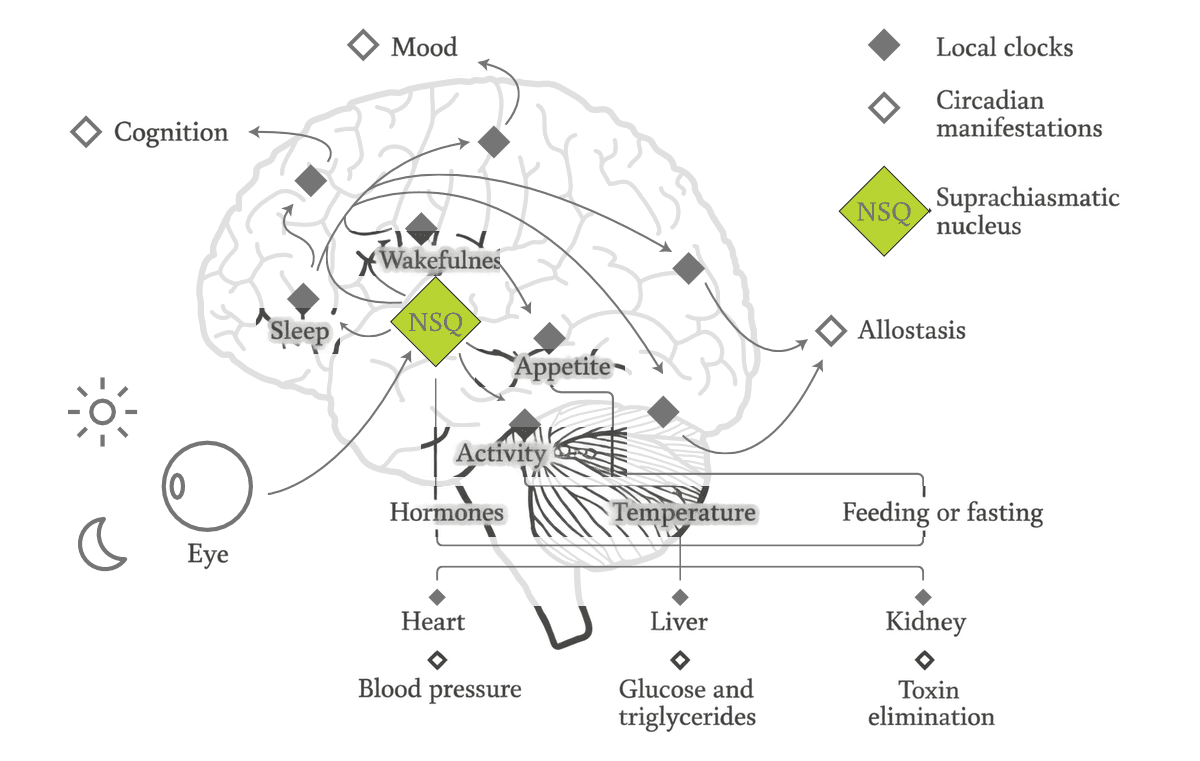
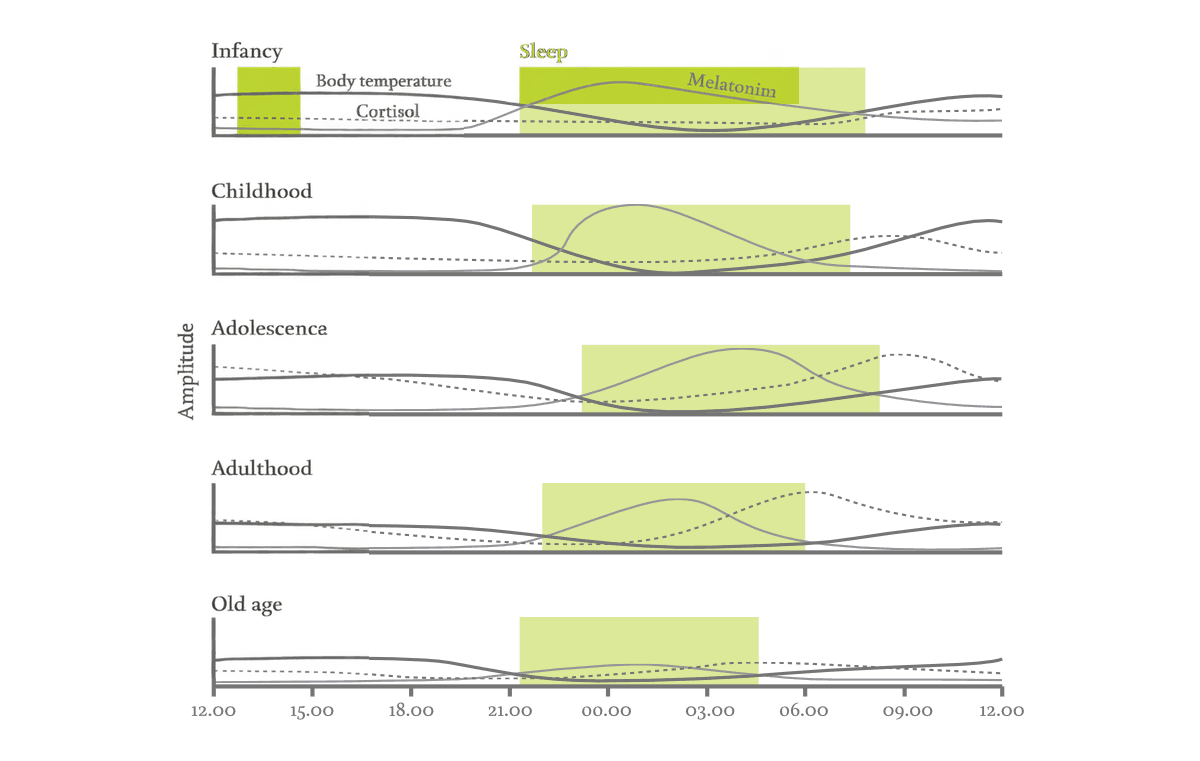
The circadian rhythm has two clearly distinct phases, like two acts in the same play. The suprachiasmatic nucleus, our conductor, is in charge of sharing the spotlight and cueing two great soloists: cortisol and melatonin. During the day, the stage lights up for cortisol, whose song is one of energy. We tend to call cortisol the “stress hormone,” though its everyday job is actually to get us ready for the day. It starts rising before we open our eyes, peaks in the early morning, and gets us moving: it mobilizes glucose (the body’s main fuel), wakes up our muscles, raises blood pressure, and sharpens our attention. Its melody slowly fades over the course of the day, preparing the way for the next performer. As darkness falls, the conductor gives the floor to melatonin, which performs the song of restorative rest. Melatonin appears after sunset and gets us ready to sleep: it lowers body temperature, eases blood pressure, slows digestion, and signals to every organ that it’s time to clean, repair, and regenerate. It peaks in the middle of the night and then recedes, leaving the stage clear for cortisol to resume the first act at dawn. However, daylight isn’t the only signal capable of resetting the biological clock. Mealtimes, physical activity, changes in temperature, and even social activity—like greeting people, talking, or sharing a routine with others—are also powerful signals for the master clock. As long as those signals recur with some regularity, the brain can use them to adjust the beat. But when light is present, everything else takes a back seat.
But this dance between day and night isn’t exactly the same in every body. Even though the score is the same, each organism plays it at a slightly different tempo. Some people wake up as soon as the first light appears and do their best in the morning. Others come alive later, and their energy peaks when everyone else is already slowing down. This variation in sleep and wake times isn’t a flaw; it’s part of human biological diversity. These are chronotypes and they’re usually classified into three groups. There are the larks, who get up early and function best in the morning; the owls, who go to bed late and do better at night; and an intermediate group some call hummingbirds or, in a less glamorous version, pigeons. But this three-category division is just a simplification. In reality, chronotypes form a continuum, with most people clustered near the middle and clearly distinct extremes at either end. Studies that investigate chronotype more precisely use the time of night when melatonin peaks as a physiological marker, an event that marks what’s known as the biological night. In urban populations, most people have a biological night that falls around four in the morning, which corresponds to an average sleep schedule of midnight to eight in the morning. But some people fall asleep before ten at night, with biological nights that occur at one or two in the morning, while others don’t go to bed until three or four, with melatonin peaks as late as six. The best way to find your own rhythm is to let yourself live like Michel Siffre for a weekend, completely disconnected from the outside world and screens, and fully attentive to your body’s needs. You don’t have to go into a cave; you can do it at home or go camping somewhere remote.
That tendency isn’t fixed; it changes over time. In childhood, we tend to be early risers. During adolescence, our rhythm shifts later; it’s typical for us to go to bed late and wake up after noon. In adulthood, the clock shifts earlier again, and in old age many of us return to early schedules, as if completing a cycle. This curve over the course of our lives isn’t just a physiological curiosity; it may also be an evolutionary clue. A fascinating study conducted in 2017 with Tanzania’s Hadza community showed that it was rare for all members of the group to be fast asleep at the same time. For twenty consecutive nights, researchers measured the adults’ nighttime activity using motion sensors and found that participants were asleep at the same time for only 18 minutes. In other words, during 99.8% of the nighttime period analyzed, at least one person was awake, and on average about eight members of the group were active at any given moment of the night. What’s fascinating is that this spontaneous vigilance wasn’t organized or assigned in shifts; it arose naturally as a consequence of variation in chronotypes. It’s thought that, over the course of evolution, staggered sleep and brief awakenings were an adaptive strategy for protecting the group from predators, environmental threats, or conflicts with other humans. A kind of decentralized biological guard, sustained not by explicit rules but by the diversity of our bodies themselves.
But of course, this delicate system wasn’t designed for the world we live in. For millions of years, our internal clocks evolved in sync with sunrise and sunset, with simple, stable routines and no clocks or alarm clocks. Today, though, everything has changed. The body is still waiting for a finely tuned orchestra to set the pace, but the modern city gives it deafening noise. And when internal clocks stop matching the environment, it isn’t just sleep that gets disrupted. Our entire physiology falls out of tune.
Around the same time that Michel Siffre was isolating himself in a cave to let his body set the pace without clocks or sunlight, on the other side of the Atlantic, a California teenager was trying to demonstrate the effects of not sleeping. In 1964, Randy Gardner, just 17 years old, decided to stay awake for as long as his body would let him as part of a project for his school science fair. With help from his friends, plenty of caffeine, and later the support of a medical team led by sleep specialist William Dement—who couldn’t believe what he was seeing—Randy managed to stay awake for 11 days straight. As the days went by, his body and mind gradually began to fall apart. In the first few days, he had trouble concentrating and became clumsy; then came forgetfulness, sudden mood swings, and visual hallucinations. On the fifth day, he began experiencing microsleeps: brief brain blackouts that happened without him noticing, even with his eyes open. His attention became increasingly erratic, his speech grew fragmented, and he started confusing people with objects. By the tenth day, he could no longer hold a coherent conversation. After completing the trial, Randy slept for 14 hours straight and woke up seemingly lucid, though it took his brain weeks to function normally again. Gardner broke the Guinness World Record for the longest time without sleep, a feat others tried to replicate for decades, until the book stopped tracking it in 1997 because of the extremely high health risks involved.
When the conductor receives irregular signals from outside, the rhythm gets lost and the orchestra starts to go out of tune. The clocks don’t stop, but they stop coordinating: the liver thinks it’s nighttime, the intestine thinks it’s time for breakfast, and the brain can’t quite decide whether to sleep or think. It’s as if each instrument were playing a different song in a different key. If this happens every now and then, the body can recover the melody. But if it goes on over time, harmony turns into noise and the circadian rhythm breaks down. And that’s not just an inconvenience; it’s a real threat to health. There are few more brutal ways to throw a body out of sync than forcing it to stay awake when it should be sleeping. That’s why the consequences of a disordered rhythm are so clear in people who work rotating shifts, such as healthcare workers, security personnel, factory workers, long-haul drivers, and call center operators, among others. They wake up at night, eat lunch in the early hours of the morning, sleep in daylight, and try to stay alert when their bodies are telling them to stop. As a result, the body no longer knows whether it should store energy or release it, whether it’s time to digest, repair tissue, or face a threat, whether it’s dawn or dusk. Physiological tasks overlap and interrupt one another, and each system does what it can to adapt. The intestine no longer anticipates meals, hormones lose their rhythm, the immune system becomes dysregulated, and sleep becomes fragmented.
I know this from personal experience. During the final year of medical school, we students go through the final hurdle: hospital rotations. These involve spending a couple of months immersed in the hospital and rotating through different specialties to understand what each one is about, getting our first taste of what it’s like to practice the profession on the front lines. That also means staying awake and alert for long hours. In my case, I’d arrive at the hospital at seven or eight in the morning and keep going until three or four in the afternoon: I examined patients, studied, took part in training seminars, observed technical procedures, and even went into the operating room. When I was on call—a 24-hour shift once a week—I stayed at the hospital after my shift ended, and the grind went on. Since I was a student, they let me leave “early,” around two or three in the morning (one of those nights, the dog from the previous chapter chased me), so I could sleep for a few hours before heading back to the hospital the next morning. But that wasn’t the worst of it. Once a month, I had to cover a 48-hour shift straight. Forty-eight hours. And the nightmare didn’t end there: the shift would end, and the week would carry on as if nothing had happened. By then, my energy was at rock bottom, my concentration was slipping through my fingers, and I felt like I was living through one endless Monday in slow motion. Surprisingly, that’s what many people experience during their years of medical residency training. The difference is that, on top of maintaining that absurd pace, they’re responsible for making clinical decisions, delivering babies, diagnosing, operating… all for miserable pay. It’s madness. While it’s a rewarding experience—because you learn so much in practice—the truth is that it can do enormous damage to the mental and physical health of both doctors and patients. The worst part is that we’ve so thoroughly normalized it that we don’t even question it. As if training to care for other people’s lives meant giving up on caring for your own. It’s no wonder that, under current conditions, fewer and fewer people are choosing this valuable path.
Over the years, the disorder builds up and leads to persistent fatigue, mood changes, brain fog, and a chain of metabolic and immune disorders. That’s why people who work rotating schedules—especially night or irregular shifts—are at greater risk of developing type 2 diabetes, obesity, high blood pressure, insomnia, psychiatric and neurological disorders, cardiovascular and autoimmune diseases, and greater susceptibility to infections. The greater the intensity or frequency of schedule changes, the greater the risk. To make matters worse, disruption of the circadian rhythm increases the risk of developing cancer, especially breast, colon, and endometrial cancer. For this reason, in 2007 the International Agency for Research on Cancer classified night shift work involving rotating schedules as probably carcinogenic to humans, placing it on the same list as glyphosate, anabolic steroids, and foods fried at high temperatures.The category probably carcinogenic to humans (Group 2A) is part of the classification system of the International Agency for Research on Cancer (IARC), which is affiliated with the WHO. It is used when there is sufficient evidence that a substance or exposure causes cancer in animals, and limited evidence in humans, generally from observational epidemiological studies rather than controlled experimental trials (since it is unethical to conduct them, this is sufficient evidence to make that statement). The desynchronization caused by night shift work involving rotating schedules is one of the most extreme forms of circadian disruption, but it’s not the only one. In fact, changing your rhythm just once a week is enough to disrupt the body’s physiology. My friends tell me I’ve turned into a grumpy old fart because I don’t want to go out partying like I used to, and maybe they’re right: every time I do, I need several days to recover before I feel okay. Besides my physical and cognitive performance hitting rock bottom the week after I party until dawn, I’m also overcome by constant fatigue, brain fog, mood swings, and body aches. And I don’t even have to stay up all night: shifting my sleep schedule by a few hours is enough for me to feel the impact. In a study conducted in 2023, a team of Japanese scientists delayed participants’ sleep schedules by just three hours over the weekend, simulating a typical change in routine. When they assessed the effects on Monday, they found increased arterial stiffness and blood pressure compared with the group that had slept on its usual schedule. This suggests that, even in healthy people, the body loses some of its regulatory balance and doesn’t always manage to return immediately to its baseline state after a sleep disruption. Given how common these kinds of shifts are in everyday life, it’s easy to imagine the cumulative impact they can have on the body.
You don’t have to be a factory worker, an on-call doctor, or a teenager at a party to throw your body out of sync. Living in the city is enough to expose you to stimuli that confuse your circadian rhythm and throw your inner melody off key. We wake up to an alarm before we’ve slept enough, and the first light we see isn’t sunlight, but the light from a bedside lamp or a phone. We spend the day shut between four walls, under cold lights and bright screens that don’t know the meaning of a schedule. We eat in a hurry when we have time, or snack in front of the TV without noticing whether we’re hungry. When night falls, we turn on another round of lights: in the kitchen, the dining room, the bathroom, and the bedroom. We watch “one more episode,” and it turns into three. But it’s not just a matter of disorganization: we live in a culture that glorifies productivity, applauding those who get up early but also those who work late into the night, answer messages after hours, and never stop. Sleeping little is almost a badge of success or dedication. And resting seems like a luxury or a waste of time. Besides—as I mentioned in the previous chapter—the city’s frantic pace sweeps us into a state of constant activation: packed schedules, constant stimulation, and the feeling that we’re always running to catch up with the day.
For better or worse, contemporary life offers us a wide range of psychoactive substances that make us think we can navigate the physiological ups and downs of circadian disruption. The caffeine in mate or coffee to wake us up in the morning, the nicotine in cigarettes to manage anxiety during the day, alcoholic drinks and marijuana to calm us down at night, and psychiatric medications to help us sleep are just a few of the many options within easy reach. These substances, however, only help us stop feeling the discomfort of being out of sync; they don’t fix the problem. So we keep going, even if we’re running on credit. In doing so, we set aside one of the oldest and most essential rhythms of our physiology: rest. And that, even if we don’t see it, drains our batteries and eats away at our health from the foundations up.
It’s no wonder, then, that sleep problems have become almost the norm of urban life. It’s estimated that about one in six adults has insomnia—that is, difficulty falling asleep or staying asleep, or waking up too early, at least three times a week for several months. That’s the most visible manifestation of a disrupted circadian rhythm, but it’s not the only one. Many more people sleep too little, wake up several times during the night, or get poor-quality sleep without meeting the criteria for insomnia, and still suffer the consequences of disordered rest. When poor sleep persists over time, its effects accumulate. For example, chronically sleeping less than six hours a night increases the risk of developing obesity, type 2 diabetes, and cardiovascular disease, as well as the risk of premature death. Even losing just one hour of sleep, as happens when the clocks change seasonally, is enough to cause a spike in heart attacks in the following days. A weakened immune system is one of the first signs of sleep deprivation. In a study conducted in 2015, 164 healthy people were exposed to the common cold virus by having it applied directly to their noses, then isolated in individual rooms for a week so researchers could observe how they responded. Almost all became infected—that is, the virus entered their bodies and began to replicate—but not all developed symptoms. Those who had slept less than six hours a night were up to four times more likely to get sick than those who had slept more than seven. The virus was in everyone, but it only manifested in the bodies that hadn’t rested enough. In addition, sleep deprivation reduces the effectiveness of vaccines and increases susceptibility to infections like the flu or COVID. Because the immune system doesn’t just fight infections but also constantly patrols for abnormal or malfunctioning cells, sleep deprivation makes it less precise at detecting threats, allowing some cells that should have been eliminated to escape. For this reason, poor sleep has been linked to the progression of certain types of cancer, as I mentioned earlier.
The brain, however, may be the most affected organ of all. When rest suffers, memory takes a hit, attention wanders, and the risk of cognitive decline or stroke multiplies. The same is true of emotional stability: without good rest, irritability flares up, anxiety and depression worsen, substance use becomes more tempting, and the risk of suicide rises. All of this fuels distress that not only persists, but feeds on itself. As mental health deteriorates, sleep becomes fragmented. And as sleep becomes fragmented, distress deepens. Worries pile up, stress increases, it gets harder to concentrate, fatigue sets in… and insomnia returns. This creates a loop, a kind of downward spiral that can sustain, worsen, or even trigger a disorder. It’s no coincidence that insomnia is a constant in almost every psychiatric and neurodegenerative condition, from depression to Alzheimer’s.
But the problem doesn’t end with each individual’s body, because poor sleep comes at an enormous social cost. Sleepiness slows reflexes, clouds judgment, and multiplies mistakes: more traffic accidents, more workplace injuries, and more medical errors. The economic cost is staggering. In countries like Australia, where these calculations have been made, it’s estimated that sleep deprivation costs the country 17 billion dollars each year in healthcare expenses, accidents, and lost productivity (1.6% of the country’s gross domestic product). Globally, losses amount to hundreds of billions, alongside an invisible cost in suffering and quality of life. That’s why some people argue that poor sleep is a public health problem on a greater scale than smoking. And as long as we keep treating it as a minor issue, we’ll continue to uphold a culture of permanent wakefulness that wears down the body, impairs the mind, and shortens life. Recognizing this is the first step toward giving sleep the place it deserves: as one of the most essential pillars of human health. So if we want to find real ways to improve our rest, we first need to understand what happens during that mysterious third of our lives when we’re unconscious.
No function of the body is as baffling as sleep: it leaves us motionless, vulnerable, and out of commission. During those hours, we don’t look for food, reproduce, care for our young, or stay alert to possible threats. And yet every animal with a central nervous system sleeps. Some species do it while floating, others hanging upside down, and others with one brain hemisphere active so they can keep swimming or watching their surroundings. Some drift in and out of sleep in short bursts throughout the day, while others sink into darkness for hours at night. But all of them, without exception, need to sleep. The only way to justify this apparent absurdity is that sleep performs vital functions that can’t be carried out any other way.
Sleep has always been a mystery, and at the same time, difficult to study. If you could observe it from the outside, like a curious extraterrestrial trying to understand humans, what you’d see would be baffling: a body lying down, closing its eyes, and going limp. Breathing slows, muscles relax, and expression fades. There’s no response to a voice, a gentle touch, or light. But a shout, a jolt, or a splash of ice-cold water is enough to rouse something, and the person returns from the trance. Everything suggests that someone who’s asleep isn’t dead, anesthetized, or entirely unconscious. Just suspended. We can say with complete confidence that sleep is a reversible state, profoundly different from coma, fainting, or hibernation. It’s as if one part of the body withdraws while another pauses, waiting for the signal to return. If we asked that person what had happened while they were asleep, they’d say they didn’t know. They might remember a blurry fragment of a strange dream, but nothing more. The curious thing is that even though we’re human and have experienced it thousands of times, we still can’t explain exactly what sleep is. We go through it every night, but we don’t really know where we’re going.
For centuries, human knowledge accumulated through exploring the world while awake and with our senses switched on. Shadows were measured to calculate the curvature of the Earth, liquids were boiled to study their boiling points, and bodies were dissected to understand how we’re made inside. Everything worth knowing seemed observable, measurable, or manipulable while awake. In his obsession with understanding the nature of light, Isaac Newton went so far as to insert a blunt needle between his eyeball and the bone to distort his retina and observe colors from within, while his consciousness remained switched on. The experiment was brutal, but it had a clear logic: to know something, you had to be present. Sleep, however, doesn’t work that way. You can’t intervene without breaking it. The real revolution didn’t come until 1924, when psychiatrist Hans Berger invented the electroencephalogram and, for the first time, managed to record the electrical activity of the human brain. His initial aim wasn’t to understand sleep, but something much more eccentric. As a young man, Berger had been in a nearly fatal accident during a military horseback-riding exercise. That same day, hundreds of miles away, his sister was overcome by such an intense sense of alarm that she convinced their father to send him a telegram. Berger had never received one in his life, and the coincidence stayed with him forever: he was convinced that the premonition had been a form of telepathy, a transmission of his mental state over a distance. From then on, he set out to prove that the mind had a physical basis that could be transmitted. That obsession led him to search for years for an electrical signal in the brain that could explain how mental states might be transmitted.By the beginning of the twentieth century, it was already known from the work of Emil du Bois-Reymond and Julius Bernstein that neurons generated electrical signals. At the same time, the discovery and development of electromagnetic fields by James Clerk Maxwell (the 1860s), and the wireless transmission of signals by Heinrich Hertz (the 1880s) and Guglielmo Marconi (the 1890s), were radically expanding the limits of what could be imagined. In that scientific and cultural context, Hans Berger had plausible reasons to believe that mental states might have a measurable physical basis and, eventually, travel over a distance.
After many failed attempts, in 1924 Hans Berger managed to detect an electrical pulse coming from the human brain for the first time. He did it in a patient who had undergone surgery to remove a tumor and was missing part of the skull bone. Berger placed two clay electrodes directly on the exposed area, connected to a galvanometer to detect and measure very subtle electrical currents. That was the birth of the electroencephalogram. Over time, Berger refined the instrument until it could record brain activity even through an intact skull. By placing small electrodes on the scalp and connecting them to an amplifier, you can record the brain’s electrical activity in real time with a needle that traces a line according to the signals it receives. What appears is a line that trembles and jerks in both directions, like the lines drawn by seismographs. At first, no one took it seriously. His colleagues thought the recordings were machine errors, but later research by others confirmed his findings: it wasn’t background noise, but a language. From then on, the brain ceased to be a sealed mystery and began to reveal itself as a shifting landscape, full of rhythms, pauses, and bursts of activity. And what began to emerge was surprising: the brain’s electrical activity wasn’t constant, but changed depending on what the person was doing. Being focused on a math problem wasn’t the same as relaxing with your eyes closed. Looking at the ceiling wasn’t the same as reading, and certainly not the same as being awake versus asleep. The electrical pattern varied during anesthesia, in comas, and even during an epileptic seizure. Thanks to the electroencephalogram, the living brain was becoming readable.
But the real astonishment came when they applied it to the study of sleep. Until the mid-twentieth century, people believed that the brain went into a state of rest during sleep, like a lamp being switched off. In 1952, physiologist Eugene Aserinsky prepared a simple experiment with his eight-year-old son as a volunteer: he connected him to an electroencephalograph, turned off the light, and let him sleep. For quite a while, the needle barely moved, drawing a predictable, almost monotonous line. Everything seemed to confirm what was already known. Until, in the middle of the night, something strange happened. The boy’s eyes began moving quickly from side to side beneath his eyelids, as if he were watching a movie. At the same time, the electroencephalogram line jolted with unexpected intensity: the brain was active as if it were awake. Aserinsky realized he was witnessing something unprecedented. Later experiments confirmed it: when people were woken at that exact moment, almost all of them reported vivid dreams, full of images, scenes, and emotions. There were dreams during other phases of the night too, but they were hazier, more fragmented, and less clear. That’s how rapid eye movement sleep (MOR in Spanish, or REM for its initials in English) was discovered: a state in which the body shuts down, but the brain switches on. That burst of electrical activity was the first tangible trace of a dreaming brain.
At the time, the rest of sleep—the part without those rapid eye movements—was called non-MOR (or non-REM in English). At first, it was considered less interesting, as if it were simply a prelude to “real” sleep. But over time, and thanks to the development of new technologies, that supposed backdrop was revealed to be a stage full of nuance. The big leap came with polysomnography: a more comprehensive method for studying the whole body during sleep, combining the electroencephalogram with other physiological recordings: breathing, heart rate, oxygen levels, eye movements, and muscle activity. This tool revealed that non-REM sleep wasn’t a uniform stage, but a sequence with different depths, each with its own electrical signature and particular function.
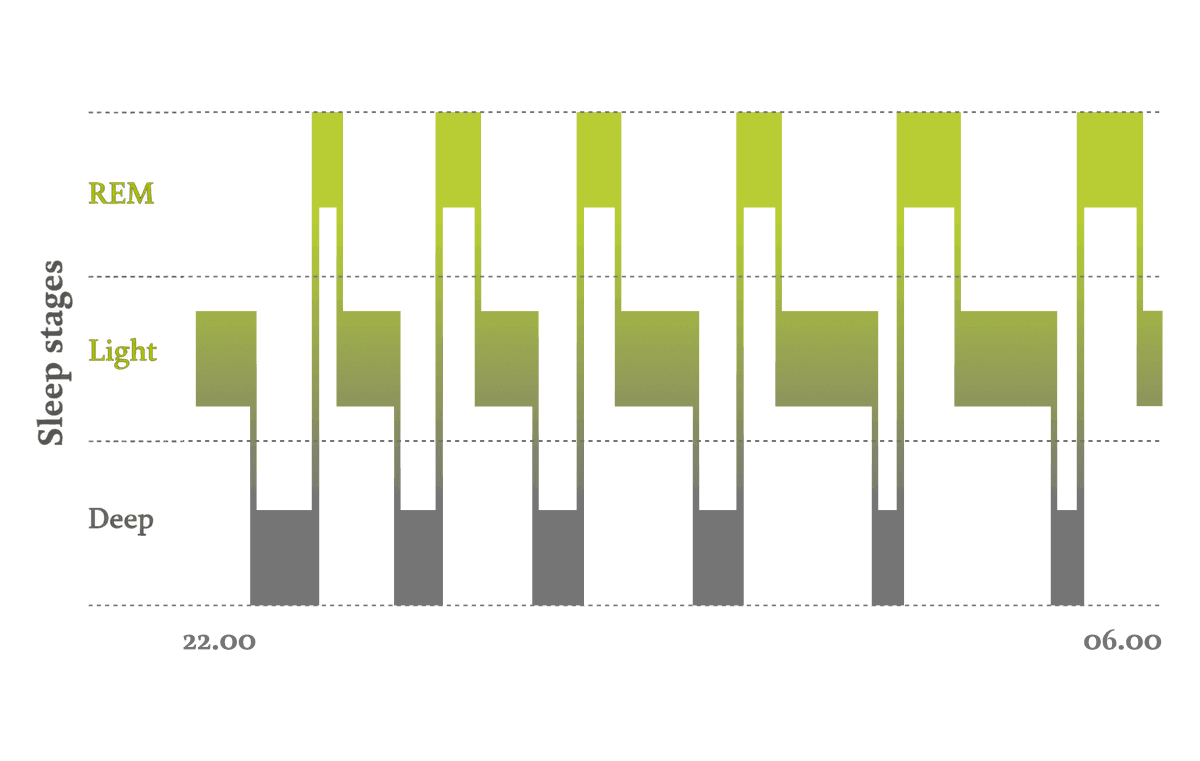
Today we know that while we sleep, we move through four distinct stages that together form a cycle. In the first stage, transitional sleep, the body begins to unwind: the muscles relax, breathing slows, and consciousness starts to fade. In the second, light sleep, the brain reduces its activity, muscle tone decreases, and the body enters a more stable state, though it is still easy to wake up. In the third, deep sleep, we are almost completely disconnected, and it is very difficult to wake someone. And in the fourth, REM sleep, the brain enters a more agitated state, where the eyes move rapidly beneath the eyelids, dreams become more intense, and emotions take center stage. This sequence forms a cycle that repeats four or five times a night, but the duration of each stage varies: during the first half of the night, deep sleep is more prevalent and there is less REM sleep, while in the second half, the opposite is true. So when we sleep too little, we not only sleep for less time, but also miss entire stages. And without those stages, there is no real rest. Each one serves a specific purpose, and understanding them separately helps us see more clearly everything the body does while we sleep.
It all begins when you go to bed. You turn off the light, close your eyes, and let your body settle in. Maybe you toss and turn as you look for just the right position, but little by little you feel your muscles loosen, your breathing slow, and your mind begin to let go. You can still hear the sounds around you, but they matter less and less. This is where transitional sleep begins, a state in which you are neither fully awake nor completely asleep. Perception gradually fades, as if someone were turning a dial and the world were slowly shutting down. But this transition is not always smooth. Sometimes, just before you let go completely, something strange jolts you out of the moment. Some people feel a sudden start, as if they had stumbled. Others feel an abrupt fall that never happened. Fleeting images or isolated sounds may also appear: a figure approaching, a sharp noise, or a word that makes no sense. These experiences are quite common and are known as hypnagogic hallucinations and sleep myoclonus. I’ve already talked about how the brain receives millions of stimuli every second, from both outside and inside the body, and how it needs to filter them to avoid being overwhelmed. Only a handful of the things we hear, smell, see, or feel reach our awareness. The one that decides which stimuli are worthy of reaching our awareness and which are not is the thalamus, a structure located in the center of the brain, just above the hypothalamus. During the day—with the exception of smell—all stimuli pass through this sensory customs checkpoint, which decides which signals stay in the background and which deserve to pass on to the cerebral cortex—the brain’s outermost layer—where perceptions become conscious. Thanks to this system, we can focus our attention on one voice amid the noise or ignore the feel of our clothes against our skin while we read.
But at night, the customs checkpoint becomes stricter and literally closes the doors of perception so the cerebral cortex won’t be distracted and can carry out its nighttime tasks. If this disconnection isn’t properly synchronized with the loss of consciousness, cracks appear in our perception. For example, the sensation of falling can occur when the thalamus blocks signals from the body before consciousness has completely switched off. When the brain suddenly stops registering pressure or contact with the surroundings, it may interpret that lack of information as a free fall, as if we were floating in a void. Sometimes the opposite happens. Since the ability to filter depends on the level of activation of the nervous system, when you’re alert, anxious, or stressed, the thalamus has a harder time doing its job. It’s as if it were trying to close a door while someone pushed from the other side. In this in-between state, with one part of the body wanting to sleep and another still on guard, the sound of a motorcycle on the street blends with an absurd image, a memory turns into a voice, and a thought becomes a figure. Although they can sometimes be unsettling, hypnagogic hallucinations are not the same as hallucinations associated with psychiatric disorders or nightmares. They are brief, harmless phenomena that disappear as we move into deeper stages of sleep.
In the second stage, light sleep, you’ve moved away from the shore and crossed the breakers. The waves are gone and you’ve put your head underwater to dive, but you’re still close to the surface. The body keeps slowing down as the alertness dial is turned down and the calm dial is turned up: your temperature drops, your heart rate becomes more regular, and your movements almost completely stop. Although technically you could still wake up fairly easily, it wouldn’t be like coming back from a blink. At this point, the thalamus becomes even stricter and sends out a powerful electrical signal to block any stimulus. That’s why, at this stage, there are no longer any muscle jerks or stray thoughts: there is silence. A kind of pause in which the body gathers momentum to descend further. If everything runs its course, what comes next is a deeper descent: deep sleep.
Now, in deep sleep, there’s no turning back. This is when we are most disconnected from our surroundings, and waking someone in this stage is usually difficult. But far from being inactive, the body is carrying out multiple tasks. The calm dial is turned all the way up and the muscles relax completely, which significantly reduces the body’s energy needs. Since muscle contraction is one of the main sources of energy expenditure during the day, we go into energy-saving mode. Blood glucose levels fall, the pancreas releases less insulin, and fat takes center stage as a source of fuel. With less muscle activity, the body also produces less heat. That’s why, during deep sleep, body temperature keeps falling until it reaches its lowest point near dawn, between 0.5 and 1 °C lower than daytime values. With less need for nutrients and oxygen, the heart also gets a break. Its rate drops by 10% to 30%, and blood pressure can fall by as much as 20% compared with waking levels. For example, if your heart beats 70 times a minute and your blood pressure is 120/80 just as you lie down, it can drop to 50–60 beats per minute and 90/60 during deep sleep.Blood pressure is measured in millimeters of mercury (mmHg) and is given as a higher and a lower value. The higher value corresponds to blood pressure during the contraction, or systole, of the heart, which is why it is called systolic pressure. The lower value corresponds to blood pressure during the relaxation, or diastole, of the heart, which is why it is called diastolic pressure. This reduction in energy expenditure and metabolic rate is not just a pause: it is an essential moment in the body’s overall recovery. When we don’t get enough deep sleep, these resting mechanisms don’t kick in as they should, and the risk of type 2 diabetes, high blood pressure, and even heart attacks increases.
But energy savings are only part of what happens. In this quiet moment, with the machine almost completely stopped, the body takes the opportunity to begin its most intensive restorative processes. It is a privileged window in which tasks are activated that could not be performed while we are awake or during the lighter stages of sleep. One of the major players in this stage is growth hormone. It is usually associated with childhood because it is responsible for lengthening bones, strengthening muscles, and developing organs during the first years of life. This is the hormone Lionel Messi couldn’t produce in sufficient quantities, which is why he needed to inject it every night to keep growing. But this hormone doesn’t disappear once we stop growing; it continues to perform essential functions throughout our lives. In adulthood, growth hormone is released mainly during deep sleep, especially in the first part of the night. And when it appears, there’s no mistaking it: it sends a powerful signal to cells that it’s time to regenerate tissue, strengthen structures, and repair the day’s damage. When this signal fails, the body feels it: wounds take longer to close, recovery slows down, and signs of wear and tear begin to pile up. Without this nighttime repair signal, the body ages faster.
As I mentioned earlier, cortisol reaches its lowest levels during the first hours of the night, and the implications of this rhythm are remarkable. Because cortisol is a powerful immunosuppressant, its low concentration allows the immune system to carry out its regenerative and defensive functions more freely. Immune cells patrol more freely, communicate with one another more effectively, and coordinate their strategies to eliminate threats. Some, such as T cells and natural killer cells, which are key to eliminating infected or cancerous cells, become more active and move from the blood into the tissues where they can act. Others multiply or train themselves to recognize their enemies more effectively. For example, some immune cells circulating in the blood carry pieces of the enemy to the lymph nodes—where their comrades are—so they can learn to recognize them without having to leave the barracks. This whole defensive operation causes a temporary increase in the production of cytokines, the molecules that orchestrate and control the immune response. This is why fevers rise at night: the immune system is more active and raises the temperature as part of its attack. So if someone sleeps poorly, their defenses become less effective. Immune cells lose their effectiveness, antibody production decreases, chronic inflammation increases, and the risk of infections, autoimmune diseases, and even cancer rises. In fact, vaccines are less effective after a poor night’s sleep. Deep sleep, by contrast, gives the body a chance to better prepare for the battles of the next day.
One of the parts of the body most in need of repair is the brain. As such an active tissue—it makes up just 2% of total body weight but uses 20% of the body’s energy—it also produces a large amount of waste that needs to be removed. And if that waste builds up, it can become a serious problem. Some of the best-known examples are the proteins beta-amyloid, tau and alpha-synuclein, which, when they are not cleared away in time, form toxic aggregates and damage neural connections. If they build up in areas that control movement, such as the basal ganglia, they can lead to diseases like Parkinson’s. If they build up in memory-related areas, such as the hippocampus and prefrontal cortex, they are associated with the development of Alzheimer’s and other forms of dementia. In the rest of the body, waste is removed through the lymphatic system, but until recently no similar sewer system in the brain was known to exist. It was only in 2012 that a group of researchers discovered a hidden drainage system that functions exclusively in the central nervous system. They called it the glymphatic system, because it resembles the body’s lymphatic system, but has a particular design that depends on glia, the brain cells that nourish and care for neurons. The most curious thing is that this system reaches its peak activity during sleep, especially in the deepest stages. While we sleep, cerebrospinal fluid seeps between the neurons like a rising tide, sweeping away the day’s waste and carrying it toward channels that remove it from the brain. It is a kind of nighttime cleaning that takes place in silence and darkness.For much of history, the brain was studied mainly through dead brains. In those conditions, the flow of cerebrospinal fluid is stopped and the glymphatic system remains inactive, since its functioning depends on the living brain and, in particular, on the state of sleep. This methodological limitation helps explain why this cleaning system went unnoticed for decades and could only be described once imaging techniques and experimental models using live animals began to be used in the early 21st century.
As the years go by, many people notice that they sleep fewer hours, with more interruptions and lighter sleep. For a long time, people believed that this decline in rest was a natural consequence of aging. And since neurodegenerative diseases occur more often in old age, it seemed logical to think they were part of the same package. But today, the story is beginning to be told in reverse. What we are coming to understand is that deep sleep is not only a consequence of youth, but also one of its causes. Sleeping poorly, night after night, can leave the brain without enough time to do its cleaning work. When that happens, waste builds up and interferes with how it functions. If this disorder persists over time, the glymphatic system begins to fail. And with it, the brain’s ability to take care of itself. What seemed like an inevitable consequence of the passage of time may actually be an avoidable warning sign.
In 1853, among the ruins of Ashurbanipal’s palace in the ancient city of Nineveh (in present-day Iraq), the British archaeologist Austen Henry Layard unearthed thousands of clay tablets inscribed with cuneiform writing. They were part of an extraordinary library—the oldest on record—and their contents were as diverse as they were astonishing: hymns, laws, spells, astronomical observations, medical recipes, and, among it all, one of the most important literary works in history, the Epic of Gilgamesh. It told of wars, friendships, sex, fear of death, questions about the meaning of life, and reflections on the limits of knowledge. Until then, many European intellectuals believed that the ability to reflect on oneself and question one’s own fate was a recent achievement of modernity. But the tablets convincingly showed that more than 4,000 years ago, people were already writing about what it means to be human.
Gilgamesh was a legendary king who really existed and ruled the city of Uruk about 4,700 years ago. But in the epic, written several centuries later, he is portrayed as a powerful and wise demigod. In the opening verses, however, Gilgamesh is not an admirable hero, but an excessive, arrogant, and cruel king who oppresses his people, takes women without their consent, and forces men into pointless contests. The people of Uruk, fed up with their king’s tyranny, raise their pleas to the gods. In response to the widespread outcry, the gods create an equal to confront him rather than punish him. Thus Enkidu is born, a human demigod who lives in the wilderness, as strong and brave as Gilgamesh, but untouched by the corruption of power. Eventually, Enkidu comes to the city and fights the king to a draw. Gilgamesh recognizes the greatness of his adversary and offers him his friendship. The epic continues with a series of adventures in which they challenge the gods together, cross forbidden forests, and defeat monsters, until Enkidu’s death changes everything. For the first time, Gilgamesh feels the weight of his finite existence and sets off on a desperate quest for immortality, which ends with his acceptance of his human condition and his own death. Beyond the fact that the epic is an archaeological gem of literature, what matters for this chapter is that this whole story is woven with dreams. For example, before meeting Enkidu, Gilgamesh dreams of a star falling from the sky and blocking his way. Then he dreams of a beautiful axe that he loves like a woman. In both cases, his mother—the goddess Ninsun—reveals that these visions foretell the arrival of someone who will not only confront him, but complete him. So, throughout the story, dreams are not only premonitions of what is about to happen—such as dangers and obstacles he must face—but also spaces where Gilgamesh processes what he does not yet understand. For him, dreaming is a way of knowing before he knows.
But Gilgamesh was not the only one who dreamed of signs and challenges. In almost every human culture, dreams were taken as warnings, messages, or paths to follow. Sometimes they were interpreted as prophetic revelations, at other times as guides to action, and at still other times as ways of communicating with the spirit world. The truth is that for thousands of years, dreaming was a deeply serious activity. It was taken so seriously that the earliest civilizations built buildings specifically for dreaming and receiving sacred visions. In Egypt, for example, rituals for interpreting dreams were practiced in these places, and some were recorded on papyri such as the famous Dream Book found at Deir el-Medina, which lists different dream scenes and the meanings attributed to them. In ancient Greece, the temples of Asclepius—the god of medicine and healing—offered retreats where worshippers not only slept, but also fasted, listened to chants, and received plant-based remedies before going to bed, in the hope of receiving revealing dreams to guide their healing. In classical China, Taoists believed that the soul could leave the body during sleep and travel to other worlds, and some temples offered ideal conditions for sleeping and receiving visions. In India, Vedic texts already classified dreams as messages from the gods, illusions, or karmic revelations, and some schools of yoga developed specific practices—such as yoga nidra—to explore consciousness through sleep, in quiet, secluded spaces. What is remarkable is that in almost every corner of the world, dreaming meant opening a door to another plane, and what happened inside was taken as seriously as what happened after waking.
However, cultures all over the world considered dreams to be something outside the person. It was Sigmund Freud, with the publication of his book The Interpretation of Dreams in 1900, who dared to strip dreams of their mystical aura and place them within the realm of human experience. Freud was a neurologist, and it seemed obvious to him that dreams were not divine messages or visits from the future, but products of the brain. According to his theory, every dream contained a repressed desire that, disguised in strange symbols and absurd scenes, managed to slip past the censorship of consciousness. He proposed that the language of dreams was not random, and that with the right method, dreams could be deciphered to access deep truths that were not prophecies, but intimate accounts. A kind of confession each person made to themselves while asleep, full of clues about their fears, conflicts, and most hidden desires. Despite how influential this view was, contemporary neuroscience has dismantled the idea that dreams have a hidden meaning or a symbolic key waiting to be decoded. Still, Freud’s intuition was not entirely wrong: although dreams are no longer interpreted as coded messages from the unconscious, they remain a window into the inner world.
One of the people who opened up this new path was psychologist Rosalind Cartwright, known among her colleagues as “the queen of dreams.” In 1984, she brought together a group of recently divorced people with depressive symptoms to study the content of their dreams. For two weeks, the participants slept in her laboratory and were awakened during REM sleep to describe what they were dreaming about. At the end of the study, Cartwright noticed something striking: those who dreamed about their ex-partner showed a faster recovery, with fewer symptoms, a better mood, and greater clarity as they reorganized their lives; while those who did not dream about the subject or could not remember their dreams remained more caught up in sadness. To her, dreams offered a space where difficult emotions, too overwhelming to be processed during the day, could unfold more freely and find an outlet.It is worth clarifying that not all dreams contain psychologically relevant information. Many are fragmentary, incoherent, bizarre, and even amusing. Recalling the previous night's dreams and reviewing their content can be an interesting exercise, but it will not necessarily provide useful insights for understanding oneself. Paying attention makes more sense when dreams recur, are emotionally charged, or are connected to significant life experiences, since in those cases they may reflect ongoing processes of emotional regulation or psychological processing. Decades later, neuroscience confirmed this intuition: during REM sleep, the brain regions responsible for emotional processing are activated, but at a dampened intensity, which allows the physiological response to the event to be gradually adjusted. Or, in other words, it helps reduce allostatic overload. When dreaming about an ex-partner, for example, the image of the other person no longer appears charged with anger, anguish, or despair, but is instead wrapped in a strange atmosphere, sometimes absurd and sometimes tender, that lets us look at the scene from a different angle. Maybe in the dream we argue about the same thing again, but this time without shouting. Or we see the other person with someone else, and it doesn't hurt as much. Or we simply walk together without talking. In this softened version of the conflict, the memory stops being a threat and becomes a story we can begin to let go of. Dreaming helps us learn. And to understand how that happens, we need to explore a little more how memory works. We tend to imagine memory as a drawer where memories are kept, one we can open from time to time to tell an anecdote or relive a moment. But memory is not an inert archive; it is a living process that leaves traces in the body as we go through experiences. Its purpose is not to preserve the past as if it were a museum, but to turn what we have lived through into a compass that guides the present and the future. In every animal studied, from worms to birds and mammals, some form of memory appears, suggesting that the ability to retain and use relevant information is a basic function even in the simplest nervous systems. The diversity of strategies shows this: bees use their memory to work out which flowers they have already visited in a given area; some birds, such as crows, rely on prodigious memory to remember hundreds of food caches through the winter; and elephants use long-standing memories to find water during droughts and pass that knowledge down through generations. In each case, memory adapts to an animal's way of life, expanding its ability to anticipate what is coming. Memory, ultimately, is how the body turns experience into anticipation. And since anticipation is the brain's central strategy for navigating the world, without memory, that strategy simply would not exist.
For this ability to anticipate to be possible, the brain organizes information across different time scales. On the one hand, there is short-term memory, which allows us to retain what has just happened for a few seconds or minutes. It's what we use to remember a number someone gives us over the phone or a sentence someone said while we were thinking about something else, but it's also what our ancestors used to follow the fresh trail of a moving animal and memorize a series of turns in the forest. It is fast, flexible, and very useful for making quick decisions—especially in uncertain environments—but it is also fragile: if it isn't reinforced, it disappears without a trace. On the other hand, there is long-term memory, which stores what the brain considers truly valuable, such as how to ride a bike, the rules of a sport, and the taste of a childhood dish, but also how to find your way back to a cave after migrating for weeks, which plants are edible and which are poisonous, and how to carve a stone or treat a wound. This memory is more durable, more stable, and distributed across different regions of the brain depending on the type of information: images are stored in the visual cortex, sounds in the auditory cortex, language in the temporal and frontal regions of the brain, and emotions in the amygdala and prefrontal cortex.Although the cerebral cortex is often described as a set of areas with clearly defined functions, it is not actually a fixed or immutable map. Throughout life, the brain retains a significant capacity for functional reorganization, known as cortical plasticity. When a sensory modality is lost or does not develop—as in blindness or deafness—the regions that would normally process visual or auditory information can be recruited for other functions. In people who are blind, for example, areas of the visual cortex become active during Braille reading or language processing; in people who are deaf, auditory areas can take part in visual processing or sign language. This reorganization is neither unlimited nor arbitrary, but it allows the brain to reuse available circuits to adapt better to the demands of the environment and experience. This long-term memory accumulates not only useful facts, but also ways of living, interpreting, caring, avoiding danger, and passing on what we have learned. But for an experience to stop being an isolated piece of information and become a lasting memory, a process that takes place while we sleep is needed: memory consolidation.
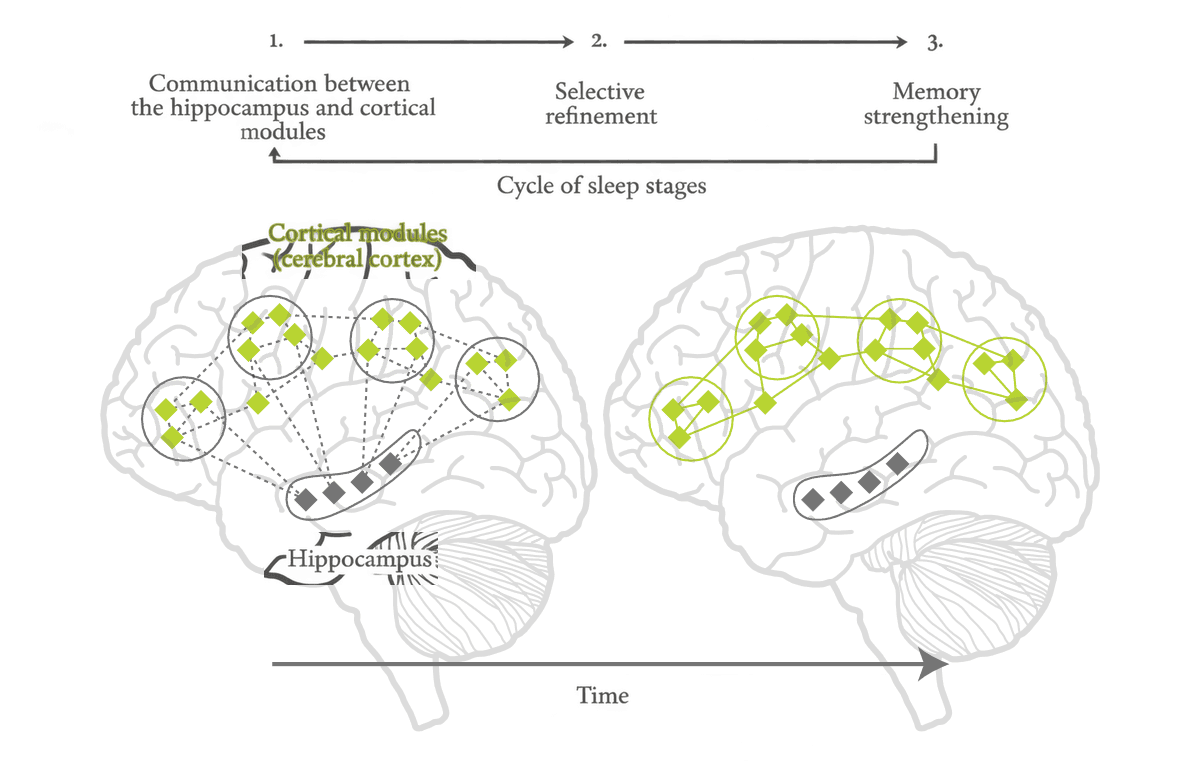
A structure called the hippocampus is responsible for short-term memory. Hidden deep in the brain, it works during the day like an indefatigable note-taker, recording almost everything we experience, from the smell of freshly moistened grass to the face of a friend we pass on the street. But because of its small size, its storage capacity is limited. That's why, at the end of each day, it needs to empty itself so it can do its job again the next day. During the first stages of each sleep cycle—light and deep sleep—the hippocampus replays the day's experiences and transfers them to the cerebral cortex, where they are stored more stably. This is where memories related to experiences and concrete facts are mainly consolidated, such as the places we visit, the events we experience, and the people we interact with. However, the cortex does not file away all the notes it receives from the hippocampus: like a meticulous and patient librarian, it evaluates which memories to keep and which to let fade. Significant memories, charged with emotion or repeated in different situations, are strengthened and integrated with prior knowledge, forming lasting networks.
During REM sleep, which closes each sleep cycle, the brain enters a distinctive state. In this phase, memories that have reached the cortex wake up and mingle with past experiences, giving rise to new connections and boosting creativity and problem-solving. At the same time, memories that could cause anguish or fear are relived, but with less intensity, which allows their emotional charge to be reduced. Out of this rearrangement comes what we experience as dreaming: movies the brain creates to test, adjust, and reinterpret what we have lived through, and which can reveal inner tensions, connect distant ideas, and rehearse responses we could not find during the day. In fact, many historical discoveries came from dreams: the chemist Kekulé dreamed of a snake biting its tail and realized that benzene must have a ring structure; Paul McCartney heard the melody of “Yesterday” in a dream; Mary Shelley conceived the plot of Frankenstein after a nightmare; and Einstein himself, as a teenager, dreamed he was sledding at full speed down a mountain, an image that stayed with him as he reflected on time and light.
For our ancestors, this ability to simulate scenarios was vital. Imagining new routes to find water, resolving a conflict with a member of the tribe, anticipating a predator's behavior, or planning a hunting strategy could make the difference between life and death. In a 2023 study, a group of researchers interviewed members of the Bayaka hunter-gatherer communities of the Congo and the Hadza of Tanzania to understand what they dreamed about and how they interpreted their dreams. When they analyzed the content of the reported dreams, the researchers found that more than half involved potential threats, from wild animal attacks to accidents or social conflicts. But what was most revealing was not the presence of those threats, but the way the dreamers dealt with them. Their accounts featured escape routes, help from other group members, alternative paths, or more effective defense strategies. For example, one participant said: “An elephant was chasing me in the bush, near the camp. I was with four women I didn't know. I managed to escape by running toward the mountains.” Another said: “I dreamed a buffalo was charging at me. I was in the wooded area of Numbeya, where we usually go looking for honey. I was looking for the ‘small honey.’ There was another man named January, and he came to help me.”
Although dreaming about threats can be useful for rehearsing responses and preparing us for danger, not all distressing dreams serve that purpose. Nightmares—those dreams that jolt us awake, our bodies on alert and the emotion still close to the surface—seem to stray from that path. Unlike dreams that let us relive a difficult situation in a safe environment and explore different ways out, nightmares repeat the threat without allowing us to find a solution. The dreamer runs away, freezes, falls into the void, or is attacked, but rarely manages to change the outcome. Instead of regulating the emotion, the dream leaves it suspended and unresolved. Sometimes, nightmares seem to come true. One of the most bewildering—and distressing—experiences for many people is sleep paralysis. It is a brief but intense episode in which someone wakes up completely but cannot move a finger. The muscles don't respond, and the surroundings may seem distorted or downright terrifying: shadows in the room, presences drawing near, strange voices, or the feeling that someone is pressing on our chest. It is no coincidence that in many cultures sleep paralysis has been interpreted as possession, a demonic attack, or a visit from beyond. However, the scientific explanation is much simpler and more reassuring. During REM sleep, the brain disconnects from almost all the body's muscles, except those that control breathing and eye movement. This disconnection allows us to dream freely without physically acting out those actions, something that can sometimes go wrong and lead to sleepwalking. In people who experience sleep paralysis, waking happens before this muscle disconnection is reversed: the body remains blocked, but consciousness has already returned. To complicate things further, the brain remains partly in a dream state, which explains the vivid and terrifying hallucinations; they end once the brain manages to leave REM sleep and wakes up fully.
Returning to nightmares, it's worth clarifying that having one every now and then is no cause for concern. In fact, it may be a sign that the body is trying to process something that overwhelms us. In most cases, over time, nightmares change and find new outlets, or simply disappear. But when they become recurrent, appearing night after night with the same threatening tone and no way out, dreaming no longer helps process fear; instead, it becomes a pointless repetition that leaves the nervous system trapped in a loop. It is no coincidence that nightmares are more common in people under high levels of stress, with unresolved psychological trauma, or with little emotional support. In these cases, seeking professional help is not only advisable but necessary.
Today we no longer flee from predators or search for water on the savanna, but the function of dreams remains just as valuable. REM sleep, that intimate laboratory where dreams unfold, allows us to process conflicts, reorganize complex experiences, and explore possible paths through the challenges of everyday life. In that protected space, the mind rehearses decisions, relives intense emotions, and tests solutions before facing them while awake. Dreaming is neither a luxury nor a biological whim: it is one of the oldest and most sophisticated ways we have of preparing ourselves to live. Understanding this invites us to care for rest as the sacred temple it once was.
It is often said that you should sleep between seven and nine hours a night. That number, which appears everywhere, repeated like a universal mantra, is no myth: numerous studies show that people who sleep within that range are less likely to get sick and enjoy better health. So aiming for those hours is a good starting point. But—as with almost everything in biology—the real answer is more complex. Sleep is not always the same, for everyone, or at every moment. Because sleep is how the body repairs and reorganizes itself and responds to the demands of its surroundings. And those demands are constantly changing. Going through a move, a bereavement, or a series of exams is not the same as being on vacation and reading in the shade of a tree. Caring for a newborn, waking every two or three hours, is not the same as living alone and working from home. Training for a marathon is not the same as recovering from surgery. Each situation brings with it a different need for rest. The same goes for different stages of life: sleep needs are not the same for a child, a teenager, a young adult, or an older person. We sleep differently because we live differently. And understanding those variations is the first step toward learning to sleep better.
Now, when nighttime hours aren't enough, the body tends to look for shortcuts. One of the oldest and most effective ways to do this is a nap, that little stretch after lunch when the body asks us to slow down and give in to rest. Although the habit of taking a nap has been disappearing in big cities as work and store hours run straight through the day, in many small cities and towns it still survives as an everyday ritual. One that, I confess, I love and try to practice every day. Used well, naps are powerful allies for clearing the mind and restoring the body's energy. But if they go on too long, they can backfire, leaving us more tired than before and interfering with nighttime sleep. That's why the key is how long and when. It seems that the optimal nap length is somewhere between fifteen and thirty minutes, long enough to skim the surface of light sleep but not to drift so far from shore that we sink into deep sleep. This short rest is enough to give the body a kind of physiological “reset,” helps lower blood pressure, calms the alert response generated by the first half of the day, and gives the brain an extra dose of restoration, especially for people who don't get enough sleep at night. However, just as with total nighttime sleep, the right amount varies from person to person. As for timing, there is no specific hour to let yourself drift into a short nap if you feel your body needs one, but to preserve nighttime sleep—which is more important—it is wise to limit naps to no later than three or four in the afternoon.
For those who can't meet their sleep needs during the week, sleeping a little more on the weekend may seem like a good recovery strategy. And to some extent, it is: making up hours of rest when you're in a deficit has a restorative effect. The body appreciates it. But it's important to understand that sleep doesn't work like a bank account where you can withdraw from Monday to Friday and deposit on Saturdays and Sundays without consequences. In 2019, researcher Christopher Depner designed an experiment to evaluate the effect of the strategy of “paying off sleep debt” on appetite and blood sugar levels. In other words, he wanted to know whether sleeping poorly during the week and making up for it on the weekend could alter how the body decides how much to eat, when to eat, and how it regulates fuel use. To do this, they recruited 36 young, healthy people and, after three nights of restorative sleep, divided them into three groups. The first slept nine hours every night. The second slept only five hours a night throughout the study. The third also had their sleep restricted to five hours, but on days five and six they were allowed to sleep as much as they wanted, simulating weekend recovery. Since the study was conducted in a laboratory, lighting, screen exposure, caffeine intake, and meals could all be controlled. Everyone received the same food at the same times, and multiple physiological variables were measured throughout the process.
To begin with, they found that people who slept less ate more, especially at night. This is a well-known fact: a body deprived of rest goes into a state of alert and seeks to increase its energy reserves to face whatever is putting it on alert. As a result, there is more hunger and less control over what is eaten, with a particular preference for high-calorie foods. In addition, these participants needed more insulin to handle the same amount of blood sugar, an early sign of a metabolic dysregulation called insulin resistance, which, if sustained over time, can develop into type 2 diabetes. The most striking results came from the group allowed to sleep freely during the weekend. Over those two days, some variables improved: they ate a little less, their blood glucose dropped, and their insulin response became more efficient. But the improvement was short-lived. As soon as they returned to sleep restriction—or to their weekday routine—their bodies became even more unstable. Blood sugar rose, insulin efficiency fell, and appetite surged again. Instead of protecting the body, that back-and-forth between deprivation and recovery seemed to confuse it even more. This experiment confirms that rest is not a luxury or an account you can settle when you have time, but a biological expectation that demands consistency.
As you know by now, our bodies don’t wait for something to happen before reacting; they try to predict what’s coming so they can use their resources as efficiently as possible. And in this chapter I also told you that part of this ability to anticipate is guided by an internal clock that sets the rhythm of sleep and wakefulness, but also of body temperature, hormones, digestion, and even our defenses. So when we stick to a regular bedtime and wake-up time, our bodies find their harmony. But if that rhythm is interrupted over and over—with late nights, late-afternoon naps, or weekends that throw our schedules off—our bodies lose their compass. If this happens every now and then, the body can recover, but when irregularity is constant, physiological coherence is lost, and over the years this manifests as disease. In a revealing 2024 study, researchers analyzed the sleep habits of more than 61,000 people over six years and found that during that period, people who went to bed and woke up at roughly the same times each day—regardless of whether they slept seven, eight, or nine hours—had up to nearly half the risk of dying compared with people whose schedules were irregular. In other words, regular sleep, even if it doesn’t last the right amount of time, seems to be more protective than sleeping a lot but at chaotic hours. As if the body needed not only to sleep, but also to know when it was going to do so. The best way to achieve this is to stick to a regular schedule, even on weekends. There’s no need to be obsessive, but consistency matters. Going to bed and getting up at more or less the same time—with no more than a one-hour difference between weekdays and weekends—seems to be enough to keep the internal clock in sync.
You may think it’s a lot to ask to go to bed and get up at the same time every day, but that’s how humanity lived for almost all of its history. Before we could turn on a light with the push of a button, people generally ate dinner early (or didn’t eat dinner), talked for a while by the dim light of a candle or a fire, and then went to bed. That’s how things were for hundreds of thousands of years, until the discovery of electricity and the invention of the light bulb changed everything. Night stopped being the end of the day and became a time to stay active. This is because light is a powerful biological signal. As the sun goes down, specialized cells in the retina detect the growing darkness and tell the suprachiasmatic nucleus that it’s time to wind down.The cells that send this signal are intrinsically photosensitive retinal ganglion cells. They contain a protein called melanopsin, which responds to the presence of light, especially light in the blue spectrum. Although cones and rods also take part in this process, their role is smaller by comparison. In response, this master clock orders the release of melatonin and lets the body know that the day is over. But when there is light—especially bright artificial light—that signal weakens or disappears, and the body interprets it as meaning that the day is still going. Although this can happen with almost any artificial light, the effect is especially strong with so-called “cool lights,” like the light emitted by screens on electronic devices, LED bulbs, and fluorescent lights. Unlike warm light, which has a yellow-orange hue—like candlelight or the light from incandescent bulbs—cool light sources tend to be bluish white because they emit a significant amount of blue light, the type of light that most strongly stimulates the photosensitive cells in the retina.The light visible to the human eye is a small portion of the electromagnetic spectrum, ranging from wavelengths of 400 to 700 nanometers, corresponding to violet and red, respectively. Within that range, blue light falls between 450 and 495 nanometers, and it is the type that most strongly stimulates the photosensitive cells in the retina that regulate the biological clock. That is why, although all lights may look the same to the naked eye, they don’t all affect the body in the same way. Its effect is so powerful that just half an hour of exposure to this kind of light can reduce melatonin production by 60%, and after an hour, suppression can reach as much as 80%. This means that staring at bright screens late into the night or leaving all the lights on in the house doesn’t just artificially extend the day; it also worsens sleep quality night after night, often without us noticing.
But as always in biology, not everyone is equally sensitive to light. Melatonin suppression is estimated to be up to fifty times stronger in some people than in others: for some, it can happen in candlelight, while others can sleep well even after staying up late watching television. This variability can also increase with age and in certain clinical contexts. For example, as we grow older, the peak of sensitivity extends to other colors, such as green and yellow, and antidepressant medications—such as sertraline, escitalopram, or fluoxetine—seem to increase sensitivity to light. This means that uniform lighting can worsen sleep quality in populations that already tend to have trouble sleeping. Since we usually don’t know how sensitive we are, most of us make our way through the night as best we can, without knowing whether the light we use is helping or harming us. The good news is that there are simple ways to improve our rest without having to live in the dark or move to the countryside. It’s more a matter of redesigning the atmosphere as evening falls. For example, instead of turning on all the ceiling lights as if it were midday, you could try table lamps, salt lamps, or warm string lights that cast a softer, more orange glow. Instead of leaving the TV on in the background, you could put on some gentle music or sit down for a chat by lamplight. If you look at your phone before bed, turn on the night filter or, better yet, leave it charging in another room for at least an hour before going to bed. In the kitchen, you could turn off the main lights and switch on just one light under the cupboard. If you go to the bathroom in the middle of the night, a small night-light can keep you from waking up completely. With a couple of simple changes, your home can go from feeling like an office around the clock to becoming a refuge that invites you to rest. I discovered that I’m in the hypersensitive group, so at my house we keep the lights dim after sunset. I also wear blue-light-blocking glasses at night, especially in places where I can’t control the lighting.I have two pairs, one with orange lenses and the other with red lenses. Both block blue, green, and yellow light, but the red lenses go a little further and block all the light stimulus that suppresses melatonin. They’re not magic, but they help my brain understand that the day is over and help me get better rest.
But light isn’t the only everyday nuisance that interferes with rest. There’s a psychoactive substance we use every day to stay awake that often stays with us until the early hours without our realizing it: caffeine. Found in coffee, tea, yerba mate, and many energy drinks, caffeine is a powerful stimulant that increases alertness, improves cognitive performance, reduces fatigue, and can even lift our mood.For a long time, people thought the stimulant compounds in tea leaves and yerba mate were theine and mateine, respectively. But more recent research has shown that they are caffeine, the same molecule found in coffee beans and citrus flowers. This means that caffeine appeared several times over the course of plant evolution, in distinct lineages that are not related to one another, a phenomenon known as convergent evolution. In every case, its stimulating effect on insects and mammals seems to have been a useful strategy for protecting plants or attracting pollinators. Its effect comes from blocking adenosine, a molecule that builds up in the brain during the day and creates the feeling of tiredness that, in sync with the circadian rhythm, pushes us to sleep at night. When we have a caffeinated drink, the fatigue signal is temporarily silenced, and we feel awake and energized. Although its effects last about three hours, the body can take between eight and twelve hours to eliminate it completely. That means that a cup of coffee or half a thermos of yerba mate at five in the afternoon may still be circulating when you go to bed, even if you no longer feel its effects. And although some people say they sleep just fine after drinking coffee, in most cases—including mine—caffeine at the wrong time makes us take longer to fall asleep, interferes with the deep stages of sleep, and increases the number of brief awakenings during the night. To make matters worse, these consequences can go unnoticed because unless we’ve had an awful night, we don’t usually realize how light our sleep was. And the most paradoxical thing is that the next day, sleepier than energized, we turn to caffeine again to get going.Coffee, tea, and yerba mate are incredible drinks, rich in antioxidant compounds and associated with multiple health benefits. So to get the best they have to offer—without interfering with sleep—it’s a good idea to limit consumption to the first few hours of the day, ideally no later than eight hours before going to bed.
The result is a vicious cycle: we sleep worse, get less rest, and need more stimulation to keep functioning. Then we reach for quick fixes: a glass of alcohol, melatonin drops or pills, valerian or passionflower infusions, or cannabis in its various forms. Although many of these options can help in certain cases, they don’t always work as we expect. Alcohol, for example, is a central nervous system depressant, and as I explained, sleep is a time of high brain activity. So although it creates a feeling of relaxation, alcohol interferes with brain function during sleep, fragmenting it and making it less restorative. Cannabis rich in the psychoactive compound THC (tetrahydrocannabinol) can make you sleepy at first, but like alcohol, it can also affect sleep architecture if used regularly. In fact, one of its best-known effects is suppression of the REM phase, which is experienced as an absence of dreams, followed by a rebound effect when this type of marijuana is no longer used (with very vivid dreams). The opposite happens with marijuana rich in CBD (cannabidiol) or with more balanced proportions of THC and CBD. Although effects vary from person to person, this type of cannabis may help improve sleep thanks to its calming effect, especially in people with anxiety, chronic pain, or sleep disorders. Even so, the effects depend on the individual. As for melatonin, we should remember that it is a hormone and, as such, should be used judiciously and under medical supervision. What’s more, melatonin supplements are not regulated as medications, and it’s not uncommon for them to contain amounts different from those stated on the label—up to four times as much—which can throw natural rhythms off instead of correcting them.
Returning to light: just as it can be poison at the end of the day, it can be a powerful tonic in the morning. As soon as it enters through the eyes, light activates the suprachiasmatic nucleus and triggers the release of cortisol. But this isn’t stress cortisol; it’s the morning surge that helps us get the day started with energy. What’s more, the start of the day also starts the countdown to bedtime. The clearer and more defined this surge is, the easier it is to wake up, get moving, feel alert, and sleep better at night. And nothing stimulates it more powerfully than natural sunlight. The problem is that in modern environments, we often start the day in half-shadow: dark rooms, closed curtains, dim lights, or screens that barely reach the threshold needed to switch on the biological clock. Just as we need deep darkness at night to release melatonin, we need bright light in the morning to suppress it and activate the daytime rhythm. When that contrast disappears, we feel it in our bodies: it’s harder to get going, our energy takes longer to kick in, and our mood dims, as if something inside us never quite wakes up. This is what many of us feel in winter, when the amount of natural light decreases and sunrise comes later. In some cases, the days can get truly dark: some people develop seasonal affective disorder, a form of depression that occurs cyclically during the months with less natural light. Those who experience it tend to feel more fatigued, irritable, sleepy, and withdrawn, with changes in appetite and mood. This condition improves with the arrival of spring, so light is one of the most effective treatments for winter depression. Exposure to a bright blue-light source upon waking—for about twenty or thirty minutes—has been shown to be more effective than psychotropic medication (and combining the two often boosts the results even further). It’s no surprise, then, that morning light exposure also benefits people with depression unrelated to seasonal changes. So although sunglasses look cool and help hide dark circles, wearing them in the morning and in urban settings is a bad idea: they block the body’s most important signal for knowing it’s time to be awake.
But sunlight does much more than improve our mood or regulate our internal clock. For thousands of years, many cultures have considered the sun a source of life and health. In traditional Chinese medicine, the sun was seen as the expression of Yang—what is active, warm, and vital—and was used to strengthen qi and treat imbalances associated with fatigue or internal cold. In Ayurvedic medicine, the sun was the bearer of prana —the energy that sustains life—and its presence was central to morning rituals such as “sun salutations.” And although we sometimes forget it, Western medicine also revered the sun for centuries. The phrase attributed to Hippocrates, “Where the sun enters, the doctor does not,” is famous, and he was the one who popularized the term heliotherapy to refer to the sunbaths he prescribed to his patients. Although excessive sun exposure can damage the skin—especially during the middle of the day and without adequate protection—we now know that a lack of sun can also make us ill. The best-known example is the synthesis of vitamin D, a molecule that regulates hundreds of genes and plays a role in a wide range of processes, including bone metabolism, immune system modulation, blood sugar control, inflammation, and neurological health. Its role is so central that many consider it a hormone rather than a vitamin, and its deficiency has been linked to many illnesses, including multiple sclerosis, type 2 diabetes, osteoporosis, infections, and certain types of cancer. But that’s not all. Sunlight also stimulates the production of nitric oxide in the skin, which enters the bloodstream and acts as a natural vasodilator. This small compound helps relax the arteries, lower blood pressure, and improve cardiovascular health, even in people who get brief but regular sun exposure.Studies have found that people who are regularly exposed to sunlight have a lower risk of hypertension, coronary heart disease, and stroke, even when comparing people with the same vitamin D levels, suggesting that the benefits of the sun go far beyond this hormone. In addition, natural light during childhood and adolescence seems to have a protective effect against myopia. None of this means we should expose ourselves carelessly, but in moderate doses and at the right times of day, we can benefit from this free medicine.In general, it is estimated that during summer, a fair-skinned person can produce a good amount of vitamin D with 5 to 15 minutes of direct sunlight on the face, arms, and legs between 10 a.m. and 4 p.m., without sunscreen. For people with darker skin, or during winter, this time may increase to 30 minutes or more, and exposing larger areas of the body, such as the torso or back, is recommended. Outside of summer, the available UVB radiation decreases and the exposure time needed increases considerably. Other factors that affect skin synthesis also come into play: latitude, pigmentation, age, sunscreen use, and, above all, spending most of the day indoors. As a result, many people don’t manage to reach optimal levels through sun exposure alone. In such cases, daily supplementation with 1,000 to 4,000 IU of vitamin D₃ is recommended; this has been shown to be safe and effective for achieving serum levels between 40 and 70 ng/mL. For people dealing with an illness, vitamin D supplementation may be beneficial, but it’s best to consult a health professional first to assess each situation individually.
But even when we do everything right—turn off our screens, dim the lights, avoid caffeine, and get sunlight as soon as we wake up—we may still not be able to sleep. That’s because chronic insomnia and poor sleep aren’t always caused by light or caffeine. Sometimes the problem isn’t outside us, but within: thoughts that won’t switch off, emotions that churn, and worries that sneak in like thieves in the night. In these cases, it’s best to ask for help. Among the most effective strategies we know, cognitive behavioral therapy and acceptance and commitment therapy have been shown to improve sleep duration and quality over the long term. Therapy can help break the negative associations we develop with sleep, the habits that unintentionally reinforce insomnia, and the thoughts that fuel nighttime anxiety. And although these approaches have specific protocols, many of their tools can also be found in other practices, such as meditating before bed, learning to recognize and let go of the thoughts that tie us in knots, or relaxing the body with deep breathing or a body scan.
That said, there are times when neither routines, meditation, nor therapy are enough. Because sometimes insomnia isn’t the problem itself, but the way the body expresses something deeper. It may be a sign of persistent anxiety, sadness that has become chronic, a disrupted mood, the use of certain substances, or difficult traumatic experiences that have left the nervous system in a constant state of alert. When rest becomes elusive and we feel that nothing is working, the most important thing is not to go through it alone. Seeking help from a mental health or sleep professional can make a big difference. In some cases, it may be necessary to support the process with medication. And there’s nothing wrong with that. On the contrary, when properly prescribed, it can help us get the rest we need so much while we work through what we’re going through. Because the goal isn’t to sleep for sleep’s sake, but to regain our balance and inhabit our bodies calmly once again. Medication isn’t a magic solution, but it can be a valuable tool on the path to well-being. And like any tool, it’s used when needed and set aside when it’s no longer needed.
Sleeping well is neither a luxury nor a waste of time. It’s a biological need that has been with us since before we were born, a restorative tool that prepares us for everything else. Every night, the body asks for a pause so it can heal, learn, and recover its energy. And even though the contemporary world seems to want to convince us otherwise, taking care of our sleep is one of the most powerful ways to take care of ourselves. So if we want to live well—more awake, clearer-headed, more vital, and for longer—we need to learn how to sleep. Because when the body rests, everything else becomes a little more possible.
This is the second chapter of What the Body Knows. Along with theoretical concepts, this project offers exercises to help you practice concrete tools that will help you understand your body, take care of your health, and feel better.

Teoría y práctica para entender cómo sentirte mejor y efectivamente empezar a hacerlo.
Incluye:
- Lo que el cuerpo sabe
- Lo que el cuerpo sabe | Cuaderno de ejercicios para sentirte mejor

¿Qué nos pide nuestro cuerpo para estar saludable? ¿Podemos darle lo que necesita? Un libro con herramientas de la medicina del estilo de vida y la medicina evolutiva para entendernos y sentirnos mejor.
296 páginas. Impresión a dos tintas (negro + Pantone). 15 x 21 cm. Interior en papel bookcel de 80 gramos, cubierta en papel ilustración mate de 300 gramos, acabado con sello en bajorrelieve.
Biografía del autor:
Ezequiel Arrieta es Médico y Doctor en Ciencias Biológicas por la Universidad Nacional de Córdoba. Desarrolla su práctica clínica desde una perspectiva integral, combinando alimentación, movimiento, psicoterapia y herramientas farmacológicas de distinto tipo. Es editor de Un libro sobre drogas (EGLC, 2017) y Las olas (EGLC, 2022), coautor de Clima (EGLC, 2022) y autor de La invención de la comida (EGLC, 2023).

Un cuaderno con herramientas prácticas de la medicina del estilo de vida. Ejercicios sobre tu relación con la alimentación, el descanso, el estrés y el movimiento. Creado por el Doctor Ezequiel Arrieta, para cuidar el cuerpo y sentirte mejor.
192 páginas. Bajorrelieve y bordes redondeados. Encuadernación cosida. 14x19cm.
Biografía del autor:
Médico y Doctor en Ciencias Biológicas por la Universidad Nacional de Córdoba. Desarrolla su práctica clínica desde una perspectiva integral, combinando alimentación, movimiento, psicoterapia y herramientas farmacológicas de distinto tipo. Es editor de Un libro sobre drogas (EGLC, 2017) y Las olas (EGLC, 2022), coautor de Clima (EGLC, 2022) y autor de La invención de la comida (EGLC, 2023).

¿Qué nos pide nuestro cuerpo para estar saludable? ¿Podemos darle lo que necesita? Un libro con herramientas de la medicina del estilo de vida y la medicina evolutiva para entendernos y sentirnos mejor.
Formatos .epub y .mobi.
Biografía del autor:
Médico y Doctor en Ciencias Biológicas por la Universidad Nacional de Córdoba. Desarrolla su práctica clínica desde una perspectiva integral, combinando alimentación, movimiento, psicoterapia y herramientas farmacológicas de distinto tipo. Es editor de Un libro sobre drogas (EGLC, 2017) y Las olas (EGLC, 2022), coautor de Clima (EGLC, 2022) y autor de La invención de la comida (EGLC, 2023).