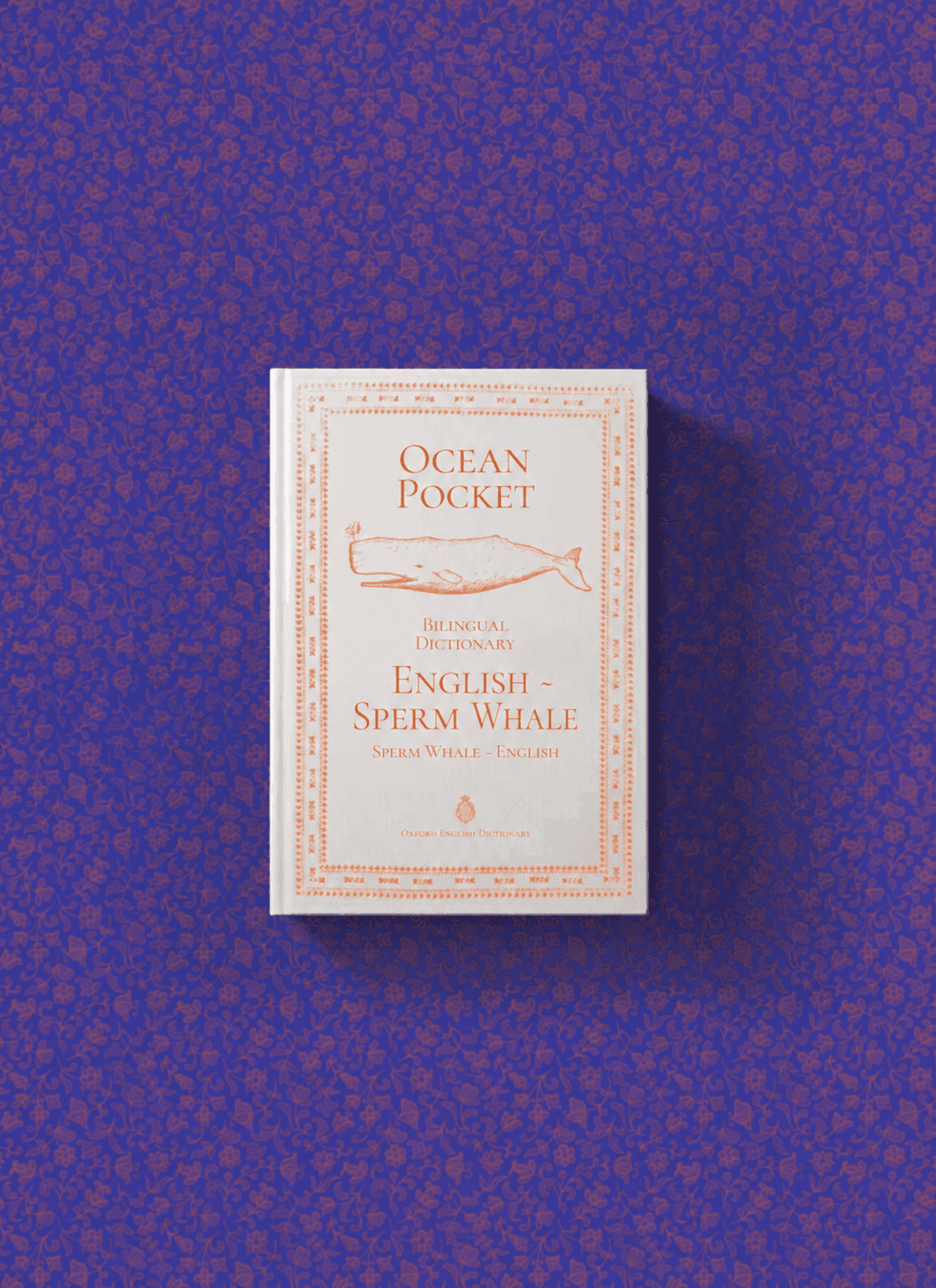
Even the most optimistic perspective will assume that there is, at the very least, a problem of translation. Even if we wanted to ignore Chomsky and claim that there are no other reasons for communication to fail, that it is simply a matter of converting the codes of one language into the codes of another, some transmutation must take place in between. Two different systems of signifiers must approach the same signified. Is that even possible?
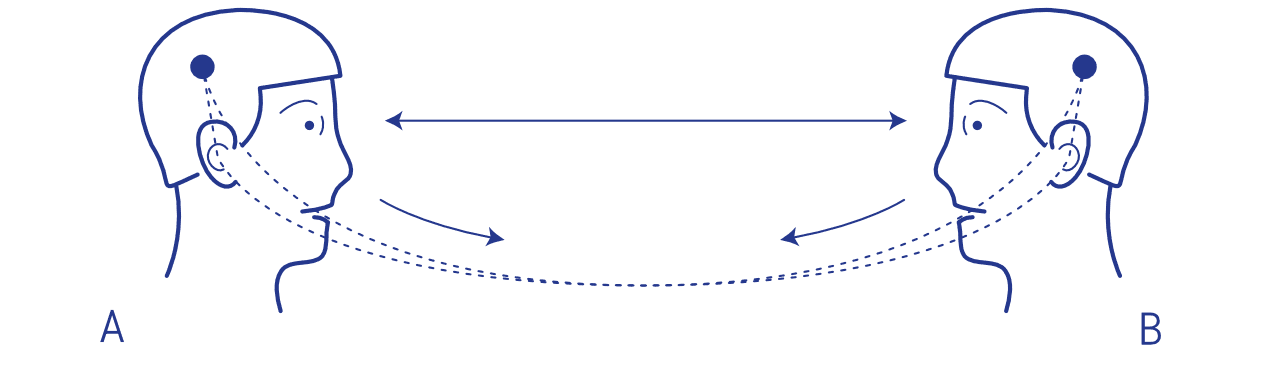
This is what Saussure imagined a communication event between two speakers to be:
Basically, speaker A says a word and B hears it. Both are working with the signifier of that word: an acoustic image, which triggers a concept—that is, a signified. The process repeats in the other direction, and communication proceeds like a kind of metaphysical tennis match.
However, any beaver, elephant, or maned wolf listening to this might ask... Acoustic image? Concept? If a sign is something that re-presents, that is, stands in for something else, trying to define its components sounds like pushing the essence of what one wants to say one step further away, over and over. I can never name “the thing,” but must always name the word that refers to the thing. I can never use language to access the intrinsic nature of the rose, its material reality, because, as Umberto Eco laments: “of the rose, all that remains is the name.” Or perhaps Eco did not personally think that way, but at least that is what the nominalists of the Middle Ages thought, for whom reality was ultimately beyond our reach. However, Eco himself says that this line (nulla rosa est) was originally used by the poet Bernard of Cluny to point not so much to an impossibility as to an extraordinary capacity: language’s ability to refer to things that have disappeared, are untouchable, intangible, and even nonexistent.
What we can explore together is the signifier. The signifier is easier to grasp, since it is triggered in our minds by a stimulus that enters through the senses. We hear the spoken word or see it written. The signified, by contrast, is a matter of dispute. For a signifier to become attached to a signified and the magic of the linguistic sign to happen, some kind of consensus (which is always inherited) must exist. Hence the endless dispute among different human groups over the meaning of things, what symbols represent, and how, in turn, they organize social spheres. Even the word of God, no matter which god we are talking about, is subject to the analysis of exegetes. God has spoken, but what God meant is another matter.
We need an instrumental definition of “meaning,” a kind of Swiss Army knife for surviving in the woods. Any of you might ask: if Saussure’s definition and Wittgenstein’s definition are no use to us, why not use the definition in any dictionary? Because the same thing would happen as when we look up “speech.” We would run into a hygienic convention of little use in this text, where we must distrust words that have spent too long in the freezer: “Meaning is the mental, social, or computational relationship established between a stimulus (word, sound, gesture) and a network of experiences, concepts, or data that makes it possible to interpret the world and act in it.” Does this definition help us communicate with animals? Not much. As far as we’ve been told, animal “language” knows nothing of conventions; it works through a direct, causal relationship between a signal and its meaning: a growl means hostility or a particular song implies seduction because they have a causal or continuous relationship with what they mean. They are a completely different kind of sign from the linguistic one. At first glance, there does not seem to be any arbitrariness, because the real world leaves an imprint on that sign. Does a fox terrier know what “up,” “paws,” “four,” and “wood” mean? It’s possible, but it can’t communicate that. Does it know what “table” means? Unlikely. Does it know what “unlikely” means? At least according to Wittgenstein, that’s impossible.
Then a daring idea emerges: perhaps we don’t need meaning, at least not to start with. Perhaps we shouldn’t wait until we have that elusive ghost trapped between our fingers. Perhaps it’s enough to understand the visible system first, and then see.
For example, let’s take a fundamental concept of Saussure’s that I deliberately set aside until now. I mean the concept of value: Saussure considered each linguistic sign to be an element within a system; it does not float in the air, but exists in relation to other signs. But then we might ask: how is one sign distinguished from another? What makes each one particular? What is its value within the system? Saussure answers these questions with a simple, eloquent idea: a sign’s value within a system is determined by its not being the other signs in the system. In other words, it is a negative value. The example is chess: I can replace the knight with a cork and keep playing, because what matters is not that it look like a horse, but that it not look like a bishop, queen, rook, or pawn. As long as it is a cork but can only move in a certain way, jump, and move a fixed number of squares each time, it will function as a knight, and the properties that apply to none of the other pieces will apply to it. In the same way, what matters in a linguistic system is that each sign is no sign other than itself. “House” is not “home.” It is in constant tension with “home,” since the concepts are somewhat close, but one cannot replace the other within the system. “Hut,” “home,” “mansion,” “shelter,” and so many other words delimit the space occupied by “house” and, in the same act, give it a position within the system.
It should come as no surprise that, a century later, data science proposed a practical method for applying this theory. The method is complex to carry out, but quite easy to describe: let’s freeze a given language at a particular moment and take a cross-section, take a snapshot of all the terms that exist, as if we wanted to write a dictionary but without the definitions. With that information, instead of writing a list, let’s draw a map. An area where each word is located at a coordinate. That coordinate is explained by its proximity to or distance from the others (and the frequency relationships it has with them). If the word is “tree,” the question is not what it means, but where it is on the map. And that depends on a statistic: how many times it appeared near which other words.
Aza Raskin, cofounder of the Earth Species Project, explains this in a talk he gave in San Francisco in 2024. In his own words, the idea is to use artificial intelligence models to translate relationships into distances and directions. The mathematical model Word2vec (“words to vectors”) is an attempt to translate semiology into geometry. The goal? To encode our natural language in a language a machine can understand.
Large language models (LLMs, for their initials in English) are not based on words as we understand them, even though we have complex criteria for defining what a word is. LLMs work with tokens. What is a token? It can be practically any fragment of discourse: word roots, whole words, scraps of phrases, verbal elements crudely mutilated or perfectly dissected. If we give the algorithm enough text—I mean exorbitant amounts—and ask it to determine the probability of one token occurring after another, we get predictive text: that tool that suggests the next word after the one we’ve just typed or guesses which word we were trying to type even if we got it wrong. It is a mere matter of statistics, made possible by the enormous computing power and memory that only computers possess. That is why, for a long time, and until AI began to show certain signs of “reasoning” more like the kind we understand in the human brain, the constant criticism of these systems was that they were “stochastic parrots”—devices capable only of repeating what they had already seen, based on a statistical estimate, without the slightest idea what they were saying. This criticism has deeply offended parrots with its definition, but it is believed they will pay a price for the impertinence: parrots are, in every respect, living beings, a quality we still refuse (for good reason) to grant AI.Note to parrots: we don’t know how much longer we’ll be able to defend this position; things look complicated. Consider fleeing.
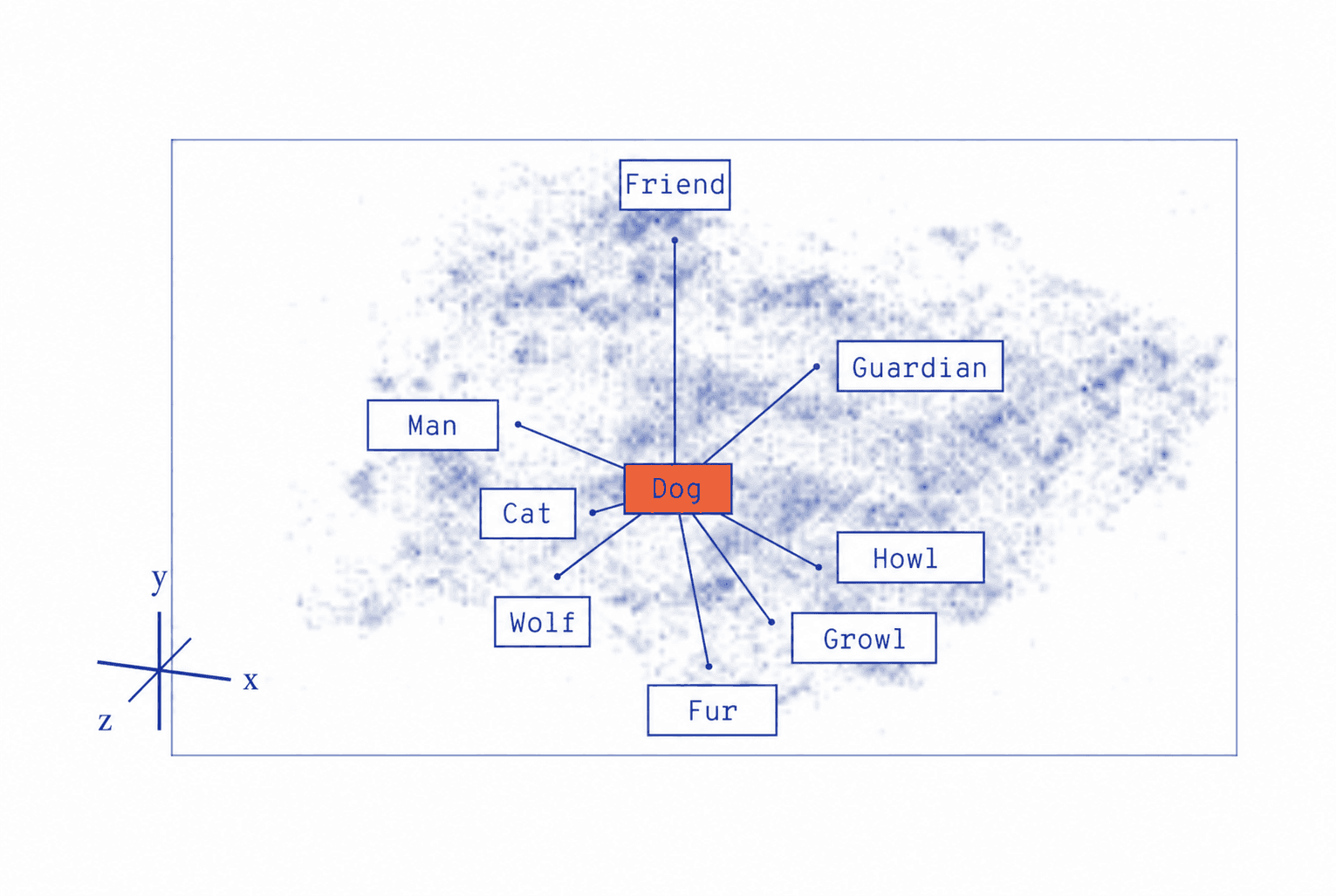
So what happens if we ask AI to turn the entire lexicon of the English language—not into a list, but into a graph mapping the relative position of each term in relation to the other elements of the system? First, a slight shudder would ripple through the dust resting inside Saussure’s tomb. Then, this:
A galaxy of words. A latent space. The real possibility of photographing the chessboard halfway through the game. Something better than a dictionary because it does not form a list in which each signifier is associated with a signified, but a map on which they are placed at just the right distance from one another.
At first glance, it seems like an infallible method, but a closer look might make us suspicious. Where linguistics points to a coin with a signified and a signifier, this method dispenses with the signified and focuses only on mapping the signifier, trusting that the other side of the coin will always be there. Isn’t that perhaps an excessive simplification? Semiotics will say that a third element is needed to associate the two.Note to semiotician animals: unlike Saussure, Charles Sanders Peirce argued that the sign was not actually dual but triadic. Perhaps taking a leap, we could say that the third element Peirce adds is an “interpretive mechanism.” That is, for a sign to be interpreted, it must carry certain laws (established by other signs around it) that determine how that sign can relate to an object. Most of us humans chew through a fair number of pencils before we understand how this works. For the purposes of this book, we can spare ourselves the effort of knowing that this matter exists, but there isn’t room for one more flea on the dog. Wittgenstein’s perspective will say that every instance of a word’s use would have to be exhausted in order to define its meaning. And some irate readers will be seething with other objections I am incapable of conceiving. For now, I’ll say that this method of drawing a vector map, as proposed by data science, is arrogant enough and modest enough to be content with mapping relative distances between concepts in order to translate dissimilar languages. It is a translator that knows neither of the two languages it connects. Or knows them only in their perceptible form and yet aspires to translate. Why? Because it estimates meaning from the frequency of occurrence and the contexts (which other words surround it) in which it is used.
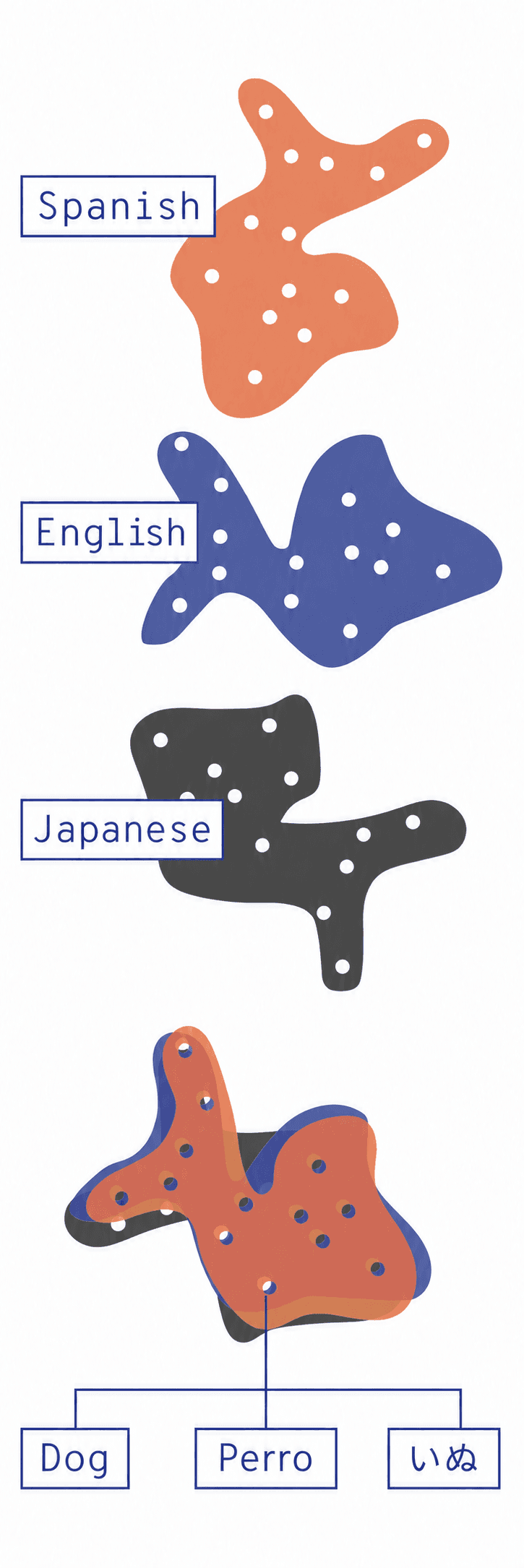
The daring of the method did not end there. Once the sublime terror of seeing all of English condensed into a cloud had passed, the inevitable question arose: what happens if we do the same with other languages? To do so, the researchers simplified the phenomenon (again), compressed the three-dimensional map into a two-dimensional one, and made another important methodological discovery: namely, that this way of mapping the meaning of words produced practically identical maps for very different languages. Maps with the same shape, which only needed to be rotated to match one another, so that the words in each would be located at similar coordinates.
This is known as the language isomorphism hypothesis. And it was soon considered that if all human languages display the same shape, perhaps that tells us something about the deep nature of language, something that could guide us in understanding other codes about which we have little information.
In his presentation, Aza Raskin draws an analogy that may be useful. For centuries, Egyptologists kept banging their heads against the wall, particularly the wall of a pyramid covered in hieroglyphs. Hieroglyphs are a particularly difficult language to decipher because they are not simple visual representations of concepts, but a hybrid system in which each sign can represent a sound, an entire word, or silently indicate the category to which the previous sign belongs. The possible interpretations of those texts—because they were clearly texts, something easy to see from the way one element was placed beside another, inviting us to read them as linguistic signs and not images—branched off and vanished, became entangled, slipped away through the pores of the stones. The language of the ancient Egyptians remained in the dark and, with it, much of their culture was inaccessible, no matter how many mummies and vessels archaeology kept unearthing.
In July 1799, near the Nile Delta, the French captain Pierre-François Bouchard found a giant stone, the famous Rosetta Stone, covered in engraved signs. The stone had one particular feature: it was written in hieroglyphs, in Demotic script (another kind of Egyptian writing, at first glance more like alphabetic writing, though not quite) and in Ancient Greek (koiné), but the meaning of all three texts was the same: a decree by Pharaoh Ptolemy V, published—that is, the stone was set up in a public place so the law could be proclaimed—in the city of Memphis, in 196 BC.
Reproductions of the stone soon began to circulate, and various specialists managed to decipher the ancient Egyptians’ system of hieroglyphs with the help of koiné. In other words, they used a law promulgated in antiquity as a plain old trilingual dictionary.Note to lexicographers: this author acknowledges and appreciates dictionaries, which are beautiful, dynamic, and everlasting devices. Stylistic turns of phrase like “plain old” are meant only to enliven the argument and carry no animosity whatsoever. This footnote deliberately uses extravagant words as a tribute and an offering of peace. In the nineteenth century, valuable things in Africa worked according to a very clear rule: as Mufasa tells Simba in The Lion King, everything the light touches ends up in the British Museum. The Rosetta Stone was no exception, but the knowledge it held spread beyond the imperial islands. Soon afterward, the doors of ancient Egypt opened to modern humans.
Now, the difference between having a Rosetta Stone and an artificial intelligence algorithm is enormous. The stone offers two possible codes (or, in this case, three) and a human being in the middle who translates from one to the other. They interpret the meaning of one system and mediate in order to decode the other. In the case of the algorithm, that role of interpreter is delegated. And to make matters worse, it is delegated to a device whose operation is opaque.Note to Eastern species: in the 1980s, John Searle proposed the Chinese Room thought experiment: a person is locked in a room with a rulebook. A text in Chinese is passed through a slot and, although the person does not understand the language, they translate the characters by following the manual’s instructions to the letter. When they return the result through another slot, everyone thinks the room is intelligent; inside, however, no one understands anything. Searle used this scenario as an argument against the supposed intelligence of artificial intelligence: the man in the Chinese Room, like Silicon Valley algorithms, operates in absolute cognitive darkness. Forty years later, there is still debate over whether the algorithm remains in that darkness or, through sheer repetition, begins to “understand.” In between, a process took place that we cannot see, and it was carried out by an agent we cannot be sure understands it.
Why would we tolerate that system? Why would we pay the price of putting an unreliable intermediary, a blind translator, at the center of the problem? Because we hope that translator will let us talk to animals, of course. Let’s not lose sight of the goal. But perhaps we are flying too close to the sun. Aza Raskin boasted that the system that allowed them to superimpose maps of different languages—and see that they mostly matched in a similar shape—could be entirely generalized to other communication systems. From that point of view, the possibility of establishing coordinates for the meaning of a concept would apply to Japanese, Croatian, and Mapudungun, but also to images, movement, music, programming code, sound, fMRI... “Everything that can be translated will be translated,” he said. Even the many ways in which nonhuman species communicate.
If these claims were proven true, their consequences would be incalculable. But perhaps the process is not as simple as I have just described. To begin with, linguistics and semiotics, as I said at the start, have multiple schools, complexities, and riches that it would be strange to consider resolved by a simple algorithm. But voices of protest arose from zoosemiotics, the discipline that specifically studies animal communication.
Soon after these unsupervised translation models became popular, a group of researchers led by Anders Søgaard, Sebastian Ruder, and Ivan Vulić decided to test this supposed geometric equivalence between languages. The result was a bucket of cold water poured over Silicon Valley’s enthusiasm: maps of human languages are not identical. Far from being twin galaxies, the maps are drastically deformed by the culture, history, and syntax of each language. For example, if we try to align English with radically different languages such as Finnish or Turkish—which bundle grammatical relationships into a single word instead of using separate prepositions—the magic collapses.
This is where the purely algorithmic ambitions of projects like the Earth Species Project hit a wall. Because if the vector galaxies of two human languages—produced by the same species, with the same brain, and under the same physical laws—turn out to be geometrically incompatible, what makes us think that a bonobo’s linguistic topology will fit ours?
The 2025 article “AI and Animal Communication: A Generative Zoosemiotics Perspective,” by Nicola Zengiaro, analyzes some of these cases and argues that animal communication cannot be translated as if it were encrypted, without taking the animal itself into account. Animal signs are intrinsically different from linguistic signs and indivisible from the flesh they inhabit. Trying to put into words what a fish, a bird, or a frog says is to assume that there is a universal meaning that can be joined to different signifiers; it is to forget that not only language, but also our bodies and the environments we live in, are the conditions that make it possible to understand the world. No living being can access meaning in the abstract, but always through the interaction of its body with the outside world, at that boundary where consciousness occurs.
Put another way, Zengiaro’s objection scales down Stanisław Lem’s dilemma: there is no need for a difference in size like the one the scientists in Solaris faced in relation to the ocean they wanted to communicate with. The differences between humans and other species would be vast enough to make that translation impossible. And consequently, all of this—the writing of this book, but also the enthusiasm of reading it—would be nothing more than a fantasy. “Traduttore, traditore” (translator, traitor) goes the Italian saying.
Later, Aza Raskin’s team acknowledged the validity of this objection. Today, the engineers at the Earth Species Project no longer rely solely on processing audio floating in a vacuum. They understood that they need what is known in the jargon as multimodal grounding: cross-referencing sound spectrograms with physical variables. They now know that for artificial intelligence to have any chance of succeeding in its role as a translator, they also need to feed the algorithm videos, motion sensors, and ecological data. In other words, Silicon Valley had to admit that zoosemiotics was right: to understand animal language, we have to pay attention to animals’ bodies again.
Still, the fact that not everything can be done doesn’t mean that nothing can be done. On the one hand, I think of Derrida’s or Haraway’s position, which insists on focusing on human beings’ belonging to the animal kingdom: I refuse to accept that we belong to the same great club of life and yet cannot establish a common code. At some level, the universe is the same for everyone. And if we can’t translate things that are too complex, at least there are phenomena any intelligent being should recognize: gravity, wind, currents, pain, solids. On the other hand, the insistence of zoosemiotics and Chomsky’s generative grammar on how special human language is leads me to believe that if such translation is impossible, then we ought to start accepting certain hierarchies that would make anti-speciesists’ hair stand on end.
At that crossroads, I thought of bats. We’re more like a bat than an ocean or a forest. For starters, we’re mammals, our life expectancies are comparable (a bat lives between 10 and 30 years), our physiological needs are similar, and our environments are comparable: we don’t have to navigate the cosmos, but caves, jungles, and cities. Even without mentioning costumed heroes, we can accept that bats are slightly anthropomorphic. The question is whether this series of coincidences brings us close enough to build a bridge of words. And whether Aza Raskin’s method is the way to do it.
In El nudo de la conciencia, Enzo Tagliazucchi introduces a thought experiment by philosopher Thomas Nagel, in which he proposes trying and failing to feel what it is like to be a bat:
Bats lead lives very different from those most of us lead, and so we can suspect that their perception of the world is also very different from ours. First, they’re nocturnal animals, they eat insects, and they spend most of their time in caves or other dark places. Although some human beings share this kind of behavior, society generally doesn’t consider it healthy. We also know that the limits of chiropteran visual perception are much narrower than ours, but, by way of compensation, they get a substantial bonus in auditory perception. Bats use a spatial navigation mechanism similar to sonar, called echolocation, which is based on emitting sounds and then decoding the structure of their surroundings by analyzing the resulting echo.
The echolocation system is the coup de grâce. No matter how tightly I close my eyes, or how powerfully my imagination makes me feel like a bat, when the time comes to use my hearing the way bats do, I run up against an insurmountable barrier. Not even hanging upside down by my feet and screeching while wrapped in a black cape will bring me close to the subjective experience of being a bat.
But do all human beings need to be able to have that experience for me to consider the species accessible, or is just one enough? In 2002, as part of Project Cyborg 2.0, an English engineer named Kevin Warwick underwent surgery to implant a set of microelectrodes (known as Utah Array) directly into the median nerve in his left arm, connecting his peripheral nervous system to a computer. For a few months, Warwick connected the implant to external ultrasonic sensors mounted on a cap. The sensors measured the distance to objects and sent proportional electrical pulses directly to his nervous system. His brain learned to interpret these signals, allowing him to detect obstacles and perceive distances while blindfolded. Warwick said at the time that thanks to this extrasensory stimulus he could feel “in the same way a bat perceives the world.” Nagel, of course, wouldn’t agree. “It’s not the same!” he might cry. But to some extent it is the same. Or better yet, it’s similar. And similar is all we need. Because if we were trying to communicate with impossible beings, we would have given up before we started. If we’re going to think there’s a way to do it, then we have to allow for the possibility that even utterly dissimilar organisms can meet in some kind of communicative in-between. We have to be able to translate them. We have to be able, against all advice, to try.
In fact, we did.
In 2016, in Professor Yossi Yovel’s lab at Tel Aviv University, a group of researchers had the idea that fruit bats are particularly noisy creatures and that, to the untrained ear, their vocalizations sound like protests. Naturally, the question they asked was: what are they complaining about?
Recording the din inside a bat cave is particularly difficult, so they took 22 individuals and isolated them. Then they recorded them for 75 days, 24 hours a day, with strategically placed cameras and microphones to observe their behavior. By the end of this part of the process, they had a record of no fewer than 10,000 interactions between bats. The research team selected those in which a sound was accompanied by some identifiable behavior, for example: “Bat A tries to take food from Bat B,” or “Bat H climbs on top of Q to sleep.” Then they gave all this information to an artificial intelligence trained to recognize human voices and asked it to process it. As a result, the algorithm learned to separate different types of sounds and associate them with different types of behavior, and was able to identify: a) who the sender was, b) who the complaint was directed at, c) the reason for the complaint, and d) the outcome.
In other words, an algorithm fed a certain (enormous) amount of information classified by human beings was able to determine that fruit bats really do scream to complain, that they don’t scream into the air but at a specific other bat, and that they do it to argue over food, sleeping space, mating, or simply because they’re sleepy. The Tel Aviv experiment showed that bat communication is referential: it has a sender, a recipient, and a specific topic. It’s probably the closest thing to a human conversation found in small mammals. Other studies of bats have even determined that these animals’ “speech” isn’t a purely genetic faculty: they have dialects learned in the colony—that is, their language has a social character that until just a few years ago we thought was exclusive to human beings.
In this way, the first step is complete: it would be possible to build a bridge because there is an “other side.” Bats communicate with each other in a way analogous to our own. Where the researchers in Solaris fail, the beings of Earth can still try.
But we shouldn’t get carried away by the happiness of knowing that a bat is a critter closer to us than an ocean is.Note for anthills: I can’t think of a single work of fiction in which human interaction with a hive mind goes well, except Finding Nemo, when Dory gets friendly directions from a school of little silver fish. That hope, like all human happiness, balances precariously on the tragedy of not knowing the true scale of our loneliness in the cosmos. In my conversation with Matías Grinberg, he was very cautious not to dwell on each of the conditions that would have to be met for an interspecies conversation to take place, but it’s my duty to revisit them while my cat waits for me. Perhaps the two most important conditions, and the ones we most readily choose to forget, are self-awareness (the idea that there is an “I”) and intention (the will to manifest that “I” in the world). In other words, we can try to communicate with other beings who live on our same scale, as long as they possess a degree of consciousness and share the intention to communicate with us.
The objections to Aza Raskin and the adventurers of interspecies communication are entirely valid. But it’s also time to admit something. This isn’t about finding a way to speak with all animals. It’s about finding a way to speak with at least one. So I should say now, in case I haven’t made it clear before, that not all species will be able to enter the agora at first. The tree of life has many branches; not all will be able to speak, and perhaps not all will have something to say. Perhaps we should focus on species that belong to the mammals, with whom we’ve co-evolved for a long time, that don’t live in environments different from ours, and whose bond with us is so strong that no one can claim there’s an abyss between us. What’s more, a species we’re completely sure would speak to us if it could. To the delight of many readers, the next chapter involves dogs.
Un viaje ilustrado acerca de la posibilidad de, algún día, hablar con los animales. Desde océanos pensantes hasta polémicos experimentos con chimpancés, disputas entre murciélagos y ballenas rebeldes. Lingüística, inteligencia artificial, literatura y mundo animal en un ensayo lúdico.
212 páginas. Encuadernación Binder. Impreso a tres tintas (negro + 2 Pantones) con laca sectorizada. 14,5 x 20 cm. Ilustraciones de Belén Kakefuku Del Solar.
Biografía del autor: Juan Cruz Balian nació el 3 de junio de 1984. Es Licenciado en Artes de la Escritura (UNA) y publicó el libro de cuentos Simple e imperfecto, y las novelas Ministerio de Invierno y La pausa.
Una plancha de stickers A5 (14,8 x 21 cm) de animalitos para hermosear cualquier superficie. Hechos en impresión UV sobre vinilo transparente con laca sectorizada.
Ebook Cosas que mi gato tendría que saber$13.900
Un viaje lúdico por la lingüística, la inteligencia artificial, la literatura y el mundo animal. Desde océanos pensantes hasta polémicos experimentos con chimpancés, disputas entre murciélagos y ballenas rebeldes. ¿Podremos algún día hablar con los animales?
Formato .epub y .mobi
Biografía del autor: Juan Cruz Balian nació el 3 de junio de 1984. Es Licenciado en Artes de la Escritura (UNA) y publicó el libro de cuentos Simple e imperfecto, y las novelas Ministerio de Invierno y La pausa.