Discussing the concept of the soul is a pointless exercise. Any debate on the subject will mean fighting over how to draw boundaries around an indistinct blot. Words here act as a mask that supplies features even as it conceals the nature of whoever wears it. Perhaps, when we remove it, we will find nothing. And yet that mask exists because we need something to look at. Comedian Pete Holmes put it better: “God is the name we give to the sheet we drape over a mystery to give it shape”.Note to the clergy: the quote originally came from the road manager of AC/DC, Barry Taylor, who at some point in his life found faith and was ordained a priest. Holmes wonders, with some justification, whether he should not have heard that line in church rather than through the road manager of AC/DC. Rock moves in mysterious ways. Something similar, then, happens with the soul. In the first chapter, I already mentioned the critique of an entire philosophical tradition for its unfounded subordination of the animal realm to the human realm. Part of that tradition insisted that a lack of articulated language amounted to a lack of reason, and a lack of reason to a lack of a soul. And the lack of a soul, as everyone knows, gives license for all kinds of atrocities. But today we know that, like dolphins, dogs are sentient even if they do not use subjects and predicates, and that is even more valuable, since consciousness can be studied scientifically, whereas the soul is purely a matter of faith: the sheet we pull over ourselves when our helplessness is so great that not even science can shelter us.
But I am not the one—and my cat certainly will not be either—to fling myself weeping around a horse's neck to ask its forgiveness for what Descartes said, as the philosopher Friedrich Nietzsche is said to have done once. There are two reasons for our restraint: first and foremost, we are not sure there is even such a thing as a soul, because we are atheists—I am one by choice; my cat, I assume, is one too, but because he is incapable of abstract thought—. The second reason is that Nietzsche threw his arms around the horse and wept while the exhausted animal was being whipped by a coachman, but then Nietzsche lost consciousness and in the years that followed lapsed into a fairly severe state of dementia, something my cat and I would rather avoid.
By contrast, around the same time—barely ten years later—Jack London did something far more convincing as an argument for consciousness in dogs. He wrote The Call of the Wild, a novel about Buck, a lazy, bourgeois dog, domesticated to the point of perpetual languor, charged with guarding a house where nothing ever happens, who is stolen one night and sold as a sled dog. As soon as the story begins, Buck's misfortunes go from bad to worse: he must learn to deal with masters of every kind, cruel and kind, skilled and clumsy, sensible and mad. He must learn to fight his own packmates for food and rank. He must learn to hunt, to pull a sled on impossible journeys through the Yukon, to fight duels—fang against fang—and to dig holes in the snow to sleep in, anticipating which way the wind will blow before dawn if he does not want to freeze to death. While all this is happening, Buck's domestication begins to fade. Every step along the way takes him further and further from his former life: he unlearns humanity and remembers with growing clarity what nature seared into his species. And when he finally finds a good master who is also a companion, with whom the prospect of an excellent, wandering life opens up, he ends up abandoning him. Why does Buck do that? Why does he break the sacred bond between man and dog just when he seemed about to reach the pinnacle of friendship? Because he lets himself be seduced by a pack of wolves who draw him in and make him one of their own, to live free among equals. Does he choose it, or can he not help himself? Hard to say. All we can say is that Buck finally answers the call of the wild.
I say this book makes a better argument for the soul (or consciousness, call it what you like) of dogs because, to write it, the author applies—without knowing it, since the term would not be coined until many decades later—theory of mind: the ability to attribute desires and beliefs, that is, mental states, to other beings, whether or not they belong to the same species.
The charm of The Call of the Wild lies in the fact that the story is not told in the first person, from the dog's point of view, but is focused on him. That is, the narrative device sidesteps the responsibility of “making Buck speak”, which would have completely destroyed any sense of verisimilitude. Instead, the one speaking to us is a human narrator who peers into what is happening in Buck's mind and tries to explain it as best he can in his own words. He posits a mind, and all the possible states associated with it: fear, longing, anticipation, anxiety, difficulty understanding what humans say, the orders they give him. London frequently introduces foreign characters who speak other languages or complex dialects, making human language strange or incomprehensible to readers too, further reinforcing their alignment with the dog's point of view. And, using a less realistic but extremely eloquent device, he places in Buck's mind dreams of primeval times, when the world was taking shape and animals, including us, lived in a state of nature. The result is a novel that creates the feeling of experiencing the world through Buck's mind. Even if what Thomas Nagel said (and Tagliazucchi revisits) about the impossibility of knowing what it is like to be a bat is true, in the dog's case, and within the bounds of the reading pact the novel establishes, it seems that the experience can be conveyed. At least that is how London makes us feel. Humans and dogs have so many years of shared evolution behind us that, even before theory of mind was formulated or brain-imaging instruments were invented,Note to humans: two years before The Call of the Wild was published, Sigmund Freud had published his theory of the unconscious. We cannot know whether London was familiar with Freud's work, and the truth is that neither man's work has the rigor we demand of a scientific assertion today, but these are intuitions on which cathedrals of knowledge have been built. London was able to put into words extraordinarily accurate intuitions about possible canine consciousness. Even when he took risks. For example, in this passage, where Buck wins a duel against a violent dog named Spitz:
Fang clashed fang, and lips were cut and bleeding, but Buck could not find an opening in his enemy's defenses. Then he grew fierce and enveloped Spitz in a whirlwind of attacks. Again and again he tried for that white throat, where life bubbled just beneath the skin, but Spitz tore at him with his teeth and drew back. […] Yet Buck possessed a quality that contributed to his excellence: imagination. He fought by instinct, but he could also fight with his head. He attacked as if attempting the old shoulder trick, but at the last instant crouched low in the snow, and his teeth closed on Spitz's foreleg. There was a crunch of breaking bones…
Decades would pass before humanity confirmed that dogs do indeed have imagination, understanding imagination as the ability to conjure up things that are absent. For example, that they go through phases of REM sleep in which brain activity in the hippocampus is identical to their activity when awake and doing things like running, fighting, or looking for something. Also, that they can engage in “tactical deception”, like the trick Buck uses to defeat Spitz. Let us pause here. Marianne Heberlein, at the University of Zurich, conducted an experiment in which dogs interacted with two humans: one “cooperative” (who gave them food) and another “competitive” (who kept the food). The dogs had to lead these people to one of three boxes: one containing a sausage, another a dry biscuit, and an empty one. After realizing that the competitive human kept the reward, the dogs began leading the competitor to the empty box more often, saving the sausage's location for their interactions with the cooperative human. This would suggest that dogs' brains, like ours, “simulate” realities that are not present; that is, they can model the world: imagine two parallel scenarios in which different hypothetical actions lead to different outcomes. However, more skeptical contemporary researchers suggest that this kind of behavior does not constitute a “lie” based on reading another's mind, but rather complex conditioning. The dog might simply have learned that “pointing human X toward box A does not result in food, but pointing them toward box B does”. In other words, there would be no mental representation of “deception”, no intention to plant a false belief in another mind, but rather an optimization of outcomes based on trial and error.
This forces us to split the problem of intention into two parts. On the one hand, we must ask whether dogs can interpret others' intentions. This part is relatively easy, insofar as there is also an experiment designed for that purpose. It is called unable vs. unwilling: it involves placing a dogNote to apes: this was also done with chimpanzees, but the memory of Nim is still fresh in these pages, and I would rather not talk about it. behind a pane of glass and having a human try to give it tasty food—sausages, say—through a tiny window. In one case, the human tries to pass the sausages to the dog through the tiny window but changes their mind at the last moment and withholds them. As a result, the dog tends to grow impatient, move away from the glass, and protest. In the second case, the human acts as though they intend to give the dog the treat but fails—the window is too small—and cannot do it. Then the dog is much more patient and willing to wait, or even help by giving the human cues.
These results imply that dogs have a considerable ability to read our mental states, attribute intentions to us, and respond accordingly. Even to adjust their emotional response and frustration to two scenarios that are similar but very different: the human wanted to give me food and could not vs. the human refused to give me the food. But can they “manipulate” those intentions? Can they take actions that allow their intentions to prevail over ours through an elaborate deception?
Once again, communication between humans and dogs is frequent and runs extremely smoothly—we know that dogs understand more than 200 words, and we know how to read their body language—but it seems unlikely that the two species will ever meet in a common language. If a dog can engage in tactical deception, it is operating at an enormous level of complexity, but it is still incapable of using propositional language, articulating subjects and predicates, making complex abstractions. Wittgenstein asks: “The dog is waiting for his master. But can he expect his master to come the day after tomorrow?”. The answer is no, because for Wittgenstein, complex (prospective) imagination is anchored in the grammar of language. A dog can “imagine” its owner's return because there are signs in the present (the sound of keys), but it cannot imagine an abstract concept like Tuesday or retirement, because it lacks the linguistic structure to sustain that thought.
Does this mean dogs will never be able to have a conversation with us? Never is a very big word. In my conversation with Matías Grinberg, he had proposed the idea that intelligence is a space where things have different resolutions. Dogs and humans look at the same space with our minds, but where dogs can only make out a blurry patch called the future, we can distinguish a multitude of details that mean tomorrow, in a little while, next year, or two moons from now. For that reason, and because of the additional phonological obstacle (dogs can only produce a very limited range of sounds), establishing a true translator between dogs and humans would require us to use MRI machines or other neuroimaging devices (like the ones Gabo Mindlin uses on birds to learn about their nightmares) to translate images directly from canine brains into a language intelligible to us, and vice versa. We could even dream that this practice might act as a kind of environmental pressure, expanding canine consciousness, slowly pushing the species to gain resolution in its mental space, to “evolve”. But if what came before was speculation, this is sending the ball even farther.
Of course, once I had set off speculating, and perhaps spurred on by Matías's optimism and Gabo's clairvoyance, I did not find it inconceivable that Wittgenstein's brainy musings might reveal weaknesses when tested against some fieldwork. Nor did I want to take it for granted that merely consulting papers and theory would be enough for me to understand such a complex subject—especially considering that my cat will someday have quivering questions to ask me about dogs—so I decided to abuse someone else's time once again. In this case, the morning hours of Laura Rial, a veterinarian and doctoral fellow in the Canid Behavior Research Group (CONICET), where they have been studying comparative psychology, animal behavior, and animal welfare for more than twenty years. We met at a café for a conversation that would end up running beyond the time we had scheduled. Laura's doctoral thesis aims to understand whether dogs can (and want to) comfort a human subject after that person has had a conflict with another human being or when they experience a negative emotion such as sadness or fear. Preliminary results indicate that they can. There is a core of empathy that connects us living beings—or at least us mammals—which, Laura told me, is called “emotional contagion” and prompts “prosocial behaviors”, but predates all verbal language. However, when I tried to ask her the questions that had kept me up at night throughout this chapter, I ran into problems. Laura could assure me that dogs think, model, imagine, and have theory of mind. In other words, they have everything they need to lie. But do they lie? That is harder to answer, since there are no specific experiments aimed at answering that question, at least in the terms in which we frame it.
The main problem Laura points out is that, despite living alongside dogs every day, we know very little about them. Between 70 % and 80 % of the world's canine populations live in free-living societies, and only a small group have become pets. The difference between those populations and urban pets is enormous. And yet most studies focus on the latter, which were raised in environments heavily mediated by human presence. So much so that a dog's caregiver invariably becomes its attachment figure and therefore cannot be replaced by members of its own species. In these cases, the canid will always prefer its human. In cases like Buck's, it will surrender to the call of free-living societies.
Pressed for an opinion, Laura agrees with Wittgenstein and believes that complex dialogue between dogs and humans—the kind we dream of and are sold in ads for Chinese apps that translate your pet—is impossible. There is a gulf between us that is ultimately unbridgeable. But she focuses on listening. Not just because of the most obvious physical issue—the fact that dogs operate at sound frequencies our ears cannot perceive—but also because of our inability to listen and our stubborn insistence on turning everything we hear into a kind of bad translation. Once again, the critique of anthropomorphizing. Besides, she adds, to take on that challenge we would have to unlearn much of what we already think we know. Tear down a collection of biases built up over a very long time. Though it is worth stressing again that none of this prevents nonverbal communication, which, as we have seen, can happen through other means.
My main takeaway from all this is the idea that a dog can deceive but cannot lie, understanding lying as a more sophisticated form of deception because it requires linguistic skills. Once again, reality seems to lie somewhere in between, as though interspecies communication were doomed to happen halfway. In Laura's words: “Perhaps dogs have everything they need to lie, but even so, how would they do it? Even if they could conceive of a lie, they could not communicate it”. And this is a problem for what my cat and I want to achieve, because that ability to construct a lie and communicate it is probably the very foundation of a real conversation.Note to dolphins: male dolphins sometimes use lies to find a mate by whistling false alarm calls (the sound they make when there is a shark nearby) just as a female tries to leave the group. The aim is for the female, frightened by the imaginary predator, to stay close to the male who sounded the alarm, giving him a reproductive advantage. We humans describe that as toxic behavior. Don't be toxic, brolphin.
Un viaje ilustrado acerca de la posibilidad de, algún día, hablar con los animales. Desde océanos pensantes hasta polémicos experimentos con chimpancés, disputas entre murciélagos y ballenas rebeldes. Lingüística, inteligencia artificial, literatura y mundo animal en un ensayo lúdico.
212 páginas. Encuadernación Binder. Impreso a tres tintas (negro + 2 Pantones) con laca sectorizada. 14,5 x 20 cm. Ilustraciones de Belén Kakefuku Del Solar.
Biografía del autor: Juan Cruz Balian nació el 3 de junio de 1984. Es Licenciado en Artes de la Escritura (UNA) y publicó el libro de cuentos Simple e imperfecto, y las novelas Ministerio de Invierno y La pausa.
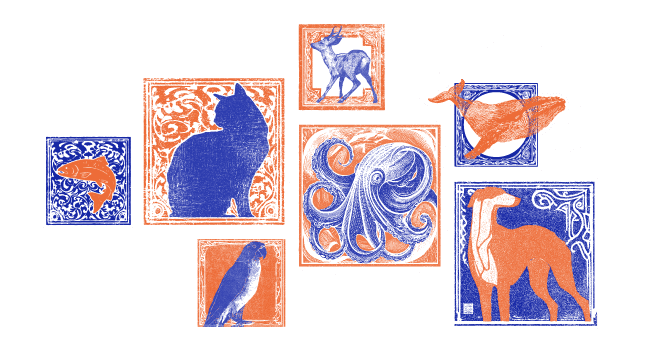
Una plancha de stickers A5 (14,8 x 21 cm) de animalitos para hermosear cualquier superficie. Hechos en impresión UV sobre vinilo transparente con laca sectorizada.
Ebook Cosas que mi gato tendría que saber$13.900
Un viaje lúdico por la lingüística, la inteligencia artificial, la literatura y el mundo animal. Desde océanos pensantes hasta polémicos experimentos con chimpancés, disputas entre murciélagos y ballenas rebeldes. ¿Podremos algún día hablar con los animales?
Formato .epub y .mobi
Biografía del autor: Juan Cruz Balian nació el 3 de junio de 1984. Es Licenciado en Artes de la Escritura (UNA) y publicó el libro de cuentos Simple e imperfecto, y las novelas Ministerio de Invierno y La pausa.