By now, there’s no doubt that thought and language are closely linked. They’re so intertwined that analyzing one often reveals things about the other. What part of human language is so unique and privileged that we can’t find it in other species? This question forces us to return to Chomsky—not now in his almost-ridiculed public persona (or to argue over the news about his life), but to consider his work seriously.
As we’ve seen, for Chomsky, animal language and human language are utterly irreconcilable. And to prove it, he became obsessed with finding a “universal grammar”: the principles that would explain how human language works at its most basic levels, a set of rules that would be the same for all languages. Not rules specific to each code—English, German, Greek, Swahili—but a kind of thermodynamics of verbal communication. The very foundations on which we build our empire of reason.
It’s important to point out two things here. First, when Chomsky wrote the first version of his theories, “universal” meant “all human beings,” not “all conscious beings,” much less “all living beings.” After what happened with Nim, even his boldest detractors didn’t dare challenge this part of his thinking. At best, the idea that a nonhuman species could have an articulated language equivalent to humans’ would be like expecting someone from outside planet Earth to win the Miss Universe pageant: technically possible, highly improbable. Second, as I’ve already mentioned, Chomsky starts from the conviction that human beings have a language-processing center in the brain—whether centralized in a group of specialized neurons or not doesn’t matter—that we’re born with it, and that we’re therefore destined—barring specific illnesses or other exceptions—to develop the faculty of language. For the American researcher, an experimental child whom no one deliberately taught to speak or exposed to adults’ articulated language could at least create the rudiments of a language. And those rudiments could only emerge within the rigid limits of universal grammar, laws no one can escape. In other words: if Nim had had a language-processing module in his brain, he would have learned something of human language through mere exposure, even if no one had taught it to him.
In 1965, Chomsky tried to explain how this reality of language was anchored in our biological reality and developed his first theory on the subject, the standard theory. Basically, this theory assumes that there is a deep structure in the brain where meaning is generated and then, through a series of rules and operations, blocks are assembled until they reach the surface structure—that is, the sentence in its final form, ready to be uttered. Here, the heart of language is syntax, beating beneath all structures. It’s the secret machinery governing how we can combine words to make larger structures, give each one its place, group them into intermediate constituents, and play at moving them around, whether or not changing the meaning of the sentence. Say words, yes, but say them in a logical order. Say them in a logical order, yes, but a hierarchical one, like someone building a pyramid out of wooden blocks. At this stage, Chomsky’s main aim was to align himself with the natural sciences, to establish a theory explaining why a language grows in us the way arms do, regardless of where in the world we’re born and grow up.Note for academics: Chomsky argued that linguistics should be studied in the natural sciences faculties, although linguists preferred to stay in the arts and humanities faculties. To understand that decision, we’d have to find out which department at MIT threw the best parties.
For some reason, syntax is a difficult field of study for most students (myself included), and it’s one of the first disciplines people choose to ignore. Understanding the syntax of your own language means becoming conscious of knowledge you already possess, apply every day, and use with grace most of the time, but whose workings are hard to explain—like pilots performing complex aerobatics in planes without the slightest notion of aerodynamics. But don’t despair. Syntax is one of those riddles that seem obvious once you know the answer.Note for all species: the first to come up with this idea was Gandalf the Gray, a powerful wizard whom we can’t consider human, but can consider one of the wisest men who, according to a certain mythology, may ever have walked the Earth. And, at least for students of this noble discipline, the answer is the heads.
Everything in syntax starts from a head that expands. And according to the Bible, the first thing is the Word. The verb is the head of the sentence, and everything is organized around it. In fact, nonverbal sentences—“How hot!”—are of little interest to syntax (though they’ll become hugely interesting to the study of language developed by pragmatists, as we’ll see in another chapter). What always matters is finding that head. Let’s try a sentence:
[Los lobos grises aullaron a la luna llena desde la cima de la montaña.]
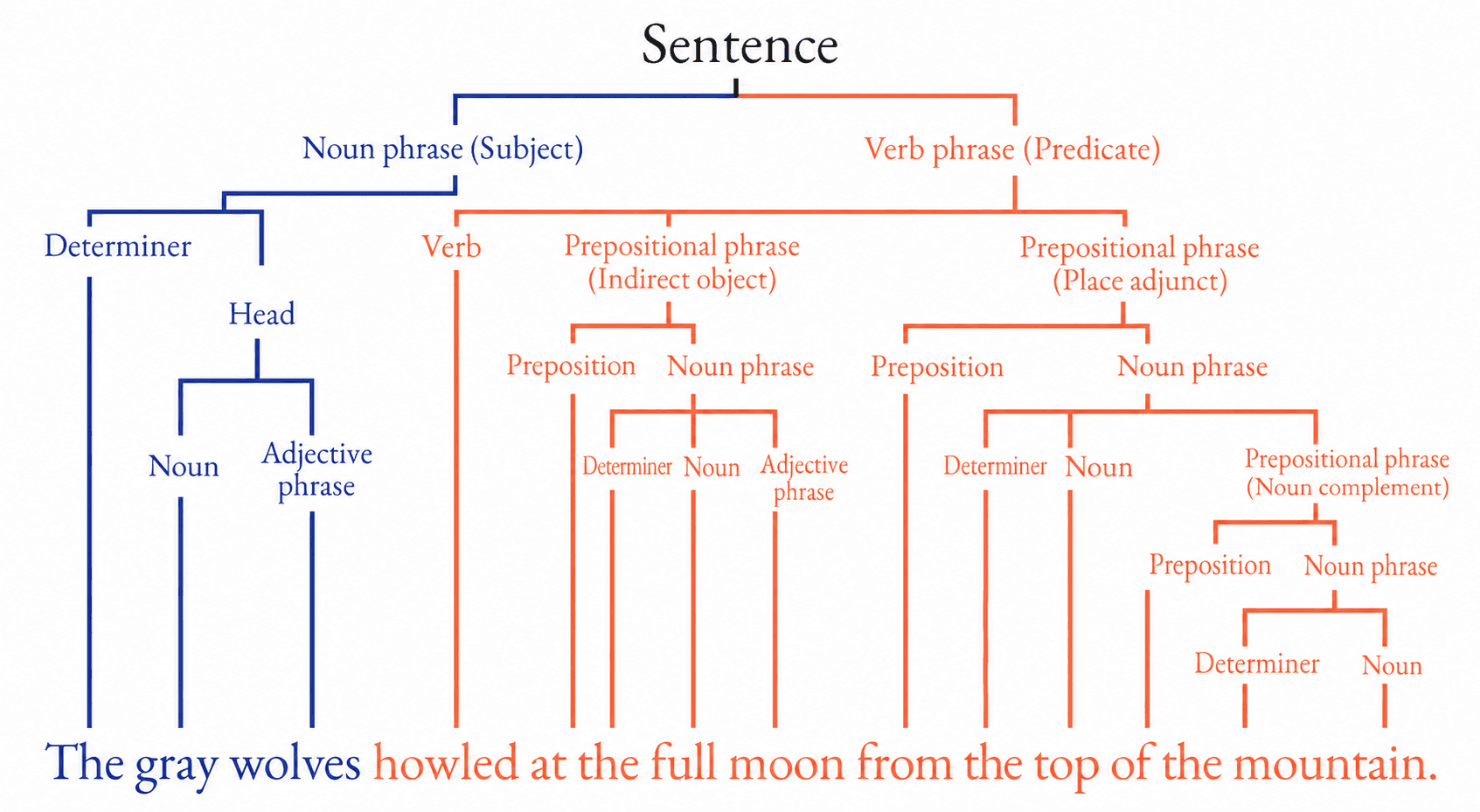
The main head is right there in plain sight. Because the verb [howled] carries grammatical information (number, person, tense), I can identify the other major phrase in the sentence: [The gray wolves], which would be the subject. Then we have [at the full moon] and [from the top of the mountain], which, together with the verb, form the predicate and are phrases that provide extra information about that howl: what its target was, where it happened, and under what circumstances. That’s why they’re called adverbials.
In the end, the sentence analysis would look like this:
As you can see, the unit syntax cares most about isn’t the word but the phrase, which can be a complete sentence or an intermediate construction, a segment that can be moved around and occupy different places as long as it still fits correctly with the others so the bridge doesn’t collapse:
[Los lobos grises] [aullaron] [a la luna llena] [desde la montaña]u003cbru003eu003cbru003e[aullaron] [a la luna llena] [Los lobos grises] [desde la montaña]u003cbru003eu003cbru003e[desde la montaña] [Los lobos grises] [aullaron] [a la luna llena]
It’s a game of blocks. What you can’t do is scramble the words in such a way that the blocks break:
*[Los lobos] [desde aullaron] [la montaña] [a la luna][grises] [llena]
Now, thanks to a range of resources (prepositions, pronouns, conjunctions), syntax can combine concepts to make new ideas emerge. Subordinate one within another, coordinate them, set them against each other. Raise the complexity of the utterance until it becomes dizzying. For example, with infinite recursion:
[The man was playing with cards that had been brought from Spain, which was at war with France, where playing cards were made that belonged to a different deck because it had been designed by a man who was playing with cards brought from Spain…]
This capacity of syntax is one of the most remarkable features of language and can quickly become an insurmountable challenge for any brain. But it’s not all anguish and frustration. The best-known example of infinite recursion is that song that goes:Note for humans, seals, sea lions, and chimpanzees: clap twice at the end of each verse.
There's a hole in the bottom of the sea,u003cbru003eThere's a hole in the bottom of the sea,u003cbru003eThere's a hole, there's a hole, there's a hole in the bottom of the sea.u003cbru003eu003cbru003eThere's a stick in the hole in the bottom of the sea,u003cbru003eThere's a stick in the hole in the bottom of the sea,u003cbru003eThere's a stick, there's a stick, there's a stick in the hole in the bottom of the sea.u003cbru003eu003cbru003eThere's a toad on a stick in the hole in the bottom of the sea,u003cbru003eThere's a toad on a stick in the hole in the bottom of the sea,u003cbru003eThere's a toad, there's a toad, there's a toad on a stick in the hole in the bottom of the sea.u003cbru003eu003cbru003eThere's an eye on a toad on a stick in the hole in the bottom of the sea,u003cbru003eThere's an eye on a toad on a stick in the hole in the bottom of the sea,u003cbru003eThere's an eye, there's an eye, there's an eye on a toad on a stick in the hole in the bottom of the sea.u003cbru003eu003cbru003eThere's a hair on an eye on a toad on a stick in the hole in the bottom of the sea,u003cbru003eThere's a hair on an eye on a toad on a stick in the hole in the bottom of the sea,u003cbru003eThere's a hair, there's a hair, there's a hair on an eye on a toad on a stick in the hole in the bottom of the sea.u003cbru003eu003cbru003eThere's a louse in the hair on an eye on a toad on a stick in the hole in the bottom of the sea,u003cbru003eThere's a louse in the hair on an eye on a toad on a stick in the hole in the bottom of the sea,u003cbru003eThere's a louse, there's a louse, there's a louse in the hair on an eye on a toad on a stick in the hole in the bottom of the sea.
The evidence suggests that nonhuman animals can use referential language, but are incapable of mastering complex syntactic structures. And that’s an insurmountable problem for our purpose, because so far it seems that syntax is the fire in which our thought is cooked, the magic spoon that lets us generate an infinite number of sentences from a finite set of elements and then fish ideas out of the depths of our brain. It’s our machine for creating infinite meanings. To prove it, Chomsky pointed out that we can understand and generate sentences that have never been conceived in human history. As an example, he himself coined a grammatically perfect but semantically absurd sentence: “Colorless green ideas sleep furiously.” Our brain recognizes the structure even though the image makes no sense. The argument is so convincing and the example so clear that over the years this one-of-a-kind sentence has been repeated countless times.Note for heptapods: this fact is irrelevant to you.
Much later—in 1983, after the whole business with Nim had happened—Chomsky decided his theory was too cumbersome: instead of conceiving of brains that have to perform a thousand transformations to produce a sentence according to the language they’re operating in, he proposed that all languages share the same basic principles (unbreakable universal rules, like “every sentence must have a head”) and that those principles inhabit the very structure of our brain. Differences between languages and dialects would correspond to parameters, a kind of light switches (on/off) that vary according to the language a person hears while growing up. A clear example of this would be the category of subject: Is a language without subjects conceivable? It isn’t. That’s a principle. But the way the subject is expressed in a sentence can take different parameters depending on the language: in English I have to express it, whereas in Spanish I can leave it unspoken, thanks to the fact that person and number are marked on the inflected verb. For example, in English we have to say “I am going to talk to a spider”; it’s not possible to say simply “going to talk to a spider” (except in particular contexts where speech breaks the rules by taking advantage of the fact that the conversation’s context supplies the missing information). In Spanish, I can say only the predicate: “voy a hablar con una araña,” since the verb “voy” already indicates that it’s me, just as “vas” indicates you (vos), and “va” indicates he or she. Same principle, different parameters.
Unfortunately, this theory, which sounded very convincing to many people, seemed defective to Chomsky himself. He was looking for a way to explain the connection between the deep mind and the surface of speech, and he believed the secret had to lie in evolution, since, as we’ve seen, only our species evolved in such a way as to turn thoughts into words. If all humans have a universal grammar within us, inherited and latent from the moment we’re born, which expresses itself and takes shape very quickly in the first years of our lives, that universal grammar must have simple rules. It couldn’t include all the ad hoc mechanisms developed by the theory of principles and parameters. Why? Because the speaking human species is a recent animal in the history of life; there wasn’t time to develop machinery as complicated as the kind he was imagining. He needed to find a single function deep in our brain that could give rise to the whole palace of language.
Chomsky still had one last arrow in Chomsky's quiver, of course: his final thesis. The Minimalist Program is a more streamlined version of his earlier theories and seeks to answer one question: what is the most perfect, economical, and simple design possible for the brain to conceive an utterance?
To answer it, he proposed a key concept: Merge. A mathematical principle, a computational engine, a blind center for language generation where there is not yet any meaning (that will emerge later, delegated to other areas of the brain), but only a single logical and syntactic operation. Merge simply takes two elements (e.g., “the” + “dog”) and joins them to form a new one (“the dog”). Then it takes that block and joins it with another (e.g., “runs”), and so on, building the syntactic tree we saw from the bottom up. In this way, a sentence is born as a purely mental architecture, buried in the depths of the immensely powerful human brain, and through a series of computational processes it is translated outward until it finally takes the form of an utterance spoken aloud or, at least, consciously thought in accordance with the rules of the speaker’s language.
This capacity for assembling—joining, interleaving, and nesting terms to enrich an utterance from the bottom up, like someone simmering an improbable stew—would in principle be infinite. It would be limited only by the speaker’s memory, but this time it would finally be an undeniable human quality. None of the species studied would have a similar capacity.
But then we started studying starlings.
For the purposes of writing this book, I had already requested an interview with researcher Gabriel Mindlin. He received me one sunny afternoon at Pavilion I on the Ciudad Universitaria campus. Summer had just begun, and we walked along quiet corridors, where here and there you could glimpse people absorbed in research that doesn’t take time off.
With great generosity, Gabo—as he asked me to call him—shared his work on birdsong with me. Over the years, he had been able to establish that the songs of certain bird species can be manipulated by humans. That is: we can record them, cut them up, generate new melodies with artificial intelligence, and expose birds to those new songs. In the nature vs. nurture debate, his discovery corroborates the experience with Nim: birds can learn new sound sequences, but they can’t do anything new with them except repeat them. And when key moments in their lives arrive—mating, the announcement of danger, the approach of winter—they abandon all the songs learned through human intervention and go back to singing the ones they’ve always known. On a “cultural” level—Gabo uses the word freely, and it seems valid—what happened is beautiful: his team recovered old lost hits from the ’60s, reconstructed them with AI, and reintroduced them into nightingale populations by placing discreet speakers hidden in their habitats. After listening to the recordings for a while, the nightingales started singing again the music that had been lost decades earlier through the mere ebb and flow of populations and their fortunes. Gabo told me about it with a smile, amazed by his own work and team, like a music influencer who manages to make tango fashionable again among young trap artists.
He also showed me how a musical phrase is drawn, the trio of muscles birds combine to sing (they can produce more than 4,000 notes), and gave me a warm introductory lesson on interacting with other animals. He even told me about the imaging procedure that lets researchers find out when a bird is having a nightmare and what the nightmare is about.Note for avian therapists: the method is based on selecting species capable of learning, whose brains are very neatly mapped in terms of parts and roles: by measuring the activity of a part assigned to a role (for example, singing or giving an alarm call) while the bird is awake, the same measurements can then be compared with those taken during sleep, making it possible to infer the neural activity specific to nightmares and to each nightmare scenario. According to Gabo, when the night's neural activity closely reproduced that of the day, it was possible to interpret the content of the nightmares. When new neural patterns appeared, it was no longer possible, because the process would then require us to know “the language of neurons,” which we still don’t.
Sooner rather than later, I started to forget why I’d gone there. Now I only wanted to know about the birds’ nightmares and the science that lets us read them. But that wasn’t what I’d gone looking for. What they did at the university wasn’t talking to animals. It’s true that it had the merit of playing with their languages, not ours. It also showed a first productive use of AI. But the truth is, I got up from the table a little more confused than before.
That was when Gabo, to help with my investigation, told me about a paper published in the US on starlings. The paper’s aim was, once again, to take issue with Chomsky. But this time, from a much humbler and more respectful position. Its authors set a clear goal: to understand whether other species could distinguish a sequence of sounds built according to rules of recursion (something we’d believed only humans could do until now) from a simple repeated sequence of sounds. They chose starlings.
The researchers isolated eight sound motifs consisting of warbles and eight of rattles characteristic of these animals, and assigned a letter to each type: A and B. Using these pieces, they distinguished two kinds of structures. The first followed a simple rule in which the mechanism for building sequences consisted simply of adding new elements to the end of the chain, creating an ABAB pattern. Like making a pearl necklace by alternating one color with the other: a purely linear, repetitive rule. The second kind of structure, by contrast, was more complex and recursive: its phrases were generated by inserting or nesting new sound blocks right in the middle of the previous phrase. To create an AABB pattern, the original block (AB) was “opened” in the middle and something else was inserted inside it (A-[AB]-B). The key point is that understanding this would mean perceiving a hidden hierarchy, not just memorizing a sequence. The researchers then trained eleven starlings, using a reward system, to distinguish between the two types of structure, which we might think of as simple syntax and complex syntax. Finally, after a great deal of time and work, nine of the eleven birds managed to learn the task.
The researchers took some precautions that would be tedious to go through here, but whose worthy aim was to prove that the starlings weren’t using simple strategies to fool the researchers, but were actually recognizing the central structure of the proposed grammar. The rails of this essay invite us not to linger too long at every station, so I’ll skip to the conclusion, which is why Gabo told me about the paper: the study showed that starlings can recognize acoustic patterns structured by recursive rules, which means that this faculty can no longer be said to be exclusive to humans.
Of course, as a victory, it feels a little underwhelming. To make language flourish, mastering recursion isn’t enough. Just compare the smartest starling with the dumbest human to see that we have more complex equipment, so Chomsky’s central position seems to hold, even if, in the specific case of recursion, the feathered rascals match us. At least now we can do two things:
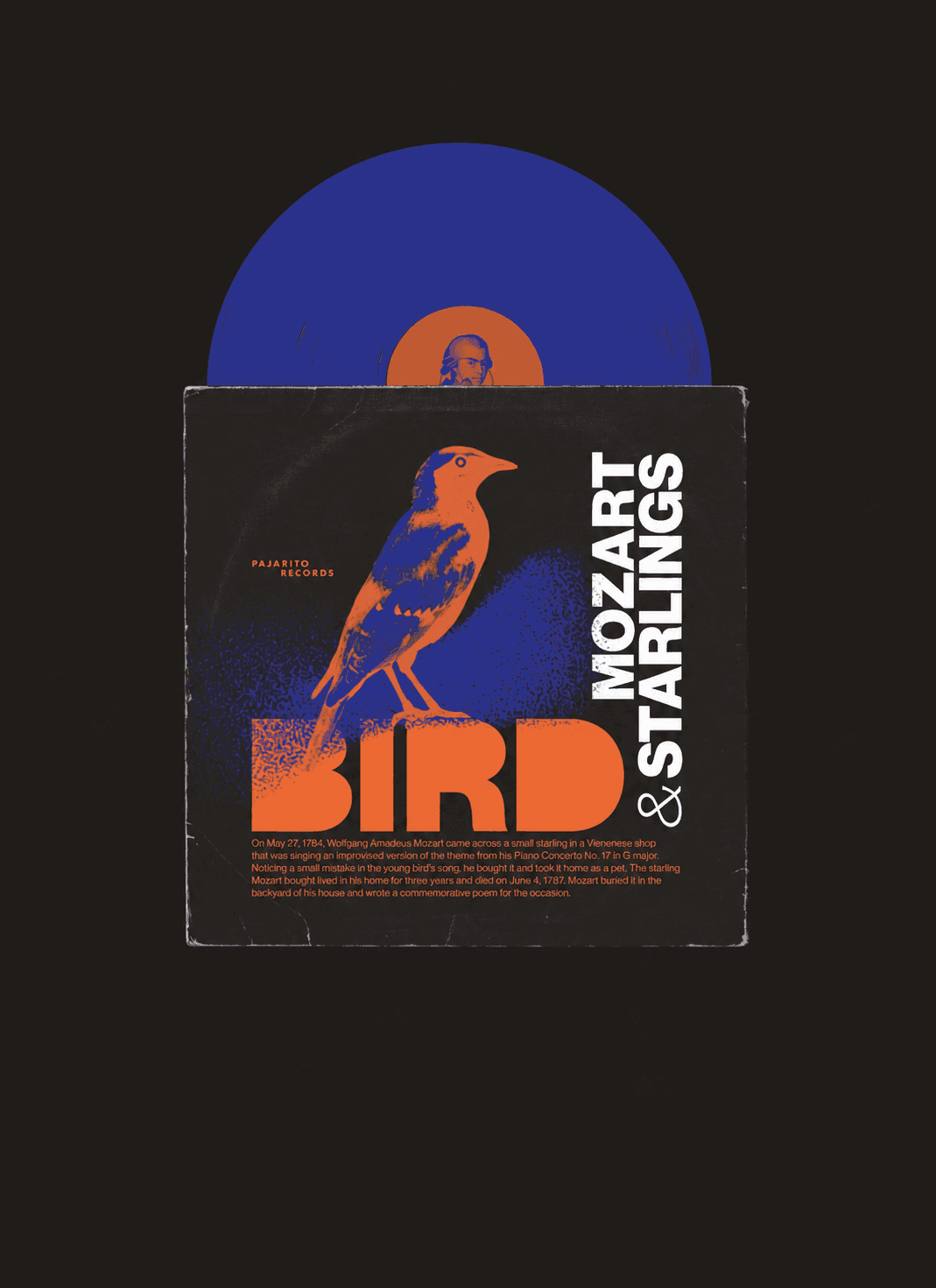
First, we can give more credence to Mozart and the story of how, passing by a pet shop, he heard a starling whistle part of his Piano Concerto No. 17. Naturally, Mozart bought the bird and developed a deep bond with it over the next three years. When it died, he gave it a pompous funeral and wrote a poem that he read aloud to his friends.
Second, we can assure my cat that the most famous of human linguistic capacities exists in other species and, therefore, there would be no reason to think that we cannot find, scattered here and there throughout the animal kingdom, the other components needed to sustain a conversation: scale, phenomenological consciousness, the ability to articulate sounds, syntax… The challenge is to find a species, besides our own, that contains them all.
Un viaje ilustrado acerca de la posibilidad de, algún día, hablar con los animales. Desde océanos pensantes hasta polémicos experimentos con chimpancés, disputas entre murciélagos y ballenas rebeldes. Lingüística, inteligencia artificial, literatura y mundo animal en un ensayo lúdico.
212 páginas. Encuadernación Binder. Impreso a tres tintas (negro + 2 Pantones) con laca sectorizada. 14,5 x 20 cm. Ilustraciones de Belén Kakefuku Del Solar.
Biografía del autor: Juan Cruz Balian nació el 3 de junio de 1984. Es Licenciado en Artes de la Escritura (UNA) y publicó el libro de cuentos Simple e imperfecto, y las novelas Ministerio de Invierno y La pausa.
Una plancha de stickers A5 (14,8 x 21 cm) de animalitos para hermosear cualquier superficie. Hechos en impresión UV sobre vinilo transparente con laca sectorizada.
Ebook Cosas que mi gato tendría que saber$13.900
Un viaje lúdico por la lingüística, la inteligencia artificial, la literatura y el mundo animal. Desde océanos pensantes hasta polémicos experimentos con chimpancés, disputas entre murciélagos y ballenas rebeldes. ¿Podremos algún día hablar con los animales?
Formato .epub y .mobi
Biografía del autor: Juan Cruz Balian nació el 3 de junio de 1984. Es Licenciado en Artes de la Escritura (UNA) y publicó el libro de cuentos Simple e imperfecto, y las novelas Ministerio de Invierno y La pausa.