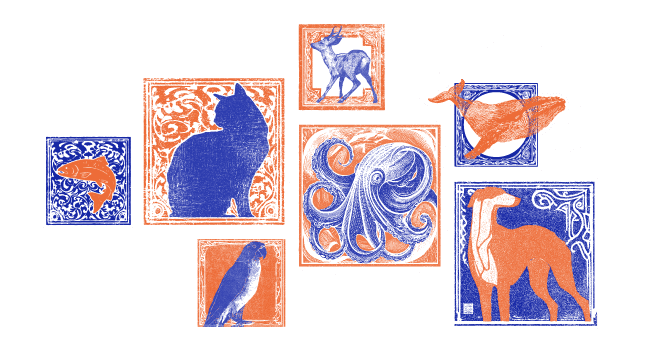
For Saussure, the linguistic sign is a dual entity that has the signifier on one side and the signified on the other. Both the signified and the signifier are psychic in nature; their union is a phenomenon that occurs in the brain when we see a written word or hear it, but also when we think. The signifier is the trace of a stimulus (visual, auditory, tactile) that is irrevocably attached to a signified. The two sides of the sign are indivisible—like the two sides of a coin or a sheet of paper—and neither should be confused with the object it refers to. If the sign is the word “cat,” the signifier and the signified are its two halves; neither corresponds to the real, flesh-and-blood cat. That cat, the one that exists in the world, is off somewhere else, up to its own antics, indifferent to all this we’re saying. The sign “cat,” by contrast, exists in the speakers’ psyches, and that’s where we’ll go looking for it.
According to Saussure, the relationship between the two sides of that coin (signified and signifier) is arbitrary and very difficult to change: there is nothing in the signifier /cat/ that is essential to thinking of a cat, and that is why the same signified can be associated with signifiers as different as chat, cat, neko, Katze, Māo, quitt, goyangi, etc.A note for anyone who’s just raised their index finger: this is only half true. While it is true of many signs, not all signified/signifier relationships are completely arbitrary. Saussure had already pointed out that onomatopoeias (the “plaf” of diving into water or the “slam” of a door closing) are signifiers that have a moti- vated relationship with their signified—that is, a resemblance. Decades later, the Kiki-Bouba effect showed that our brains carry a subtle synesthesia wired in by evolution: we almost unanimously associate sharp, piercing sounds with pointed shapes, and low-pitched phonemes with soft, rounded silhouettes. It takes a long time for a society to change the meaning of a word, and it rarely happens voluntarily; rather, it is the result of such widespread use that there is no choice but to accept it as the norm.A note to women: the most fascinating discussion of which usages could become the norm and which could never do so because they directly break inviolable rules of the system came from feminism in the last decade, with the promotion of inclusive language, which disrupts gender marking in words to introduce a rupture that forces us to read any statement through a feminist lens. The movement was so effective that it provoked outrage in part of society and a whole series of identity crises in peo- ple who felt the very foundations of their ontolo- gies tremble. Although inclusive lan- guage did not become the general norm, its spe- cific use in certain lexical items (for example, “todes”) remains current in some groups of speakers, even without stirring up as much resentment anymore. It is not unimaginable that in the future the RAE (Royal Spanish Academy) might admit the term as an exception, among the many others that have already been made. But more importantly, unlike other signs we live with every day (images, for example), the linguistic signifier is linear: the perceptible side of the sign can unfold only in a chain, one at a time. To say /dog/, I have to pronounce the phonemes /d/, /o/, /g/ in order. An image of a dog, by contrast, I can communicate all at once (although attention may then focus progressively on different details).
But not all signs are linguistic or work linearly. Some work through similarity (like icons, which resemble what they represent), and others through convention and arbitrarily (like symbols). A yellow sign by the roadside showing a leaping deer has a very specific meaning: “caution, animals may cross the road.” The deer figure is iconic; it visually resembles what it refers to. At the same time, there is nothing in the diamond shape or the color yellow that necessarily means “caution.” To understand the sign, one must know the symbolic convention behind traffic signs. In other words, in all its complexity the sign can only be interpreted by a human being, not by a deer, even if the deer can see the road, the sign, the color, and the figure of another deer printed on it.
What kinds of signs can a deer interpret? Perhaps certain traces in nature: for example, if there’s smoke, there’s fire. There you have a sign: an element that points to or indicates something else and can be interpreted by a being with some level of intellect or experience in the real world. A deer can also understand information conveyed by other deer according to their own communication systems—that is, “animal languages,” which may be more or less complex and have developed in each species to allow communication between individuals, especially in social species. These languages are of a very different nature from the one founded on our linguistic signs and from the symbol at the roadside, because in them something from the real world has been imprinted on the signifying matter perceived by the senses. For example, they allow an immediate relationship to be established between thunder and lightning, clouds and rain, a growl and the lunge that follows, the hiss of a snake and the danger of death. These signs are called indices, signs whose relationship to what they signify arises from a physical, causal, or contiguous connection. Indices matter to detectives who see a bullet hole and understand that a shot was fired, just as they matter to deer who need to assess the color of a puddle before deciding whether to step in or jump over it. Once I asked my father how birds knew which wires to perch on so they wouldn’t get electrocuted, and he told me they simply avoided the ones that smelled like fried chicken. A note for chickens: from my father I also learned a popular verse whose joke is that you pronounce the esdrújula words as if they were graves: “In the age of the apostles / the men were barbarians / they climbed trees / and ate birds.” Apparently, birds in general amuse him.
Human language freed itself long ago from this animal physical immediacy, but in exchange it became trapped in that other dimension we mentioned earlier: linearity. Since the signifier is a chain, human languages all have, without exception, some kind of syntax: rules that arrange words within a sentence according to hierarchies. This plays an essential role in understanding meaning and makes it possible to generate new sequences that no one has ever uttered before.
Syntax is so fundamental that I’ve given it a chapter of its own. But first, it’s worth asking whether this linearity plays a role in how human thought works, or whether the nature of our thought shaped the way we developed our faculty of language. It’s an important question, and we’ll take a moment to consider it.
Around 1920, the linguist Edward Sapir and the engineer Benjamin Lee Whorf set out to study this phenomenon. Although they died young without publishing a book together, their work laid the foundations for others to develop a theory (named in their honor) according to which the language a person speaks determines the way they think. The idea caused a sensation, and it took the field of linguistics about twenty years to show that the hypothesis, taken to its extreme, was false—that thought was not completely conditioned by language.
However, later research showed that the idea wasn’t entirely outlandish either. For example, in some experiments where participants were shown a range of colors, they could identify only those for which a word existed in their native language. After several advances in the field, the current consensus is a moderate version of Sapir-Whorf: the language we speak does not condition our way of thinking, but we cannot rule out that it influences it.
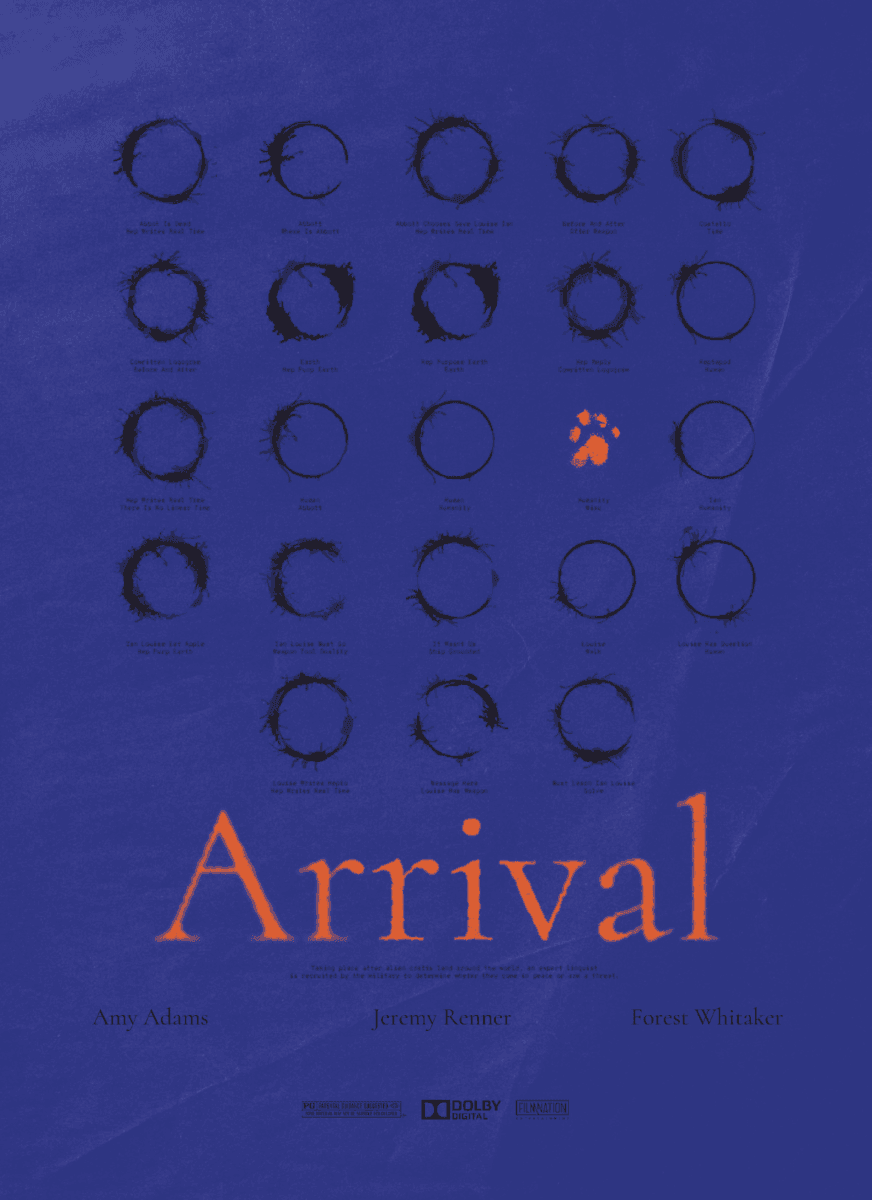
The film Arrival —based on Ted Chiang’s story “Story of Your Life”—offers one way to illustrate this idea. Perhaps a slightly extreme way, but a productive one. Arrival weaves together two narrative threads: on the one hand, we follow the story of the linguist Louise Banks, who is called in by the U.S. military to help communicate with an alien species. The extraterrestrials—called “heptapods”—have arrived on Earth aboard impressive spacecraft and invited human authorities to come aboard. But once there, neither side knows how to solve the problem of exchanging information,A note for Eridians: in the recent blockbuster Project Hail Mary, the protagonist and his future adventure companion face a similar problem. As in Arrival, science helps the characters search for a solution, though in Project Hail Mary the human’s good fortune and the alien’s goodwill play the crucial role: against all odds, it turns out that Rocky has a language morphologically compatible with English and, better yet, he’s a great guy. Otherwise, everything would have failed. so the Earthlings—and quite sensibly—decide to call in a physicist and a linguist, who set about making successive attempts to understand and be understood. The other narrative thread the film follows is Louise’s personal memories, especially those having to do with her family and the tragic death of her daughter. That is, the story of her life. Naturally, this will matter.
The first thing Louise tries in order to speak with the heptapods is to rely on referential language. She points to objects and says the corresponding word in English out loud. Then she prompts them to do the same. This confirms that the heptapods’ language—a series of sounds impossible to understand—has nothing to do with their writing. The sounds are chaotic; there is no fixed or segmentable word order, and it is almost impossible to try to figure one out.
However, she discovers that the aliens’ written language is a semasiographic system: that is, its visual symbols are not arranged linearly or representative of any sound, and they do not write linear sentences (one word next to another, from left to right, as we do); instead, they convey general ideas without depending on the sounds of spoken language. The heptapods, in particular, draw a single gigantic graphic mark, or “blot,” full of branches. A circle, imperfect yet closed. Now, at some point we learn that, for the drawing to fit together perfectly and make mathematical and visual sense, the heptapod has to know exactly how the sentence will end before making the first stroke. All parts of the symbol depend on one another simultaneously. There is no “beginning” and “end.” How can this be possible?
The answer comes from Gary (the physicist on the team), who in the meantime is struggling to explain Newtonian physics to the heptapods. They don’t understand the concept of cause and effect, and yet they excel at another kind of physics, such as the highly complex Fermat’s principle, according to which light refracted in water bends its ray because it always takes the path that gets it there fastest; but to do so, it seems to have calculated the path beforehand, as if it knew where it would end up before setting out. It’s one of those paradoxes that tie writers’ brains in knots. But to keep the summary brief, let’s say that the conclusion the two researchers reach is that the languages of Earth and those of these aliens differ to the same extent as their ways of conceptualizing (and perceiving) time differ. For us, language is sequential, an arrow that shoots forward, because that’s how we conceptualize the passage of time: past → present → future. For Chiang’s aliens, everything that happens happens all at once. They perceive the purpose, or the end, of an event at the same time as its beginning. That is why their writing is a single closed graphic, an irregular but complete circle.
In the work’s premise, the more skilled the protagonist becomes at reading the aliens’ language, the more she begins to perceive her own life in circular terms, where what has happened (her daughter’s death, specifically) is not a memory but something that is still to come, that is happening. She is overtaken by a way of processing time influenced by the heptapods’ language.
I’ll leave the dramatic consequences of such a revelation to anyone who wants to enjoy the story in any of its formats. As for the philosophical implications... well, as I’ve already said: this isn’t a philosophy book. But I hope the fictional example has helped establish the profound relationship between human language and our cognitive ability, since that is a necessary step in our search for answers. If we take certain premises strictly—for example, the idea that our conception of reality depends directly on our faculty of language and that this influences how we exist in the world—then it is not hard to imagine that the gap between species is unbridgeable.
When the opportunity arises, my mother recites an old Spanish saying: “Lo que natura non da, Salamanca non presta” I think it means that what nature hasn’t given us cannot be acquired even by studying at the University of Salamanca, though we’d have to test the aphorism in the age of AI and distance-learning courses to see whether it holds up under new educational formats. In any case, we’ll see next how, in the United States, other institutions of higher learning have tried to prove my mother wrong.
Un viaje ilustrado acerca de la posibilidad de, algún día, hablar con los animales. Desde océanos pensantes hasta polémicos experimentos con chimpancés, disputas entre murciélagos y ballenas rebeldes. Lingüística, inteligencia artificial, literatura y mundo animal en un ensayo lúdico.
212 páginas. Encuadernación Binder. Impreso a tres tintas (negro + 2 Pantones) con laca sectorizada. 14,5 x 20 cm. Ilustraciones de Belén Kakefuku Del Solar.
Biografía del autor: Juan Cruz Balian nació el 3 de junio de 1984. Es Licenciado en Artes de la Escritura (UNA) y publicó el libro de cuentos Simple e imperfecto, y las novelas Ministerio de Invierno y La pausa.
Una plancha de stickers A5 (14,8 x 21 cm) de animalitos para hermosear cualquier superficie. Hechos en impresión UV sobre vinilo transparente con laca sectorizada.
Ebook Cosas que mi gato tendría que saber$13.900
Un viaje lúdico por la lingüística, la inteligencia artificial, la literatura y el mundo animal. Desde océanos pensantes hasta polémicos experimentos con chimpancés, disputas entre murciélagos y ballenas rebeldes. ¿Podremos algún día hablar con los animales?
Formato .epub y .mobi
Biografía del autor: Juan Cruz Balian nació el 3 de junio de 1984. Es Licenciado en Artes de la Escritura (UNA) y publicó el libro de cuentos Simple e imperfecto, y las novelas Ministerio de Invierno y La pausa.