It is tempting to assume that the failure of the attempt to teach a dolphin English comes down mainly to the dolphin’s inability to pronounce the letter “m” (along with the other peculiarities of the case). The problem, however, has deeper roots. Since we humans are very persistent animals, in 1973 we tried again with a few adjustments, though we repeated the fundamental mistake: instead of crossing the threshold into adventure and moving toward the wonderful world of animals ourselves, what we did was take a chimpanzee—the animal most like ourselves that we could find—and drag him across the threshold in the opposite direction, into a particularly appalling corner of our own world: an affluent suburb in the United States. This is another story of failure, but it is also a story of betrayal. It happened fifty years ago, at Columbia University. The animal in question was an ape, and his name was Nim.
Project Nim was recorded in a documentary, still available in some basement of the internet. The experiment began in 1973 and lasted about five years. The film—which includes archival footage and interviews with those involved—was screened at the Sundance Film Festival in 2011. The shift in paradigms between those two periods and our own (1973, 2011, 2026) makes the feature, difficult to film, almost impossible to watch today. The most basic considerations about animal cruelty, bioethical standards, viewers’ sensibilities: everything seems to have changed drastically enough to turn a scientific experiment into an unsettling film, where even the happy scenes hint at a looming terror.
The research documented in Project Nim sought to settle the age-old nature vs. nurture dichotomy. That is, to determine whether we are who we are by nature or whether our upbringing is what shapes us. Any geneticist today can tell you it is both: with the tools we receive from nature, we gradually become who we will be through the influence of our environment—nurture. However, the psychologist Herbert Terrace took a more radical position and believed that simply beginning to exert that environmental influence early enough and sustaining it would allow a chimpanzee to behave like a human. To achieve this, he designed a simple experiment: he went to an animal shelter, tore a two-week-old baby ape from his mother’s arms, and gave him up for adoption to Stephanie LaFarge, one of the researchers on his team, who took him to live with her family in California.
The documentary itself describes LaFarge’s family as a group of rich hippies. They had time, space, and a liberal mindset so deeply rooted that they saw no need to stick to any kind of work plan. They simply brought the baby into the family, named him Nim—for reasons I will explain in due course—spent time with him, taught him sign language, and watched him grow up happy, like one more child. They dressed him, put diapers on him, breastfed him, and cared for him. And Nim responded accordingly: he played, learned, and, naturally, formed parent-child bonds. At first, the bond developed just as one would expect: a mammal is a mammal, and will always respond to caresses, body warmth, stimulating games, and restorative rest. But what fascinated everyone was Nim’s success in acquiring sign language. As the years went by, Nim learned more and more terms. By the end of the project, he could say 125 words, including the basics for survival (“eat”, “drink”, “orange”, “apple”), those involving interactions (“tickle”, “play”, “hug”, “give me”) and the main pronouns “(I”, “you”, “he”, “she”). All of that would have been enough to guarantee Nim (and his caregivers) worldwide fame, but things were only just picking up speed. The project really took off when Nim learned to combine words into simple structures: “I + play”, “tickle + Nim” or “more + food”. At first glance, the ape was learning to speak like a human being, however crudely. No need for a vocal apparatus or high-end technology, just good old-fashioned sign language. It was too good to be true.
Of course, Nim was still an ape. He would frequently engage in antisocial behavior, such as climbing around the house, destroying it as he went, or challenging every male figure who might come between him and his surrogate mother, but this seemed a reasonable price to pay to see him make progress. In any case, those instances of “beastly behavior” only made it more remarkable that learning was taking place in a wild creature. LaFarge’s family excused him on the grounds of his young age and urged everyone to trust his process of maturation. However, as the years went by, Nim’s aggression only increased.
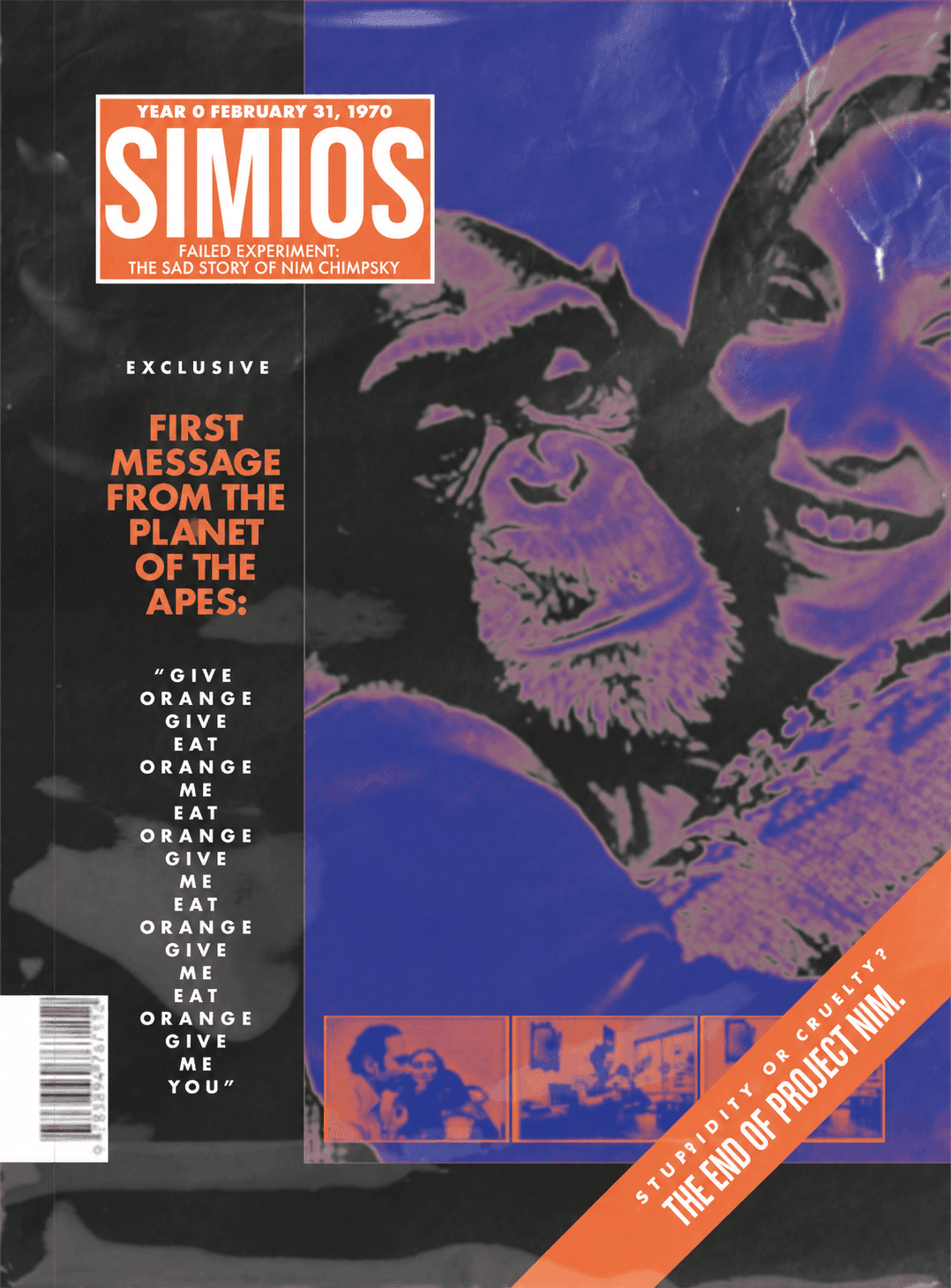
As the project’s director, Terrace made frequent visits to LaFarge’s house, and he did not like what he saw. There was no regular data collection, nor was Nim being raised with the restrictions that apply to any human child. Instead, the ape enjoyed absolute freedom, which turned the experiment on its head: without clear parameters, Nim’s upbringing could not be compared with that of an ordinary child in the United States. So Terrace made a decision: he took custody of Nim away from LaFarge’s family and moved him to a remote estate, where he was placed in the care of new volunteers who, like the previous ones, firmly believed they were changing the world. There, Nim continued expanding his knowledge of sign language and communicating fluently to ask for food, go to the bathroom, or demand affection. Sooner rather than later, he became a genuine celebrity. In fact, he even appeared on the cover of The New York Times Magazine, under the headline “First Message from the Planet of the Apes”.Note for hominids: “First Message from the Planet of the Apes” refers to the movie Planet of the Apes, a film about a dystopian future in which humanity has lost the evolutionary race against apes, who developed an entire dominant civilization, of course, once they were able to start speaking.
But the project was moving forward in crosswinds. Because as Nim adapted to a comfortable bourgeois life, he grew increasingly hostile and unpredictable. Bites inflicted on several caregivers, destruction of his surroundings when frustrated, sudden mood swings, and displays of dominance in which he tried to make his position in the group clear were the unmistakable signs that Nim had entered adolescence. And when he bit his caregiver Laura Ann’s face, something broke for good. Laura spent three months trying to heal a wound that left the inside of her mouth exposed and that doctors could not stitch up for fear of possible infections. It was a slow recovery and, as one might expect, it led her to leave the project. But first, she decided to visit Nim one last time. She wanted to have one final conversation about his behavior toward her. To bring their relationship to a close. As soon as Nim saw her, he tried to attack her again. That was the end of the experiment’s golden age.
In 1977, Terrace decided they already had too much data and had not even processed it properly yet. They had to shut down the project. This, so easy to say, meant making the difficult decision that Nim should stop living. Or, at least, stop living with humans, something easier to say and accept than to put into practice. The best idea they had was to sedate him with sleeping pills, put him on a plane, and take him to the center in Oklahoma where they had adopted him. Compared with the landscaped country estates where Nim had grown up, the center seemed a sinister place, a zoo made up of cages and guards with cattle prods. Nim’s first moments there were recorded on home movie cameras, but good-quality ones: the sharp black-and-white images clearly show the chimpanzee and the terror that overwhelms him when he sees other apes for the first time in his life, his repeated attempts to escape, the refuge he seeks in a caregiver’s arms like a frightened child.
The move was a nightmare. With a great deal of effort, they managed to get Nim to develop something resembling a friendship with another ape, selected as the most docile of all the inmates. He continued to receive visits from one of his caregivers, and his health was monitored for a while. However, the opportunity to end the story in a relatively acceptable way was lost completely: shortly afterward, the shelter sold Nim to a research center to be used in vaccine trials for HIV, hepatitis, and other diseases. There, the cages grew smaller, green spaces disappeared entirely, and sunlight was replaced by the laboratory’s fluorescent tubes. Nim would have been subjected to medical torture had he not been rescued at the last minute by the legal system and pressure from activists.
At the same time that Nim was reaching the darkest of abysses, Terrace was arriving at a devastating conclusion: they had misinterpreted the data all those years. Nim could not speak. To explain this, it is worth pointing out, now, that Nim’s name was first and foremost a taunt. “Nim Chimpsky” was intended to ridicule Noam Chomsky, already an important linguist at the time, who maintained that animals and human beings have entirely different systems of communication, and that, therefore, no amount of training could enable an animal to acquire a grammar, just as no amount of training could enable an Olympic jumper to fly like a bird. This meant Terrace had to admit a double defeat or, as he preferred to put it, “change his mind about the data collected”. Nim was an ape, and no amount of nurture could entirely transform his nature. To Chomsky’s delight, Terrace established that the ape had only managed to memorize sequences of words, but possessed no syntax: that is, he could not generate structures that would allow him to form new verbal constructions. He could only repeat what he had seen (and heard). For example, Nim’s longest recorded sentence is a sequence of gestures that translates as: “give orange me give eat orange me eat orange give me eat orange give me you”. The intention behind the sentence is clear, perhaps too clear given the insistence, but the lack of structure is obvious. And if Nim had no control over the structure of the sentences he produced, then he could not generate new sentences. That ability remained in human territory. And consequently, all the suffering Nim had been through—with the added bonus of his confinement in a disease research center—no longer seemed an acceptable price to pay to refute a poorly grounded hypothesis. As humanity, the only possible conclusion was the certainty that we had tortured and sacrificed a chimpanzee and, at the end of it all, learned nothing Chomsky had not already told us.
Nim’s final years were perhaps less sad, though that is small comfort. Public pressure was so great that a lawyer took his case and argued that, if the ape had been treated as a human all his life, then he should have legal representation as a human. He even requested that Nim be given the opportunity to testify in court, which the judges denied because Nim lacked legal personhood. At the end of the proceedings, an animal lover—Cleveland Amory—who owned a rescue ranch bought him and took him in. And so Nim escaped the worst possible fates, but spent his final years somewhere they did not know how to deal with a chimpanzee, and where his social nature came up against an inevitable solitude. A chimpanzee’s life expectancy in the wild is around 40 years, while in captivity, without predators, it can extend to 50 or 60. Nim died of a heart attack in 2000, at the young age of 26. Until the very end, he continued to receive occasional visits from his former caregiver, Bob, with whom he had developed a close bond. Basically, they spent their time walking around the grounds and smoking marijuana.
Now that the story is over, and assuming that any member of a species with lacrimal glands is at this point tending to their secretions, it is worth returning to the matter at hand and drawing a few conclusions of our own.
First of all, we can consider it established that the best way to communicate across species is not to culturally colonize an individual by drowning them in our own ways of life and teaching them a language that will be alien to them. What we have seen so far should force us to understand that, if anything, we are the ones who must face the challenge from a position of humility. We must immerse ourselves in other cultures, learn languages that are strange to us, and try to find light where we do not know whether any exists. Any other method will lead us down the path of cruelty, leave a trail of destruction, suicidal dolphins, chimpanzees dying prematurely of sadness, and who knows what other stories we never hear about. Nim’s story is horrible, but at least we could learn from it. As Ted Chiang, the author of Story of Your Life, says: “Nothing erases the past. There is repentance, there is atonement, and there is forgiveness. That is all, but that is enough”.
Meanwhile, this essay has just landed itself a new objective: to find, among all the species in existence, the most likely conversation partner. We now know that, besides needing to be on the right scale and possess phenomenal consciousness, this partner must have some kind of syntax. But what exactly is syntax? How might another animal have it?
Un viaje ilustrado acerca de la posibilidad de, algún día, hablar con los animales. Desde océanos pensantes hasta polémicos experimentos con chimpancés, disputas entre murciélagos y ballenas rebeldes. Lingüística, inteligencia artificial, literatura y mundo animal en un ensayo lúdico.
212 páginas. Encuadernación Binder. Impreso a tres tintas (negro + 2 Pantones) con laca sectorizada. 14,5 x 20 cm. Ilustraciones de Belén Kakefuku Del Solar.
Biografía del autor: Juan Cruz Balian nació el 3 de junio de 1984. Es Licenciado en Artes de la Escritura (UNA) y publicó el libro de cuentos Simple e imperfecto, y las novelas Ministerio de Invierno y La pausa.
Una plancha de stickers A5 (14,8 x 21 cm) de animalitos para hermosear cualquier superficie. Hechos en impresión UV sobre vinilo transparente con laca sectorizada.
Ebook Cosas que mi gato tendría que saber$13.900
Un viaje lúdico por la lingüística, la inteligencia artificial, la literatura y el mundo animal. Desde océanos pensantes hasta polémicos experimentos con chimpancés, disputas entre murciélagos y ballenas rebeldes. ¿Podremos algún día hablar con los animales?
Formato .epub y .mobi
Biografía del autor: Juan Cruz Balian nació el 3 de junio de 1984. Es Licenciado en Artes de la Escritura (UNA) y publicó el libro de cuentos Simple e imperfecto, y las novelas Ministerio de Invierno y La pausa.