This content was translated using artificial intelligence and may therefore contain errors.
“The morning after the storm, the waters cast onto the beach, eight kilometers northwest of the city, the body of a drowned giant.”That is how Ballard’s story begins, aptly titled “The Drowned Giant.” A small, great allegory about one of my species’ weaknesses: our compulsion to trivialize the marvelous. To put it in a few lines, the story tells of the appearance of a giant’s dead body on a city’s beaches. As soon as the news spreads, everyone abandons their tasks to go see the wonder. Onlookers, journalists, experts arrive. Soon a community forms around the decomposing corpse, and for a moment it seems that nothing else is happening anywhere. The giant is all the community needs to give free rein to its passions: the children climb all over him, the teenagers camp in his shadow, the adults desecrate him to take keepsakes. And so, little by little, through the workings of nature’s own necrotic processes and human amusement, the giant is reduced to a skeleton no different from that of any shipwreck, though immense, bones rising into the air like a ship’s rigging, a perfect perch for birds, and nothing more.
The giant in the story and the dynamics of his death present, as science fiction so often likes to do, an impossible yet deeply familiar scene: giants don’t exist, but for thousands of years humanity has engaged in the passive hunting of whales, repeating scenes evoked by the story, such as scavenging immense bodies that the sea occasionally deposits on the beach.
We’ll say whales, but it’s important to clarify that a blue whale, a right whale, a sperm whale, and an orca are not the same thing. The main difference is in the mouth: blue and right whales have baleen that filters water to capture food, while sperm whales and orcas have teeth and feed by actively hunting, like many predators. But we allow ourselves this generalization because for a long time humans understood these species as one big family. Giants of the sea. Leviathans. Monsters. Gods. And for now, more than the precise classification of each species, we’re interested in the place they occupied in our traditions. We used to regard them with reverential fear. And then, as with Ballard’s giant, we lost that fear.
During the first millennia on Earth, we humans swarmed along the coasts, unaware of how vast and how deep that blue barrier was, covered in winds, that meant the invariable end of all territories, the frontier of every civilization, the pilgrim’s obligatory resting place. In those years, the earliest of Antiquity, whales had barely been sighted or known. Attempts to depict their terrifying form ended in pastiche: what someone could draw of what someone had imagined about what someone could remember of what someone might perhaps have seen in the distance. The mythologies couldn’t agree on the nature of the animal. Isolated from one another by that same blue barrier, each civilization encoded its own relationship with the whale in different ways: the Greeks described it as an elongated fish with a dog’s snout, a kind of sea serpent, little more than a monster at Poseidon’s command. The Jewish tale of Jonah—captured inside a whale for three days until he was spat out onto dry land—also considered it devoid of will and reason. For the Inuit, by contrast, whales were sacred beings, directly related to the origin of the world. For the Vikings—reckless sailors if ever there were any—they were a unique and treacherous creature, so much like an island that, they say, some would mistakenly camp on its back, only to be dragged down to the bottom of the sea. The Mapuche believed they were old women who guided the souls of the dead. And the Japanese considered them vengeful ghosts.Note for economists: In 1651, the philosopher Thomas Hobbes used the image of the Leviathan as the title of his book on the social contract and the state. Until then, books on philosophy and politics had rather boring titles, like “Treatise on Political Philosophy,” and Hobbes’s move was a hit. So much so that animal metaphors are now all the rage, especially as nicknames for financial behaviors. The bull symbolizes a rising market (associated with the idea of charging upward), the bear represents a falling market (associated with the idea of claws moving downward), unicorns symbolize fantastical and rare startups valued at over a billion dollars, hawks are investors who favor high interest rates, doves are the opposite, sharks would represent aggressive investors, pigs would be greedy investors who always expect big profits, and chickens, the cowards who only buy very low-risk instruments. No poet was consulted in the making of this irresponsible tradition.
In any case, until humanity got better at the science of sailing long distances, whale hunting was a passive activity: we didn’t know how to subdue them in the open sea, so we scavenged their stranded bodies on beaches, like Ballard’s giant, whenever the opportunity arose. Thus, little by little, we learned their secrets. And over the centuries, we forged an instrumental, predatory relationship, at the expense of the one the mythologies had offered us. If one wanted to mark a turning point, it was the Basques who, in the twelfth century, discovered the properties of whale fat and began developing the fine, dirty art of capturing whales.
All of this, however, is only a prelude. Small flashes from the history of two species condemned for millennia to live apart—one beneath the deep sea, the other safe on dry land—but that developed a complex, still unfinished relationship in just three centuries. The real beginning came after a series of mutinies, storms, and hardships, when the navigator Ferdinand Magellan crossed the strait that now bears his name and humans finally learned something whales had known for 32 million years: that there is only one ocean.
It was on another corner of that ocean, on an island called Nantucket (United States), that the whale-hunting business formally began. To prosper and get rich, the island’s inhabitants had to choose between running a farm for a year, taking a moderate risk and earning a profit commensurate with that risk, or investing their money in shares in a whaling ship that would spend three years crossing all the known seas and return home—if it ever returned—with an uncertain haul. It was a treacherous gamble: in some cases, ships returned with enough whale fat and whale sperm to multiply, in one fell swoop, the income from any farm on the island tenfold. In other cases, whalers never came back, or returned with their crew decimated by scurvy, inclement weather or direct attacks by their prey, which were not easy to catch.Note for zoophiles: whale sperm is not seminal fluid, but spermaceti, a substance found in cavities in the head which, it is presumed, allows them to regulate their buoyancy. The first whalers, when they opened the prey’s body and saw this liquid, white and creamy but different from fat, believed it really was sperm. Its quality is so much better than fat that it sold for far more money, as a luxury material for its cosmetic properties and because, when burned, it gave light without producing odor or smoke. One of the most memorable chapters of Moby Dick, by Herman Melville, the most famous work about whale hunting, describes sailors plunging their hands into a barrel full of spermaceti and smearing it on themselves in a state of absolute homoerotic ecstasy.
In 1712, the first whale hunt to use the Nantucket system took place, or at least the first one on record. The system involved pursuing the whale in a ship but closing in the rest of the way in rowboats, from which experienced harpooners hurled their projectiles at the animal (taking advantage of the fact that they’re mammals and have to surface for air every so often), then finding a way to get close and finish it off with lances. There are quite a few cases in which the whale dived again with the harpoons still embedded, dragging the boat and its crew with it to a certain and catastrophic death. Some people might say: fair and well deserved.
It didn’t take humans long to suspect that whales were intelligent beings, which at first did nothing but increase the terror they inspired in us. In 1820, the Essex sank in the middle of the Pacific Ocean, far from any coast. There, the harpooners tried to hunt some individuals from a pod—whales travel in pods; this is important—but one of them, unusually large, chose a different strategy. Instead of fleeing, it attacked the ship. Twice it rammed the hull of the Essex with all its weight and the sturdy bone in its head. Accounts say it was a fiendish, terrifying sperm whale. And those two blows were enough to send the ship to the bottom.
The sailors had to flee in boats, carrying the little food they could get. The only port they could try to reach was Chile, but it lay 2,000 nautical miles from the shipwreck site.Note for land animals: 3,700 kilometers. Against all hope, eighteen men set out on that journey. Only eight arrived, malnourished, dehydrated, and traumatized by, among other things, having had to eat their crewmates.
This is the story that inspired the writing of Moby Dick: a novel, a philosophical treatise, an experiment in narrative, and a true atlas of whales—their kinds, their anatomy, their behavior, the details of the process of hunting them, the thousand ways they appear in culture, the economic impact of the industry built around them, and human nature seen in their light. The whales never speak in the story. But Moby Dick is famous for its complex behavior. While Captain Ahab is convinced of the whales’ intelligence and malice, the officer Starbuck, a religious man, believes there is no point in “getting angry with a mute beast.” The narrator, Ishmael, sometimes knows everything, sometimes is merely a witness; he comes and goes, wavering between a simple, illiterate cabin boy and a great scholar, and does not settle the question. But the fact that whales, especially sperm whales, may possess some kind of complex communication based on the exchange of sounds is beyond everyone’s knowledge.
Today, the exact measure of whales’ intelligence remains a mystery. With each passing day, we become more convinced it is greater than we had assumed. So much so that they may be the ideal intermediary we’re looking for.
Un viaje ilustrado acerca de la posibilidad de, algún día, hablar con los animales. Desde océanos pensantes hasta polémicos experimentos con chimpancés, disputas entre murciélagos y ballenas rebeldes. Lingüística, inteligencia artificial, literatura y mundo animal en un ensayo lúdico.
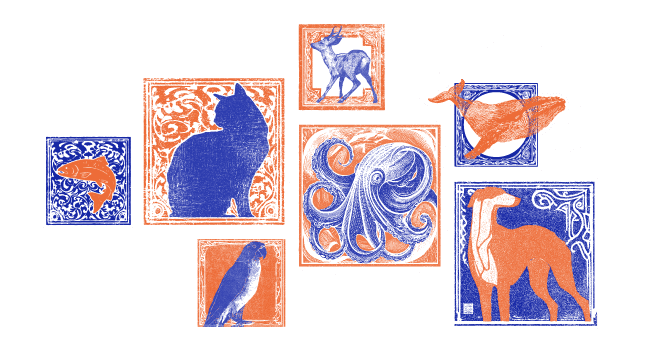
212 páginas. Encuadernación Binder. Impreso a tres tintas (negro + 2 Pantones) con laca sectorizada. 14,5 x 20 cm. Ilustraciones de Belén Kakefuku Del Solar.
Biografía del autor: Juan Cruz Balian nació el 3 de junio de 1984. Es Licenciado en Artes de la Escritura (UNA) y publicó el libro de cuentos Simple e imperfecto, y las novelas Ministerio de Invierno y La pausa.
Una plancha de stickers A5 (14,8 x 21 cm) de animalitos para hermosear cualquier superficie. Hechos en impresión UV sobre vinilo transparente con laca sectorizada.
Ebook Cosas que mi gato tendría que saber$13.900
Un viaje lúdico por la lingüística, la inteligencia artificial, la literatura y el mundo animal. Desde océanos pensantes hasta polémicos experimentos con chimpancés, disputas entre murciélagos y ballenas rebeldes. ¿Podremos algún día hablar con los animales?
Formato .epub y .mobi
Biografía del autor: Juan Cruz Balian nació el 3 de junio de 1984. Es Licenciado en Artes de la Escritura (UNA) y publicó el libro de cuentos Simple e imperfecto, y las novelas Ministerio de Invierno y La pausa.