This content was translated using artificial intelligence and may therefore contain errors.
Melville set out to write an elegy, but unwittingly produced an obituary. Less than a decade after the publication of Moby Dick, the whaling industry that had made Nantucket prosperous was dethroned. In 1849, the California Gold Rush began, and crews deserted en masse, leaving ship carcasses along the shores as they went to try their luck in the mines and rivers on the other side of the country. Nantucket went into decline. It took several generations before it reinvented itself as a tourist destination. To drive another nail into the industry's coffin, oil was discovered in 1859, and whale fat was replaced in many of its uses by products derived from black gold. The consequences of that transition still shape the world we live in today.
One might think that this was the end of the persecution we subjected whales to, an outright genocide that at last seemed to be coming to an end for lack of purpose. But we humans don't abandon anything valuable; if anything, we make it more efficient. When the Norwegian Svend Foyn invented the explosive-headed harpoon, he ushered in a new era of whaling: the industrial era. The explosive harpoon had a grenade at its tip, metal teeth that clung to its prey's flesh, and a motorized winch that made it possible to haul in the line from the main ship, without putting boats or crew at risk. A killing contraption worthy of the twentieth century.
Since nothing is lost and everything is transformed, the whale oil obtained through this process quickly found other uses: margarine, cosmetics, soaps, pet food and, above all, oil for the machinery of war we set in motion during the two world wars. Thus, the hunt did not stop even while the powers indulged themselves by calling “cold” the continuation of the war still unfolding on other boards. The whales had to wait until the most powerful bombs stopped trembling on the surface before they found an advocate. Not until 1970, when the biologist Roger Payne published a record called Songs of the Humpback Whale (Songs of the Humpback Whale), could the captivating sounds these animals exchange underwater be heard. The record was a hit and sparked a wave of sensitivity in the public, now aware that the seas are not silent abysses but worlds populated by voices. The whales suddenly recovered that aura of reverence we had stripped from them over centuries and, though we could not understand what they were saying, we sensed there was something there worth listening to. A strange tongue, the manifestation of something deeper and older than everything our species had ever built. That is why whale songs were included on the Voyager probe and sent, along with a great deal of other material representative of our planet, toward the far reaches of the cosmos. Perhaps, one day, extraterrestrial life will intercept and hear it.Note for extraterrestrials: as I write these words, the Voyager probe has left the heliosphere and is sailing through interstellar space more than 170 astronomical units from Earth, which is equivalent to 25 million kilometers, toward the constellation of Ophiuchus, if any of those references mean anything to you. We are still in contact with it, but technically it is in open waters. It belongs to whoever can hunt it down.If that happens, the water truce will need a bigger pond in which to be convened.
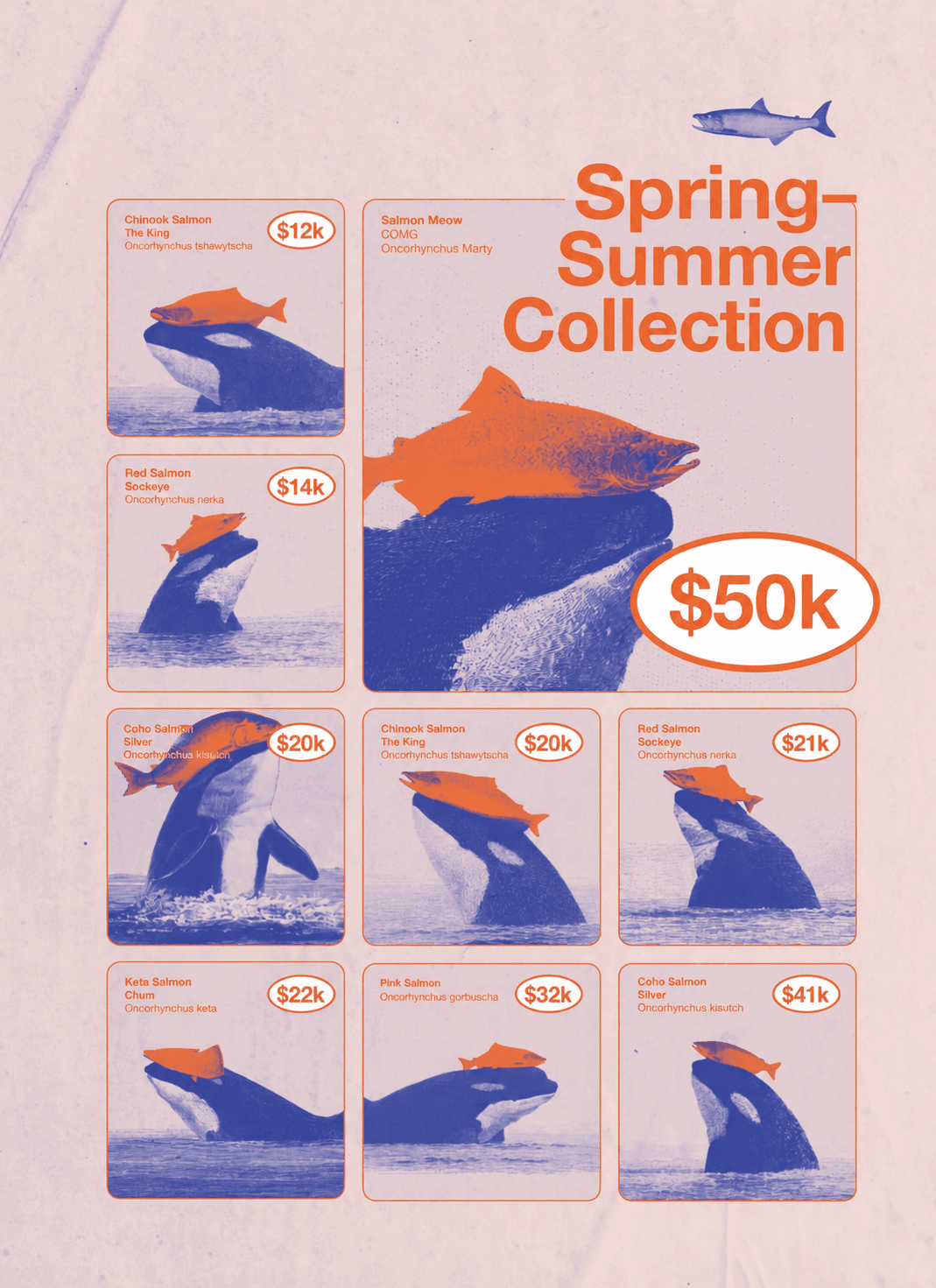
This shift toward an ecological paradigm bore fruit: in 1986, whale hunting was banned worldwide and most countries signed the relevant treaties to protect the species, with the exception of Japan, Norway, and Iceland, which argued that it was a vital resource for their economies. Just one year after that armistice, an unusual event was recorded for the first time: off the coast of Washington, an orca caught a salmon and, for inexplicable reasons, placed it on her head like a hat and surfaced to show it off. Other orcas witnessed the behavior and decided to imitate it. The fashion spread to the rest of the pod and then to other pods, so that a new custom soon emerged in the animal world, part playful and part aesthetic: a culture of orcas wearing salmon hats.
It's amusing to think that the salmon-on-the-head business was the orcas' way of greeting humans in recognition of the recent signing of the treaty banning whaling, but no evidence points to that possibility. For my part, I only want to point out that the timing is suggestive and that, to make it even more suspicious, no similar behavior was recorded off the coasts of Japan, Norway, or Iceland. That's as far as my investigations go. What's important is that the truce, if there was one, lasted until 2020, when another historic event began: the “high-seas rebellion,” a series of attacks by whales on luxury sailboats in the Iberian Peninsula.
The high-seas rebellion has seen more than 600 attacks and a total of 7 sinkings. But although legend tried to pin responsibility on an old, vengeful orca—dubbed White Gladys—who supposedly made a habit of attacking boats and teaching other orcas the behavior to incite a revolution—at the height of rhetoric blaming the rich as the primary and indisputable cause of anthropogenic global warming—science once again stripped the matter of all emotion and ruled that it was a game similar to the hat one. Apparently, it wasn't resentment toward millionaires that motivated the whales, but the particular movement of sailboat rudders, which they found very attractive and which prompted them to ram them, opening breaches in the hulls and putting the vessels at risk of sinking. Scientists predicted that, just as it began, this fashion was also bound to end from one moment to the next and without much explanation, which is exactly what happened. The attacks stopped being reported. But, giving land-based revolutionaries something to hope for, in 2024 a new whale was spotted wearing the salmon on its head, suggesting that the fashion of attacking luxury sailboats might also return when least expected.
This journey leaves us in two different places, depending on the kind of coordinates we're using. On the relational plane, we find ourselves in an undefined zone. What is our relationship with whales today? How can we unravel so many centuries of slaughter? What diplomatic value do these few decades of trying to defend them from ourselves have? How much do we have in common with these species? We know what they think of our yachts, but what do they think of our hats? On the other hand, in temporal terms, it brings us almost to the present day of this book. Because, to answer these and other questions, a highly ambitious project was launched in 2020: Project CETI, a systematic attempt to learn and interpret the language of whales. Specifically, sperm whales, those mythical prey of Nantucket's hunters.
In recent years, CETI's scientists—whose figurehead is David Gruber, CEO and founder of the project, while the team includes several dozen other interdisciplinary professionals—have developed an entire arsenal of minimally invasive tools to find out how these animals communicate. Basically, the method consists of collecting data using underwater microphone systems, adhesive tags attached to the animals by drones, and aerial footage to assess their behavior. As in the Tel Aviv experiment with bats, the process continues by feeding all that data into an artificial intelligence system and, by searching for mathematical patterns, trying to discover whether the sounds emitted by sperm whales (which we call codas and which consist of a series of clicks, unlike the honeyed, melodious song of right whales) have everything we've been looking for: discernible words and referential language, but also syntactic structure, discourse markers of self-awareness, and language games.
“What do we know so far?” my cat might ask me. The answer is that in 2024, the team published some results and, for now, they are convinced that sperm whales have a sound system whose complexity is equivalent to the human phonetic alphabet. The most optimistic researchers say they use enough variations to justify the hope that, in their more complex structures, they may generate meaning. The most pessimistic say that, for now, all we know is that the possibility of stretching some sounds, adding others at the end, and modifying the structure of the whole phrase would indicate that sperm whales have more complex communication than it might seem at first glance, but they won't venture further than that.
Perhaps one thing worth highlighting about the project, regardless of the final results—which we are still a long way from seeing—is that its aim is not to teach sperm whales the human language, but the opposite: to understand what they are saying to one another, no small thing considering that, as a species, they have been talking to one another for 34 million years, saying who knows what. Another, much more invasive, aim is for AI to extrapolate enough information from the processed data for us to produce and broadcast a greeting in their language. Some attempts using sound-emitting probes have already been made, so our calling card to the species may well have been a string of nonsense.
Which brings us to the very brink of this essay.
I pick up my cat to get his attention. He's been asleep for who knows how long, and I hear the fabric give a little as his claws release their hold on my trousers. I want him to see the photo of the sperm whale on my screen. It's a gray mass, veined with sunbeams filtering down from the surface. There's a contradictory geometry to that body, square at one end and tapering to points at the other: the eyes seem misplaced; the mouth, too flat; the fins, too small. It doesn't look like something that could swim gracefully, but like something that ought to sink. And yet, inside that monstrous head, perhaps lies the light we're searching for.
Morty conveys no emotion to me; I can barely get him to look at the screen. I think he's simply glad I'm not showing him a picture of a dog.
Un viaje ilustrado acerca de la posibilidad de, algún día, hablar con los animales. Desde océanos pensantes hasta polémicos experimentos con chimpancés, disputas entre murciélagos y ballenas rebeldes. Lingüística, inteligencia artificial, literatura y mundo animal en un ensayo lúdico.
212 páginas. Encuadernación Binder. Impreso a tres tintas (negro + 2 Pantones) con laca sectorizada. 14,5 x 20 cm. Ilustraciones de Belén Kakefuku Del Solar.
Biografía del autor: Juan Cruz Balian nació el 3 de junio de 1984. Es Licenciado en Artes de la Escritura (UNA) y publicó el libro de cuentos Simple e imperfecto, y las novelas Ministerio de Invierno y La pausa.
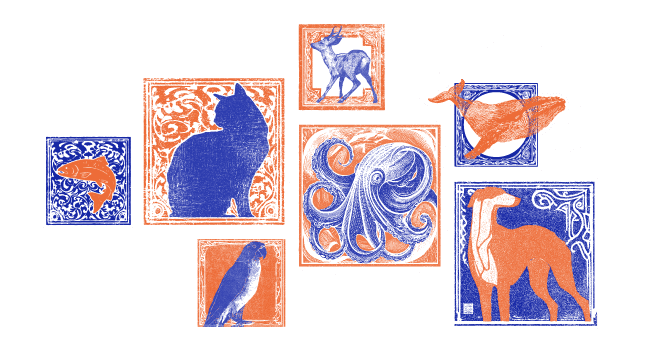
Una plancha de stickers A5 (14,8 x 21 cm) de animalitos para hermosear cualquier superficie. Hechos en impresión UV sobre vinilo transparente con laca sectorizada.
Ebook Cosas que mi gato tendría que saber$13.900
Un viaje lúdico por la lingüística, la inteligencia artificial, la literatura y el mundo animal. Desde océanos pensantes hasta polémicos experimentos con chimpancés, disputas entre murciélagos y ballenas rebeldes. ¿Podremos algún día hablar con los animales?
Formato .epub y .mobi
Biografía del autor: Juan Cruz Balian nació el 3 de junio de 1984. Es Licenciado en Artes de la Escritura (UNA) y publicó el libro de cuentos Simple e imperfecto, y las novelas Ministerio de Invierno y La pausa.