Let's try to skirt the problem. Perhaps, free ourselves from a few obligations. Let's consider an octopus.
At first glance, no other species possesses so many of the qualities we're looking for. To begin with, an octopus is an extremely intelligent being, but in a way completely different from human beings. Evolution separated us from them 600 million years ago, when dinosaurs weren't even a project of nature yet.
At the dawn of the Cambrian period lived a hypothetical creature, one for which scientists have no evidence but can nonetheless formulate solid conjectures: the urbilaterian. The urbilaterian was a kind of flatworm that swam along the seabed with the peace of existing without reason, culture, love, or passions, and without knowing that it already harbored within itself the seed of all those things, the infinite potential, the fertilized egg of intelligence.
Many species evolved from the urbilaterian, but of all of them, two interest us: human beings and octopuses. In this common ancestor, traits were taking shape that all its descendants would later share: 1) bilateral symmetry, that is, a body in which the distinction between left and right matters; 2) a continuous digestive tract; 3) a nervous system that was not yet a brain, but was a sketch of one, the notes in the draft of the manuscript of the instruction manual for making a brain; and 4) eye spots, which were not yet eyes but two groups of cells capable of distinguishing day from night, or the obstruction of light that occurs when another being is standing in front of your eyes.
However, intelligence did not arise from this worm, but at least two completely different intelligences did. The human brain is a fairly centralized organism: beyond its nerve endings, which extend to the farthest reaches of the body, its main mass is located in the head, surrounded by a powerful bony helmet that keeps it safe, except under conditions of extreme pressure which, for their part, human beings try to avoid at all costs or, in certain cases, seek out at all costs.Note for species with a self-preservation instinct: the first behavior includes cases such as falls from deep cliffs, falling trees, and bear jaws, while the second is rife with motorcycle accidents, negligent underwater dives, and bear jaws—but in circuses.
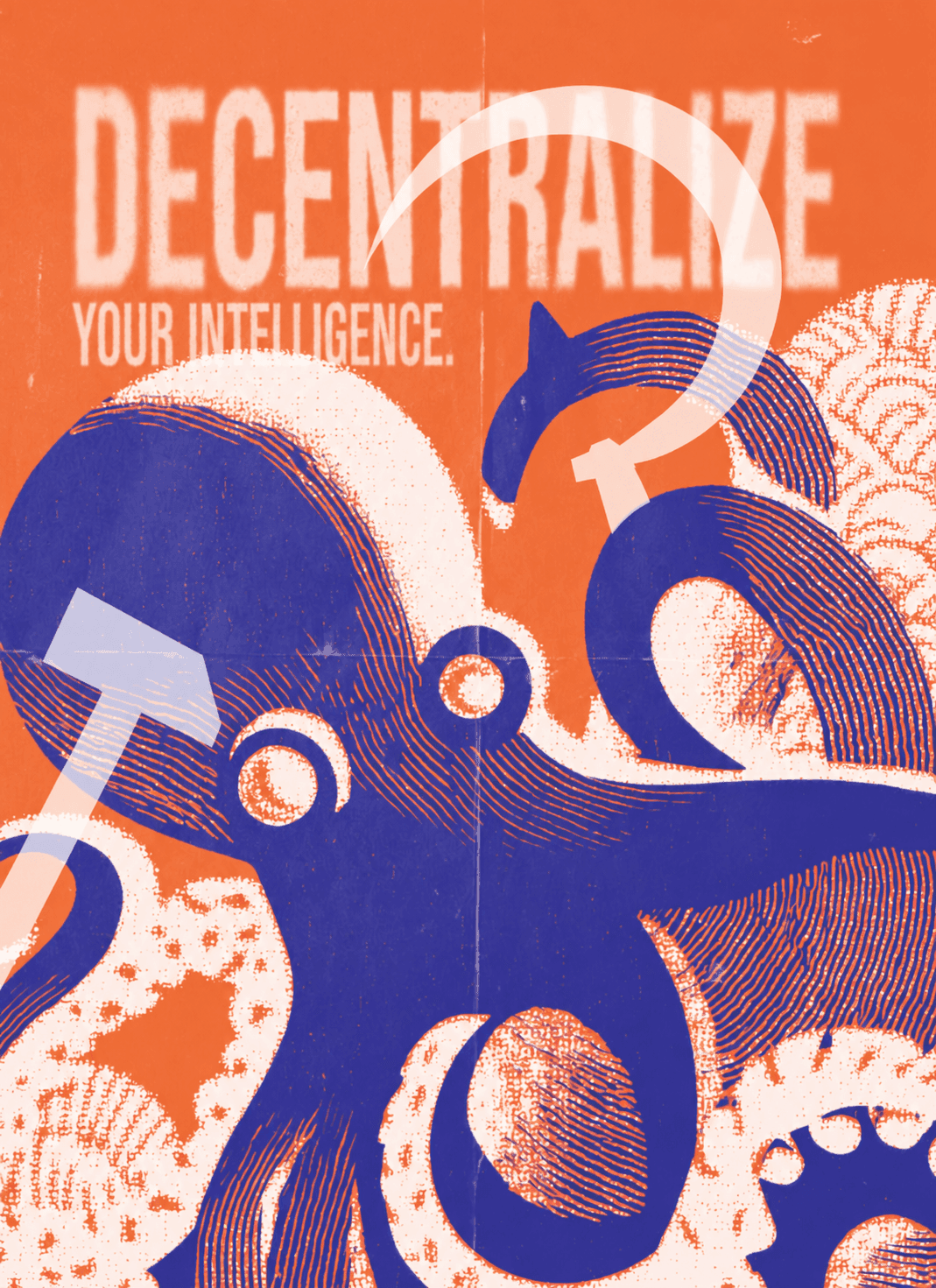
Octopuses, on the other hand, have a brain considerably different from ours: one part is in the head and shaped like a donut. The rest—about two thirds—is distributed throughout their eight arms and maintains a certain level of autonomy from the front part. It's a more decentralized sentient system, which, among other things, allows one tentacle to explore on its own until it detects something of interest, and only then, by touching or grasping it, does the rest of the octopus find out. If our brain is a monarchy, the octopus's is a Soviet committee.
The possibility that two species separated so long ago—and developed in such different environments—might communicate ought to catch our attention. If earlier we used the possibility, so often entertained by science fiction, of hypothetical communication with intelligent aliens as an example, this is the closest case we can find on Earth. In fact, science-fiction portrayals of extraterrestrials often draw inspiration from octopuses, whether to place them at the furthest extreme of otherness (like the aliens in Arrival, whose language, as we saw, was bound up with a different conception of time itself), to integrate and anthropomorphize them as much as possible (like the Hands from The Eternaut, unsettling because they are frankly humanoid and yet can operate an unnatural number of limbs), or to keep them monstrous in appearance while giving them human personalities that make mockery and satire possible, as with Kang and Kodos, the aliens from The Simpsons.
However, octopuses and humans, despite their morphological differences, share similarities. It's not easy to say whether those similarities are coincidences or expected outcomes of that shared past. But of them, the most interesting is neophilia.
Octopuses and humans alike are addicted to new things. We tend to become obsessed with them until intensive use turns them into old news, and then we abandon them. That curiosity—ironically, very ancient—governs our behavior and drives us to explore and play. A bored human can spend a long time bouncing a ball and catching it again, over and over, and an octopus in captivity can throw an empty jar against the current from a water filter so that it comes back to it and catch it, over and over. This use of the environment offers a considerable advantage over other species. Octopuses don't just swim; they also know how to walk along the seabed and use their free arms to pick up coconut shells that can serve as shields against potential predators. The ancient hominids who made use of the adaptive advantage of standing upright to go on pilgrimages in search of food aren't so different in this respect.
Neophilia explains the scene in the documentary My Octopus Teacher, which captivated audiences around the world. Released by Netflix in 2020, this South African film follows the story of Craig Foster, a diver who forms an emotional bond with an octopus in its natural habitat, the shallow waters of False Bay, part of the Great African Sea Forest. Foster takes every precaution necessary to become part of the environment: among other things, he swims without a wetsuit or oxygen tanks to avoid making bubbles that might disturb the ecosystem's neighbors. He carries only a camera to record what happens, and even then uses it sparingly. Finding the octopus is a stroke of luck: the animal is in a shallow den, but its camouflage is hardly an invitation to fraternize, so the diver must persevere for several months before establishing close contact. First comes watchful tolerance, then an approach, and finally something unexpected: after several weeks of being exposed to Foster's motionless presence, the octopus timidly begins to explore him with a tentacle (octopus suckers can also taste), touches his arm, and, its curiosity satisfied, goes back to ignoring him. Foster's superhuman patience kicks in once again: he gets the octopus used to his company and to going about its normal life with him by its side. Are they communicating? For now, they coexist, clearly aware of each other's presence, but nothing more. And yet the documentary's narrative progression is so good that they even go through a crisis, when Foster accidentally scares the octopus by dropping his camera, and then spends days tracking it down and rebuilding its trust. But the bond emerges so strengthened from their reconciliation that, in an absolutely moving scene, we finally see the animal climb up the human's body, wrap all its tentacles around him, press itself to his chest, and behave, if only briefly, as we would expect a mammal to. Again, are they communicating? It certainly seems so. It's hard to explain how. It all happens in silence, in the secret language of embraces, which can only be understood from the inside.
The story continues with a shark attack and the octopus's clever escape: it even makes it out of the water to disorient the villain, though the shark isn't all that disoriented and ends up mutilating one of the octopus's tentacles. Then comes another series of conflicts that are no longer relevant here. It's the scene of the embrace, of that nonverbal but deeply eloquent connection, that interests us. Because that connection, unlike the kind we're used to tracing with other species with which we share a more obvious coevolution, seems entirely disinterested. We know that dogs' ancestors approached human settlements in search of food, and that both they and we benefited from that bond. Something similar happened with cats. And in the case of livestock or so-called “working animals,” the dynamics of domination left little room for choice. But octopuses are solitary animals. Their bond with human beings offers them—and, at least at first, us—no immediate benefit. Curiosity, more than hunger, becomes the reason for the bond. A much more elevated, sophisticated, and, in this essayist's terms, genuine reason, if the aim is to establish complex communi-cation.Note to cats: curiosity, divine treasure.
On two occasions—the Cambridge Declaration on Consciousness (2012) and the New York Declaration on Animal Consciousness (2024)—science has recognized cephalopods as animals with the neurological capacity for subjective experiences and intentionality. And yet there are few scientific studies that try to figure out how to talk with an octopus. It seems we've focused on studying these animals' astonishing qualities, such as their ability to camouflage themselves by voluntarily changing their skin color in a matter of seconds, but we haven't looked very deeply into their potential as interlocutors. Why? Because they are solitary animals. They have no mental structure that evolved to sustain a conversation; they have no peer with whom to develop a language—in fact, they reproduce only once and die shortly afterward. They are hermits of the depths and, as a result, hold no keys to a culture but drift like outcasts, condemned to carry the weight of their heads, the weight of their intelligence, from here to there, ignoring, eating, or fleeing from beings more stupid than themselves. That's what makes the film so wonderful. For the octopus, meeting Foster is as strange and unusual as it is for Foster. But the most wonderful creature, the one most different from us and, at the same time, the one that shares some of our most particular traits—neophilia, complex play—can offer us only a silent conversation, once again confined to the world of gesture and behavior.
So we are grateful for the detour, the pause, the play, and the embrace, but we must continue on our way in search of another species we can talk to.
Where might we find one?
We said that, because they aren't social animals, octopuses haven't developed a language— a culture?—among themselves that we can access from the outside. To unlock interspecies communication, we need an animal that moves in a group, has been doing so for millions of years, and whose signals we are only now beginning to decipher in depth. A species that plays music we can understand. It's tempting to leave the water and redirect our search toward a more familiar biome, but that would be a grave mistake. Compared with the world up there, this one is beyond compare. What could be out there that could cause such excitement? There's always rhythm, ocean rhythm, under the sea.
Un viaje ilustrado acerca de la posibilidad de, algún día, hablar con los animales. Desde océanos pensantes hasta polémicos experimentos con chimpancés, disputas entre murciélagos y ballenas rebeldes. Lingüística, inteligencia artificial, literatura y mundo animal en un ensayo lúdico.
212 páginas. Encuadernación Binder. Impreso a tres tintas (negro + 2 Pantones) con laca sectorizada. 14,5 x 20 cm. Ilustraciones de Belén Kakefuku Del Solar.
Biografía del autor: Juan Cruz Balian nació el 3 de junio de 1984. Es Licenciado en Artes de la Escritura (UNA) y publicó el libro de cuentos Simple e imperfecto, y las novelas Ministerio de Invierno y La pausa.
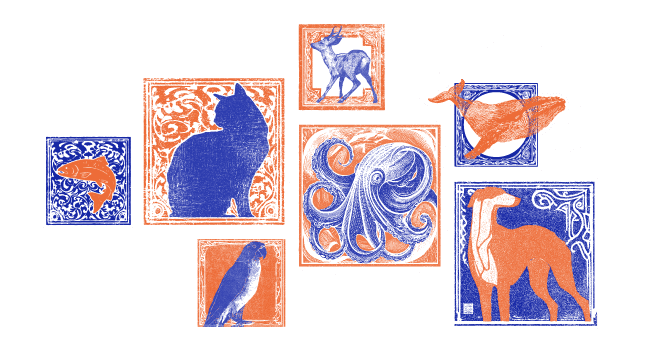
Una plancha de stickers A5 (14,8 x 21 cm) de animalitos para hermosear cualquier superficie. Hechos en impresión UV sobre vinilo transparente con laca sectorizada.
Ebook Cosas que mi gato tendría que saber$13.900
Un viaje lúdico por la lingüística, la inteligencia artificial, la literatura y el mundo animal. Desde océanos pensantes hasta polémicos experimentos con chimpancés, disputas entre murciélagos y ballenas rebeldes. ¿Podremos algún día hablar con los animales?
Formato .epub y .mobi
Biografía del autor: Juan Cruz Balian nació el 3 de junio de 1984. Es Licenciado en Artes de la Escritura (UNA) y publicó el libro de cuentos Simple e imperfecto, y las novelas Ministerio de Invierno y La pausa.