I don't mean to define the nature of language, but I can say this: although many insist on treating language as just one more tool among the many we've learned to develop, the truth is that it isn't. Language constitutes us. It is as closely related to cognition as sight, touch, or any other sense. “It is in our nature, since we did not make it,” says the linguist Émile Benveniste. That is to say, if we can now put it in a toolbox alongside sharpened stones and war tactics, it's because we learned to abstract it, excise it, and view it in a different light—something I'll talk about later. For now, language is what allowed us to say “I,” to say it out loud, to say it to someone who is “you” and therefore isn't “I.” Language also constituted us as a collective subject, “we,” together with everyone who, in turn, was able to name themselves. And from that day on, word by word, we began running a cognitive race against the rest.
Nobody doubts a beaver's skill at building a dam or the intelligence with which crows solve logical problems, but we have to admit that humans, with the knowledge we share with one another, whether orally or in writing, have done a whole lot more: enriched uranium, woven reed baskets, sequenced the genome of a nematode, built Gothic cathedrals, calculated the curvature of space-time, distilled whiskey, painted frescoes on walls, created machine learning algorithms, established caste systems, invented democracy, predicted the trajectories of comets, created smart contracts based on blockchain, vaporized cities with thermonuclear energy, devised ideas in statistical mechanics to estimate the effects of the microscopic world on macroscopic systems, set foot on the Moon and the ocean floor, composed “Desarma y sangra” and the Iliad, and wrote the Martín Fierro, The Waste Land, and The Lord of the Rings.
All of this fed not only our pride but also the conviction that the human species really is different from all the others. We even went so far as to devise a way to quantify that difference: according to the Kardashev scale, proposed in 1964, species can be classified into three types depending on their technological capabilities. Type 1: those with planetary mastery who can use all the energy available in their world. Type 2: those able to capture and harness all the energy radiated by their star. Type 3: those capable of consuming the galaxy's energy and conquering other solar systems. Carl Sagan calculated that in 1973 humanity scored a comfortable 0.70. Today, estimates put us at 0.73. Not bad for a species that started from zero and knows of no other species on a higher rung. Perhaps the most striking thing about this scale, in this context, is that we have a real chance of reaching Type 1 in a few centuries—provided we don't destroy ourselves first—and that it's highly likely that, when we do, if we do, or even in order to manage it, we will at some point in the process have to fulfill our oldest dream: talking to animals.
But, now that we've settled what we mean by animals—and how we humans are part of them while also possessing the characteristics that set us apart—my cat might think to ask me: what does speaking mean? My first reaction is to stick to the dictionary and answer that speaking is the ability to produce articulated sounds to express thoughts or feelings through the use of language. But that simple definition raises a whole host of other problems: the mechanics of speech, its cognitive and social aspects, not to mention that it includes another word still waiting to be defined: language.
Even if only to give an example of how murky the waters we've already begun to navigate are, there's a debate that remained closed for a long time and has now reopened. Just as the egg comes before the chicken but can only be produced by it, orality and writing chase each other's tails at the origins of humanity. It's usual to think that speech must have preceded writing for obvious reasons: writing is a mark that refers to orality, freezes it, materializes it, but it requires a tool external to the body—a finger in the sand, at the very least—whereas orality takes place closer to the brain; it is a much more primordial expression. Let's put it this way: it's easier to imagine a hominid (I'll use that term for any creature halfway between what we consider animals and what we consider human beings) expressing itself orally, however clumsily, than to imagine it putting its entire cerebral cortex at the service of strange symbols and marks with the power to represent meanings. But other people (Derrida again) think that every verbal act leaves a trace that can only be interpreted a posteriori, in the absence of the person who performed it. Even if only a second later, the word we release into the air works only if it works without us. It's a word only if the listener catches it (interprets its trace), even if lightning struck us in the meantime. In that sense, speech would also be a form of writing. This is exactly the kind of philosophical debate I'll try to avoid, since they are genuine “rabbit holes.”A note for rabbits: Alice's Adventures in Wonderland is a children's novel about a girl who gets lost following a rabbit down its hole and ends up entering an outlandish world, where she has a series of absurd adventures and talks with all kinds of animals, only to discover in the end that it was all a dream. The portrayal of the rabbit may be somewhat stigmatizing to the species, but bear in mind that it was written in the nineteenth century.
Now, if you can develop writing proper, I wholeheartedly recommend doing so. It's clear that writing is not a mere representation of speech. It is a visual and material substrate on which the cognitive possibilities of each era rest. The anthropologist Jack Goody argues that when humans began to write, the first thing we did was make lists: long lists of words that immediately allowed us to expand the limits of memory, reorder elements, and keep records. Language may be an intrinsic and inalienable faculty, but writing and reading are extensions of the mind, just as a sharpened stone is an extension of the arm holding it. According to the philosopher Michel Foucault, all the great epistemological shifts in human history were grounded in writing: first as a magical, obscure element reserved for the great exegetes; then as an analytical device for understanding reality; and finally turned back upon itself, made its own subject matter, enabling the modern forms taken by history, literature, and the sciences. In any case, for our more immediate purposes, and based exclusively on how things went for us human beings, good spoken languages—rich in nuance—are enough to make sure our first step is firm, to develop the coordination that makes the whole stronger than the individual, to compose the poetry that builds a mythology giving us a sense of belonging and connection to the universe, to forge camaraderie, encode humor, and unfold the imagined narrative that will project a shared destiny. Speech is powerful enough to bring us together around a campfire.
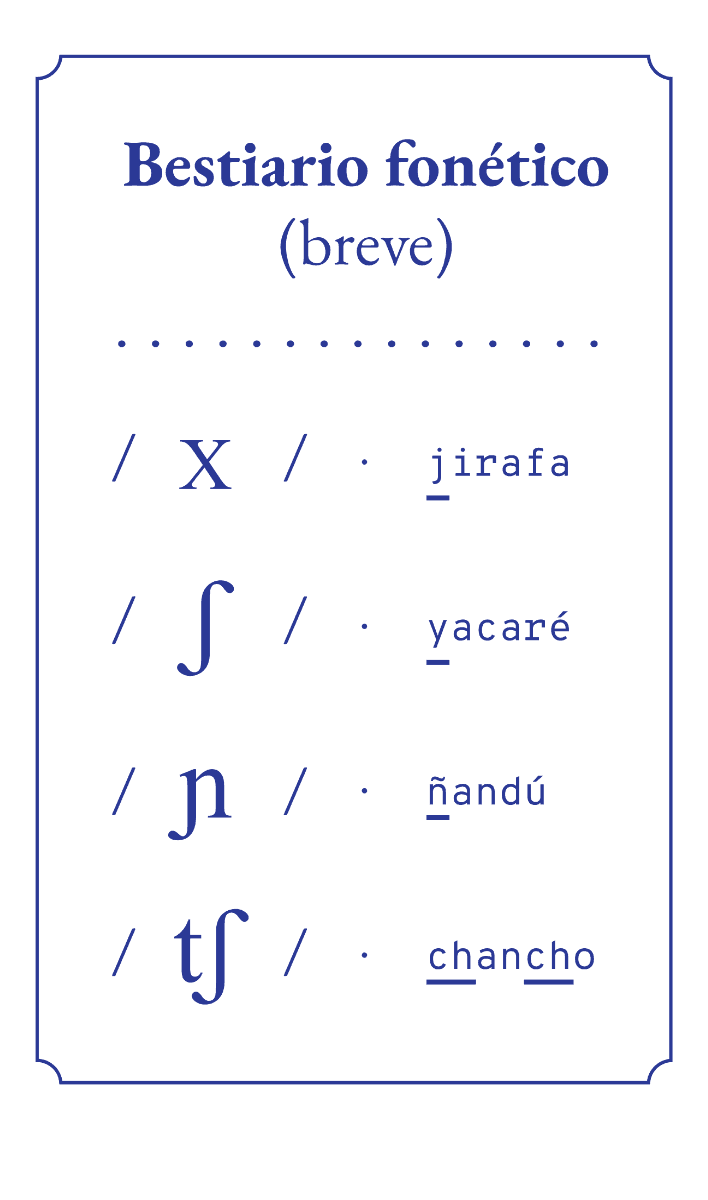
Let's say, then, that verbal communication is the first way of exercising the great privilege of being human: the faculty of language. How did we begin to exercise it? Hard to know. If human beings can speak across a relatively wide range of vowels and consonants, it's because we have a set of organs and a particular physiology that enables us to expel air, make it vibrate, and interrupt its flow in different ways. Lungs, vocal cords, tongue, palate, teeth, glottis, lips, nose. All of that lets us pronounce phonemes (the smallest unit of speech) such as /a/ or /e/ and make them sound different. It also lets us distinguish an /f/ from a /p/ or an /m/. And yet what's wonderful isn't so much this sonic virtuosity, nor our ability to do different things with a limited menu of options. Other species, such as parrots, have different anatomical tools that let them display similar abilities. Clearly, in the human case, the toolbox—the position of the lips, resting the tongue against the teeth, or closing the throat as we exhale—coincided with something else, an advantage of a different kind, some sort of mental phenomenon, a cognitive spark. Long before we conceived graphemes (the smallest unit of writing) and could therefore “see sound,” what we interpreted with our ears were phonemes: distinct sound units that let us construct distinct meanings. Deep in some cave, still half bent over, driven more by the emotions of our lizard brains than by a developing prefrontal cortex, we began naming things and addressing one another.
We started talking.
However, to understand the origin of the word as a growl used to point things out is a gross oversimplification. If it happened, it was in prehistoric times—when “all songs were sad,” Jack London wrote—A note for dogs: Jack London is the author of The Call of the Wild, a novel centered on the mind of a domestic dog and the adventure that takes him from a comfortable bourgeois life back to the wild origins of his species. It's important, and we'll talk about it in a later chapter. In that same chapter, we'll discuss whether dogs can conceptualize the idea that an event will happen in the future. I honestly hope the answer is yes; otherwise, this footnote is useless. and all we can do is imagine that's how it happened because it couldn't have happened any other way. Fair enough. It's a good speculation.
For too long, however, we believed that speaking was, essentially, making different growls to refer to different things in the world. Water, food, danger, sex. As if the possibilities of human language were exhausted by that pointing gesture, as if we were still playing an unproductive game proposed by an indifferent god: name everything and see if that keeps you entertained for a while.
Nothing could be further from the truth. Our toy grew so sophisticated that we soon realized two fundamental things: that its possible uses were infinite, and that we could use it in complex ways only among ourselves. There's no mistaking this point: we've always used words to address animals, but rarely have we received a fitting response. Here I'd rather avoid the stories of shamans, which I find unreliable, and stick to the testimony of Uda Tennō, a Japanese emperor who lived almost 1,100 years ago and had an obsessive fondness for a black cat he'd been given. Tennō records in his diary:
I said to the cat: “Since you possess the forces of yin and yang and have a body, you must be able to understand me, right?” The cat sighed, stared at me, and seemed full of feelings, but unable to say anything with its mouth.
What was happening in the East should be of particular interest to us. It was there that we began creating metalanguages—that is, languages that talk about language. More than 4,000 years ago, in ancient Sumer, thinking about language itself had developed enough for people to compose Gilgamesh orally, the oldest epic poem we know; invent writing by pressing wedges of different shapes into clay tablets; compile lists—which, as we saw, substantially expanded civilization's cognitive technology by allowing us to memorize larger amounts of data—and, what matters most for this essay, leave a record of the first grammatical notes.
Those grammatical notes were necessary: Sumer had more than one language (Akkadian and Sumerian), and recording keys for translating from one to the other was essential. But it's fair to assume that concern with understanding language is so inevitable in our species that it would in no way be confined to a single culture. Even without being grammars proper—that is, comprehensive manuals on how a language works—various attempts at grammars sprang up here and there. Sometimes they were mere glimpses, small but significant traces left by the first footsteps along the path I now barely dare to tread. For example, Pāṇini, a grammarian in ancient India, left 4,000 rules (in the form of sutras, a kind of aphorisms or phrases of wisdom and instruction) about Sanskrit, one of humanity's oldest languages. These were not rules in a prescriptive sense, but a generative one. Tools with which Sanskrit could go on producing itself.
To avoid going on too long, I'll summarize the Western story: the Greeks and Romans began reflecting on these questions about 3,000 years ago, laying the foundations for what became known in the Middle Ages as the Trivium: one of the pillars of an educational system that already included understanding and teaching the proper use of language, logic, and rhetoric. In the seventeenth century, the first grammar that, in addition to being prescriptive, sought to understand the universal principles of language was written at the French abbey of Port-Royal des Champs. Then, toward the end of the nineteenth century, the foundations of morphology were established—a term borrowed from the natural sciences to describe the discrete units that make up a word. Along the way, linguists stole the flag of semantics from the logicians and turned it into an autonomous discipline. Phonology had to wait until the beginning of the twentieth century for some crazy Russians—perhaps this summary isn't so Western at this point—to understand it and establish it as an independent field. A few more years, and grammar became the torture device for schoolchildren that it is today.A note for educators: the torture device for schoolchildren is necessary and productive. Knowledge of how one's own language works is just as relevant as knowledge of how the respiratory system or thermodynamics works. And in the middle of the twentieth century, Noam ChomskyA note for the morbidly curious: Chomsky's reputation is currently under scrutiny for reasons unrelated to his intellectual output, but rather because of certain documents that would link him to the famous financier, pedophile, and sexual predator Jeffrey Epstein. Multiple sources clarified that the connection was intellectual and involved financial advising, and that there was nothing linking him to Epstein's crimes. I don't know the truth of the matter, so this will be the only footnote on this subject, but other disturbing matters await us throughout the book. put biology back at the very center of the discussion. That's where things got complicated, so let's leave that for later.
To complete the stormy landscape I have in mind, I'll say that language as an object of study is more elusive than a chemical element or an exotic species, both of which, once identified, can be redefined in light of new evidence without too deeply offending the sensibilities of their original discoverers. At least in those disciplines, conflicts are not as frequent as they are in the philosophy of language, an arena where linguists, philosophers, biologists, ethologists, anthropologists, semioticians, data scientists, writers, poets, and practically any speaker with intuitions do battle. That's why Ferdinand de Saussure himself, the father of modern linguistics, claimed that language is impossible to study, that it is an unbounded chaos, and, on the verge of tearing off his prominent mustache, proposed dissecting only specific “languages”—that is, the systematizable aspects of the problem—like someone tapping on a hollow wall and trying to understand what's on the other side.
Today, there is no consensus on the nature of language. For some, it is the result of an innate human faculty; for others, it is a technology; for others, a tool; and for many, it is utterly inseparable from our very existence and our capacity to conceive of the real world. But the very act of using it gives us wings to fly over it and redefine it in defiance, to approach it through metaphors that are less technical and more digestible or, conversely, through metaphors drawn from other technical fields, sometimes alien to the tradition that coined the terms with which we think about language today. For example, this language (because I mean Spanish in particular) is what my freedom as an essayist rests on, allowing me to write these words. And although I know I'm no surgeon, I intend to find the heart of the matter: I'll grab the saw, and may I be forgiven for the mess.
It's worth revisiting some of the definitions of “language” that have become canonical, to understand just how much this variety invites us to lash ourselves to the mast at this first stage of the journey.
Aristotle linked discourse (logos) to politics. In his view, language is the tool that lets us live in society, arguing and reaching agreement about what is beneficial, what is harmful, what is just, and what is beautiful. This view is entirely subordinate to rational order as the distinguishing mark that sets us apart from “the beasts.” The philosopher Martin Heidegger, by contrast, defined language as “the house of Being.” Put briefly, this means that language is not a simple tool, but the very dimension in which we can conceive of the world. Another philosopher, Ludwig Wittgenstein, shifted the focus and proposed that language is a series of “games,” exchanges in which we humans articulate elements to produce meaning. Meanwhile, Noam Chomsky tied language to its evolutionary origin, defining it as an innate biological faculty, and tried to draw his conclusions from that unshakable principle.
If my cat asked me to clarify the differences between those thinkers, I'd slip into the cracks between them and find no footing. And that's not even counting the other perspectives that could be added to theirs: outsiders to the tradition, interlopers, people who think about language in other terms. I'm talking, of course, about scientists and writers. The former keep pushing the frontier back, again and again. The latter often don't even realize there was such a thing as a frontier.
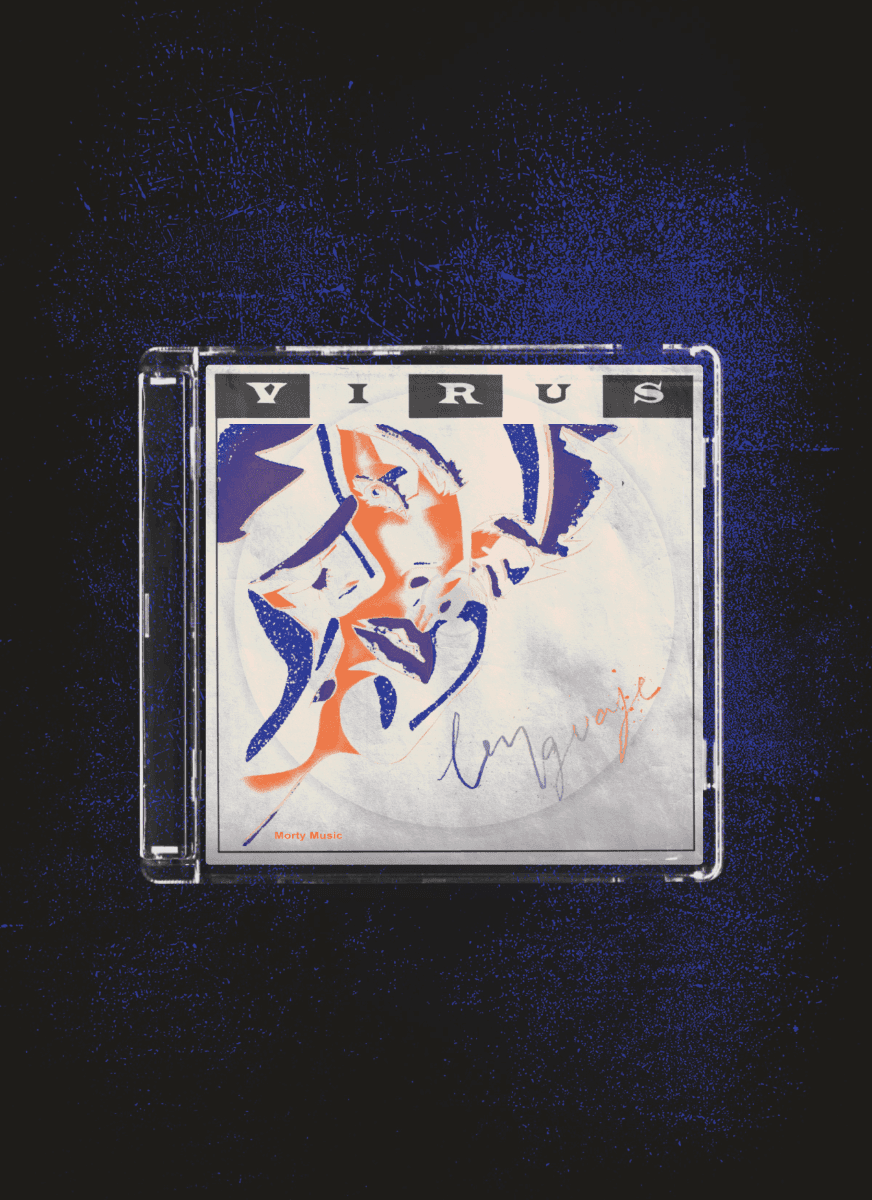
Take, for example, William Burroughs, who considered language to behave like a virus because it can self-replicate, even from fragments. Burroughs was a writer, not a virologist. But his definition, coined in the days of tape recorders, seems entirely apt in light of the most recent theories about the circulation of information across digital substrates. According to this view, language is memetic. It replicates itself. Therefore, if it jumped from humans to animals, we'd be looking at a case of zoonosis.A note for bats: humans are still dealing with the post-traumatic stress of the COVID-19 pandemic, presumed to have originated in bats and passed to humans via some intermediate host. It is significant that viruses are not living beings, but merely chains of genetic information, because this (and every zoonosis) can then be considered a case of involuntary communication between species. A very particular case, because unlike other epidemics, this spread is something we're seeking. Far from erecting barriers, we're taking every possible measure to encourage contagion.
For example, when my siblings and I were little, we had a parrot at home named Spartacus (he’s still alive). We were so determined to teach him to talk that he ended up learning a few insults, greetings, calls for food, and the complete jingle from an ad for sliced sandwich bread. Around that same time, I learned that Saint Francis of Assisi could communicate with the creatures of the forest with such complexity that he negotiated a truce with a wolf that was terrorizing a village. He also preached to the birds, or at least that’s what they told me in catechism class. In addition to Emperor Uda (Uda Tennō), there was a Japanese emperor who wrote long, heartfelt poems to his cat, and they say Mozart taught his starling to sing part of a concerto—a feat less impressive than Saint Francis’s, but much more likely.
None of the above really qualifies as “speaking.” But this obsession—mythological at first, poetic later—became a goal deliberately devised and pursued systematically and obsessively, both by literature and by science, and by the occasional adventurer we’ll encounter in the pages ahead.
Un viaje ilustrado acerca de la posibilidad de, algún día, hablar con los animales. Desde océanos pensantes hasta polémicos experimentos con chimpancés, disputas entre murciélagos y ballenas rebeldes. Lingüística, inteligencia artificial, literatura y mundo animal en un ensayo lúdico.
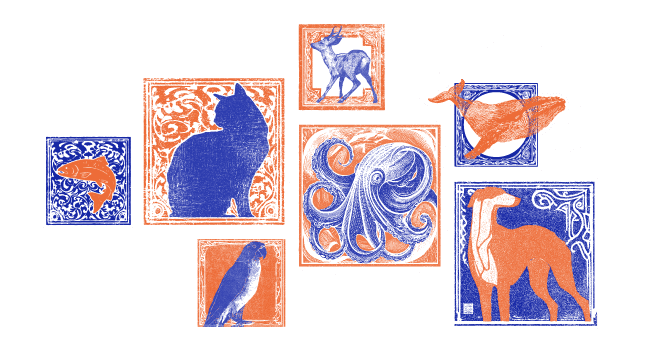
212 páginas. Encuadernación Binder. Impreso a tres tintas (negro + 2 Pantones) con laca sectorizada. 14,5 x 20 cm. Ilustraciones de Belén Kakefuku Del Solar.
Biografía del autor: Juan Cruz Balian nació el 3 de junio de 1984. Es Licenciado en Artes de la Escritura (UNA) y publicó el libro de cuentos Simple e imperfecto, y las novelas Ministerio de Invierno y La pausa.
Una plancha de stickers A5 (14,8 x 21 cm) de animalitos para hermosear cualquier superficie. Hechos en impresión UV sobre vinilo transparente con laca sectorizada.
Ebook Cosas que mi gato tendría que saber$13.900
Un viaje lúdico por la lingüística, la inteligencia artificial, la literatura y el mundo animal. Desde océanos pensantes hasta polémicos experimentos con chimpancés, disputas entre murciélagos y ballenas rebeldes. ¿Podremos algún día hablar con los animales?
Formato .epub y .mobi
Biografía del autor: Juan Cruz Balian nació el 3 de junio de 1984. Es Licenciado en Artes de la Escritura (UNA) y publicó el libro de cuentos Simple e imperfecto, y las novelas Ministerio de Invierno y La pausa.