In Warsaw, in 1961, Stanisław Lem published Solaris. A tragic, oppressive novel, optimistic in imagining our future technological capabilities, pessimistic in believing that those technologies will give us a deeper understanding of the mysteries of the universe. Solaris (the novel) tells the story of a group of scientists confined to a research station floating a few meters above the surface of Solaris (the planet). Certain clarifications are needed to understand the nature of this planet and, therefore, the scientists’ specific situation: Solaris orbits two suns, one red and the other blue. The red one causes horrific burns if people do not take shelter behind the station’s thick metal blinds while they wait for the few hours of darkness they will have before the blue sun appears, tinting things in muted shades of green, gray, and violet, a depressing scene like a night that is far too bright. The characters feel as though they inhabit two worlds and do not fully understand either one.Note for hominids: “Note for amphibians: is this a metaphor? However, Solaris has other secrets. The greatest of them was discovered hundreds of years ago by other Solarists. Solaristics is a field of research that was once in vogue in the past of that future, but it lacks the rigor needed to become a solid theory. Even so, solaristics is extraordinarily prolific in terms of publications. And there is broad consensus around one particular hypothesis, although no one has been able to prove it: the mucilaginous ocean covering the entire planet is, in fact, a single living organism.
Everyone agrees on that, but of course there are disputes. The most important one revolves around whether this immeasurable being is conscious. Many think it is, and that its movements are necessary for the planet to navigate the complex orbit imposed on it by its two suns without colliding under the three-body problem,Note for Greek sphinxes: the term refers to the impossibility of predicting the movements of celestial bodies in systems with more than two bodies, because adding a third body makes all the trajectories erratic. This has nothing to do with you. and that, therefore, it must be a primordial being with vast knowledge “piloting” the planet. But the idea sounds exaggerated. The strongest argument in its favor comes from experiments that tried to establish contact. Apparently, the ocean listens and, eventually—with timescales that seem oceanic to us—responds. Not always. Sometimes. When it does, its responses usually take the form of a soft sculpture, like a tower, rising from the surface and, through foam and dense liquids, managing to reproduce something resembling a spacecraft or objects of human manufacture that have fallen into the sea, things humans make and that the ocean seems to be trying to imitate. Deciphering the message is impossible. At the same time, the intuition that “there is a message” is too strong to ignore.
In an effort to stimulate the ocean and wrest a response from it, the scientists try everything: they bombard it with radiation, fly over it again and again, land on the giant sculptures while they remain standing (and must flee quickly before they collapse), submerge probes, and even detonate thermonuclear explosives. Nothing works. They describe themselves as “ants on an elephant’s back trying to get its attention.”
But the ocean does something else. Or at least it seems to. Because the scientists living at the base receive “visitors” every day: human replicas of the loved ones they left behind on Earth when they set out on their journey, who now appear in their rooms or in any corridor, demanding affection. To make matters worse, they behave as if it were their first day inhabiting a person’s body and mind. The realism of these “replicas” is disturbing, but so are their dysfunctions. They are the obvious work of a being that does not fully understand what a human is or how one should behave, even if it can imitate one perfectly on the outside and sketch a consciousness for it. Hence, the most logical inference is to attribute the creation of the “visitors” to the ocean, which apparently has some kind of telepathic power.
Beyond the fact that this is a violation of the intimate space of their minds, the scientists insist that it might also be a message. But no one can understand what it is, because no one knows whether the ocean is an unintelligent entity responding to a stimulus, like a sunflower chasing the light throughout the day—in this case, an ocean responding to the proximity of human beings—or whether it is a kind of child-god playing with the feelings of beings so insignificant that it cannot even conceptualize them, as—again, in the words of one of the characters—“an elephant would have a hard time imagining an ant’s feelings.”
The plot of Solaris does not answer these questions, but invites us to take the last hypothesis seriously. In any case, what interests us is understanding whether Solaris offers ideas worth considering when we try to communicate with a species different from our own.
Lem explores the possibility that this dead end has no way out: in the station library, the protagonist finds a short book in which the argument for impossibility digs in and makes its case with the utmost vehemence. It says that the idea of contact with the ocean is too nebulous, that it is a religion dressed in the trappings of science, and that if scholars insist on continuing down that path, it is only because accepting the truth would wipe out their entire field of study in one fell swoop. The accusation: Solarists are a bunch of fools blinded by their own pride. The main evidence: there have been no reciprocal experiences between Solaris’s sea and Earthlings:
What can people expect after “establishing an informative communication” with thinking seas? A record of experiences tied to an existence that does not end in time, so ancient that it surely does not remember its beginning? A description of the desires, passions, hopes, and pains released in the monumental births of living mountains, in transformations of mathematics into existence, of solitude and resignation into fullness? All of that was knowledge that could not be transferred.
For our purposes, how can we be sure, even if we take for granted the idea that there is a message to be deciphered, that the distance between the life forms that want to be part of the communication is short enough for that communication to be possible? How do we know we are playing the same game? What grounds do we have for believing that things mean the same to both sides? Lem’s hyperbole—that is, his choice of a mucilaginous ocean living thousands of light-years away from us—is nothing more than a way of illustrating something much more immediate: the first requirement for having an interlocutor is for its existence to unfold on the same spatial scale as ours.
The idea was suggested to me by Matías Grinberg, a psychologist specializing in neuroscience and an artificial intelligence developer, whom I sat down to talk with about this one sunny morning that invited belief. It was a quick conversation, woven around a couple of coffees, with both of us more inclined to chat without any fixed direction than to go through the formalities of an interview. As soon as I realized we were finishing our second cup and time was slipping away, I tried to get to the point: Is it possible to talk to animals? Is it possible to do so with the help of AI? Will it be possible in the future?
They say we choose whom to ask for advice based on the answer we want to hear, and I knew Matías was an optimist. What I did not expect was for him to tell me about a forest.
—Yes, but it depends on the kind of entity you’re talking about, he said, and immediately proceeded to perform a dissection on the table. There are organisms that may have the cognitive abilities needed to converse: to be self-aware and have a relationship with their surroundings... Maybe some kind of phenomenal consciousness is needed, Note for conscious beings: in The Knot of Consciousness, Enzo Tagliazucchi defines phenomenal consciousness as the kind that refers to “how things feel.” For example, the redness of the color red. To report that experience, another kind of consciousness is also needed, called access consciousness which is what makes that information available to express. Some authors reject that distinction. For the purposes of this book, it is irrelevant. We are looking for a species that has both. but the question is at what scale that cognitive entity exists. You can exchange information with a forest through a tree: the tree senses your presence and communicates it through the mycelium to the other trees, the whole organism reacts, and some kind of back-and-forth takes place that we call communication. But it would not be a conversation, because the forest exists on a different timescale. Even if the forest had a “self,” there would be no resonance between your “self” and the forest’s “self.” So you have to choose the scale at which the emergent properties needed for communication arise. You can try talking to an ant or you can try talking to an anthill. The ant has one kind of consciousness; the anthill has another.
So, in my search for an animal interlocutor, the first thing I need to consider is scale. That does not seem difficult. I know many animals my size. However, thinking about what Matías said, scale alone is no longer what concerns me. His words suggest another concern, one that has to do with the environment: despite the similarities, our differences from other mammals might be significant enough that we cannot share a set of common experiences and, therefore, a consensus that makes meaning possible. Still less, a flow of communication.
Un viaje ilustrado acerca de la posibilidad de, algún día, hablar con los animales. Desde océanos pensantes hasta polémicos experimentos con chimpancés, disputas entre murciélagos y ballenas rebeldes. Lingüística, inteligencia artificial, literatura y mundo animal en un ensayo lúdico.
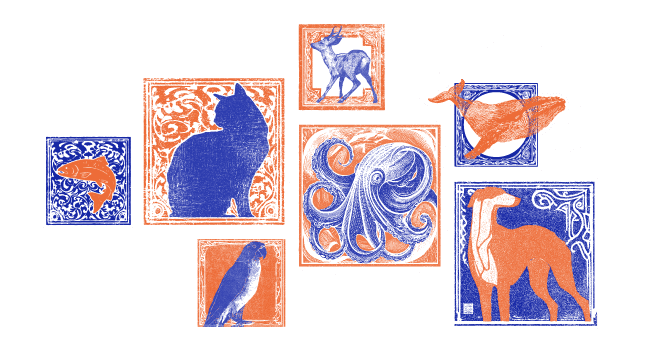
212 páginas. Encuadernación Binder. Impreso a tres tintas (negro + 2 Pantones) con laca sectorizada. 14,5 x 20 cm. Ilustraciones de Belén Kakefuku Del Solar.
Biografía del autor: Juan Cruz Balian nació el 3 de junio de 1984. Es Licenciado en Artes de la Escritura (UNA) y publicó el libro de cuentos Simple e imperfecto, y las novelas Ministerio de Invierno y La pausa.
Una plancha de stickers A5 (14,8 x 21 cm) de animalitos para hermosear cualquier superficie. Hechos en impresión UV sobre vinilo transparente con laca sectorizada.
Ebook Cosas que mi gato tendría que saber$13.900
Un viaje lúdico por la lingüística, la inteligencia artificial, la literatura y el mundo animal. Desde océanos pensantes hasta polémicos experimentos con chimpancés, disputas entre murciélagos y ballenas rebeldes. ¿Podremos algún día hablar con los animales?
Formato .epub y .mobi
Biografía del autor: Juan Cruz Balian nació el 3 de junio de 1984. Es Licenciado en Artes de la Escritura (UNA) y publicó el libro de cuentos Simple e imperfecto, y las novelas Ministerio de Invierno y La pausa.