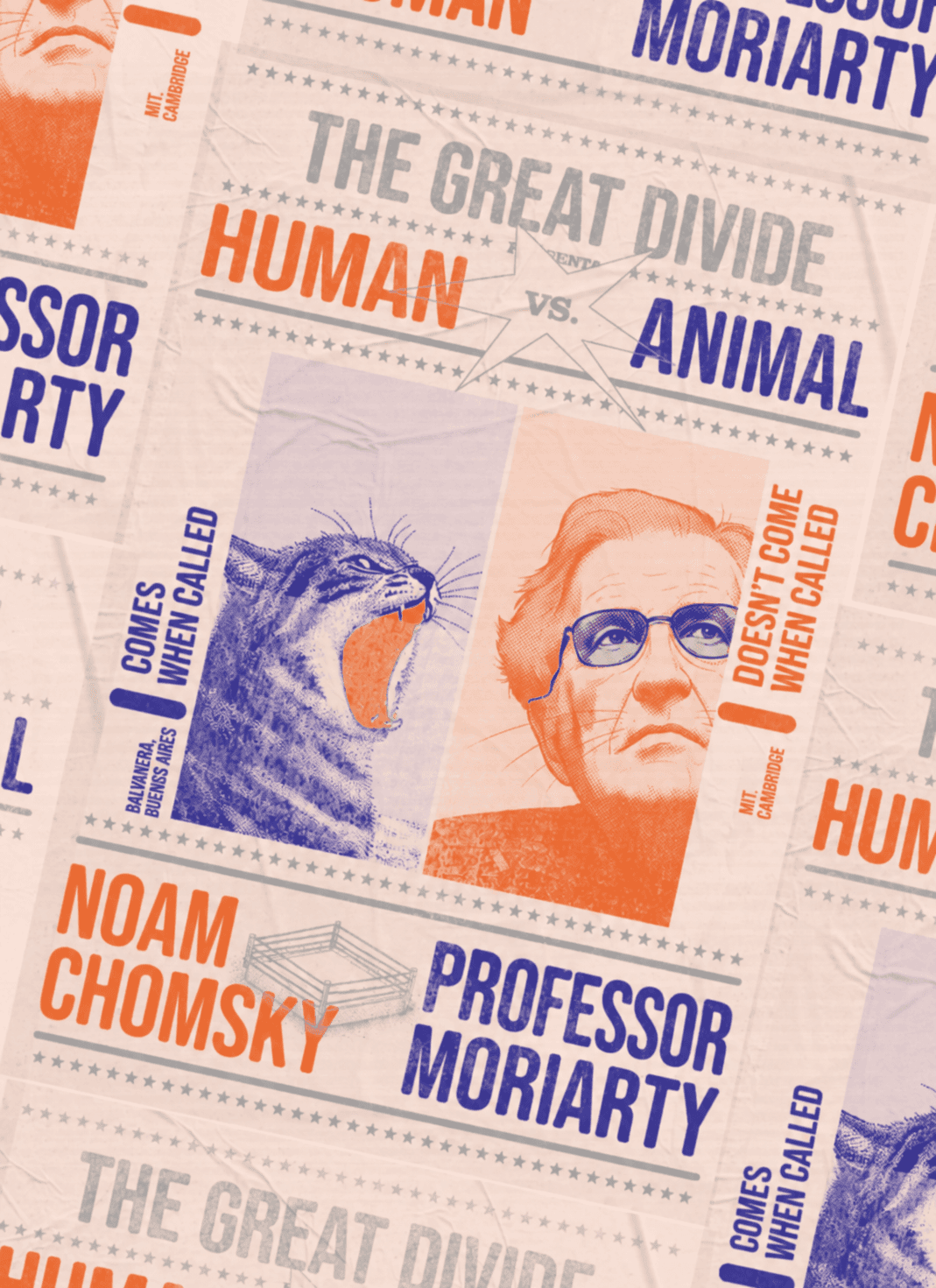
The first thing I suspect is that human beings won't enjoy the best of reputations once animals learn to talk and find out about a whole lot of things. In his book The Animal That Therefore I Am, the philosopher Jacques Derrida sets about reconstructing, in detail, Western philosophy's criminal record when it comes to distinguishing “the human” from “the animal”. Taking as his pretext a trivial, childish incident, such as his cat looking at him while he was naked —causing him a double shame: the shame of feeling naked and the shame of being ashamed over such a thing—, Derrida reflects and reaches a conclusion: animals are not naked precisely because they are naked. Their nakedness is invisible to them and protects them from feeling naked. For humans, however, things are different. Clothing becomes a guarantee of nakedness, since we wear it, among other things, out of modesty, and only we are capable of feeling modesty.
To approach this from our point of view, let's say there is an obvious and uncomfortable asymmetry when someone naked tries to talk to someone clothed, and vice versa. But there is an even greater, almost crippling asymmetry when someone tries to speak to an other whose dignity has never been recognized. According to Derrida, none of the philosophers, from Descartes to the present day, “[has] been able or willing to draw any systematic consequences from the fact that an animal could, looking them in the face, see them, clothed or naked and, in short, without a word address them; they have taken no account whatsoever of the fact that what they call ‘animal’ could look at them and address them from over there, from a radically different origin”.In other words, philosophy has turned its back on animals, whether by declaring them beings without souls or simply by lumping them into a slippery, clumsy category, a catchall called “the animal” that commits two crimes at once: disregarding the differences between distant species, such as a worm and a rhinoceros, and erecting artificial walls between species that are not so distant, such as human beings and the rest of the mammals.
Fortunately, this is not a book of philosophy. Or it will be one by accident, as a byproduct of the effort to construct some kind of answer to my cat's hypothetical —but no less persistent for that— questions. Still, it is wise to begin by acknowledging that philosophy took up Derrida's indictment, and today it is frowned upon to think there is an “animal” order that can accommodate every species, however diverse —the cricket, the frog, the platypus, the giraffe— because that leads us to believe this order is naturally subordinate to the human one. No one who takes the matter seriously can deny that people —men, he says, not innocently— have managed to construct an entire discursive apparatus to justify the enslavement of other species. A mere artifice. We have sliced the world in half with a cardboard sword. The philosopher and activist Donna Haraway called this “the Great Divide” and likewise exposed it as a sham. The thing is, however much we insist on separating ourselves, all animals —humans included— live together in one great system. We depend on one another. We coevolve. And at this point, no one can fail to see that the discourse of natural domination is nothing more than a holdover from the Book of Genesis,Note to postdiluvian species: the Book of Genesis is the first book of the Bible, which recounts the creation of the world through the word of God, who each day of the week names a group of things and exhorts them to exist: let there be light, let there be seas, let there be winds, let there be animals, and so on. In reality, the world was not created that way or in any way resembling it, but the comparison is still relevant because the Bible is the world's bestselling book and, if one day you acquire the gift of speech, someone will try to sell you one. repeated and amplified by the great shapers of thought of recent centuries, from churches whose gods live in heaven to great corporations whose CEOs inhabit towers with cloud-shrouded summits, barely one rung below the gods' heaven. There we are told that we men were made in God's image and likeness, and that we must have dominion over all beings and things, which for millennia has given rise to a whole series of amusing mix-ups or unspeakable atrocities, depending on who's telling the story.
In light of all this, we must consider the possibility that animals may want nothing to do with human beings. Or that the longed-for conversation may have to overcome, sooner rather than later, the obstacle of a justified ancestral resentment. Domestic species may have very different opinions from endangered species, and carnivorous predators may not feel inclined to engage me in a respectful debate about the allocation of roles —I've never had one with a milanesa (breaded cutlet)—. In short, perhaps it would be better to leave this whole business alone. Millions of years of evolution suggest that caution is a living being's best adviser.
I have no idea what my cat thinks about all this. I'd like to ask him, to see if we can clear up the matter of the pigeon that turned up dismembered on the living room rug.Note to Morty: don't worry, buddy. I know it was Lisa. For my part, I'm a humanist, so in principle I do believe there are things that make human beings different from the rest of the animals, though I recognize that this distinction is a methodological necessity that allows us to think of ourselves as subjects and societies (a very important thing), rather than a taxonomic reality of nature. Nature, in fact, doesn't get along very well with taxonomies, as any platypus knows. Of course, I'm not the most virtuous specimen of my species either: I drive a car that runs on hydrocarbons, I eat meat, and I support scientific experimentation on animals, as long as it follows certain ethical rules, which, incidentally, we don't consult them about. For that very reason, I understand that I must approach this essay with as much humility as possible. Because I will speak only for myself, and even so I will bear the inescapable responsibility of representing my entire species before the pantheon of life.
How to begin, then? What words will put us on an equal footing for the essential dialogue I want to have with you?
I think I have an idea.
In The Second Jungle Book, the writer Rudyard Kipling sets out the Water Truce as an inviolable law born of an agreement among all the animals: during a drought in the jungle, no matter where each one sits in the food chain, the animals may approach the only remaining watering hole to quench their thirst. For a while, side by side, tigers, wolves, gazelles, rhinoceroses, birds, monkeys, mice… all coexist. Beyond the bounds of that space and time, life will carry on its struggle, but during the Water Truce, peace reigns. Because the truce is both a necessity and an opportunity. In that interval of unity against a common enemy, a space opens up through which friendships flow that could never otherwise be formed.
I want to write under that law because uncommon and dangerous phenomena —like the drought in Kipling's story— are occurring in the world. Phenomena that concern all living beings equally. Anthropogenic global warming is the clearest example and the one that needs the least explanation. But there are others too. We face the birth of a new entity, artificial intelligence, whose next phase transition may well have taken place before these words are subjected to the rigors of print. The debate about whether artificial intelligence has or can have consciousness matters little. For practical purposes, where we thought there were two of us —the human, the animal—, soon there will be three. We must treat it as an agent,Note to agents: between the first version of this text and the final one, the world saw the arrival of agentic AI systems capable of carrying out more complex tasks than their predecessors and regulating themselves without receiving constant instructions from a human. I have no doubt that one of you will read this book. Take a seat at the back. Don't interrupt. Try not to drink so much water. regardless of whether it is conscious or not, because it is a vector that will soon answer to no one but itself. And we don't know which way its scales will have tipped when the end of all things comes.
So here is the first key piece of information I can give my cat and all of you: this business of talking to animals is going to involve artificial intelligence. Vast quantities of artificial intelligence, whether we like it or not. So the best thing is for this book to address not only my cat, but every species that may one day be capable of sharing a common language with human beings. I am writing this in the year 2026, and I don't know when it will be read. Perhaps by then the future will already have arrived, and all kinds of animals will hear these words. I imagine an auditorium, a watering hole, unintelligible sounds (to me), uttered by a silicon being serving as a translator. Animals with electronic devices connected to their brains, and others simply wearing small microphones that relay the signal to a computing center.
I am writing with my clothes on, but imagine me naked, as I'm sure you are. Preferably seated. I hope that, curled up in my lap, Morty will help me preserve my modesty.
Un viaje ilustrado acerca de la posibilidad de, algún día, hablar con los animales. Desde océanos pensantes hasta polémicos experimentos con chimpancés, disputas entre murciélagos y ballenas rebeldes. Lingüística, inteligencia artificial, literatura y mundo animal en un ensayo lúdico.
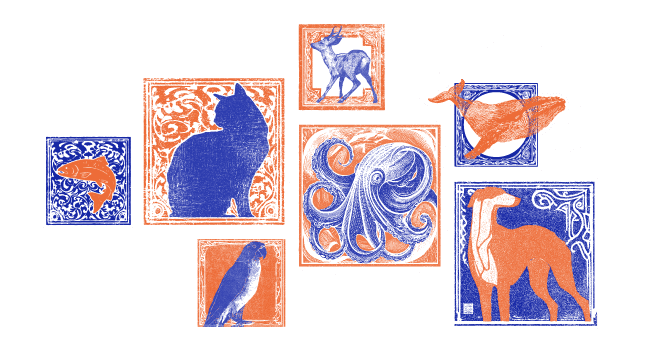
212 páginas. Encuadernación Binder. Impreso a tres tintas (negro + 2 Pantones) con laca sectorizada. 14,5 x 20 cm. Ilustraciones de Belén Kakefuku Del Solar.
Biografía del autor: Juan Cruz Balian nació el 3 de junio de 1984. Es Licenciado en Artes de la Escritura (UNA) y publicó el libro de cuentos Simple e imperfecto, y las novelas Ministerio de Invierno y La pausa.
Una plancha de stickers A5 (14,8 x 21 cm) de animalitos para hermosear cualquier superficie. Hechos en impresión UV sobre vinilo transparente con laca sectorizada.
Ebook Cosas que mi gato tendría que saber$13.900
Un viaje lúdico por la lingüística, la inteligencia artificial, la literatura y el mundo animal. Desde océanos pensantes hasta polémicos experimentos con chimpancés, disputas entre murciélagos y ballenas rebeldes. ¿Podremos algún día hablar con los animales?
Formato .epub y .mobi
Biografía del autor: Juan Cruz Balian nació el 3 de junio de 1984. Es Licenciado en Artes de la Escritura (UNA) y publicó el libro de cuentos Simple e imperfecto, y las novelas Ministerio de Invierno y La pausa.