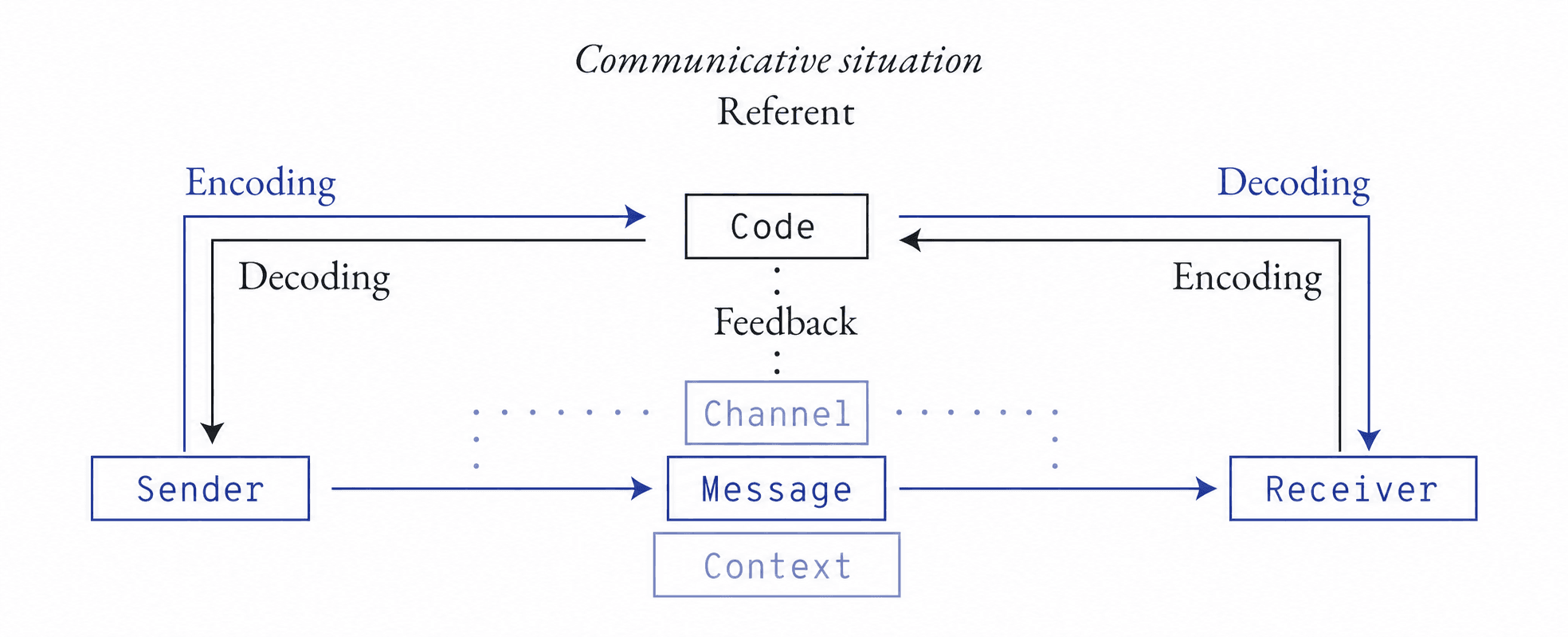
Behold, before you, Jakobson’s diagram of the communicative situation.
The diagram was published in 1960 and is one of the finest examples of the structuralist spirit of the era. From a certain age onward, we have all learned from it how an act of communication works. What roles it assigns, what elements make it up, how information circulates. It is not very different from an electronic circuit, and that is where its strength lies as much as its weakness.
Basically, someone (the sender) transmits a message through some physical medium (the channel) to someone who receives it (the receiver). That message must refer to, or be understood in relation to, something the receiver knows (the context), and it must be in some kind of language (the code). The receiver decodes the message and responds to it, activating the system in the opposite direction (feedback). And so, in orderly turns, the magic of communication happens.
Let’s see what happens when we apply it to a dog. Let’s say the dog starts the conversation. And says, “Woof.”
The dog/sender will be called Firulais. Firulais has said “woof,” and “woof” is the message. That message travels through a channel (the air) that is physical in nature and shared by the sender and the receiver. Jakobson is right: I, the receiver, hear the message thanks to my device for detecting vibrations in the air, and discover that it is encoded. That’s where things get complicated. I don’t understand the code, because I don’t speak woof, but luckily I can infer what elements of the context it might refer to: food, water, a walk? So I answer, “Do you want to go out, do you want to eat? Do you want to go for a walk?” To underscore each of these questions, I pick up objects from the context and show them to him, to help the dog decipher my message, since now the circuit has reversed and I am the sender, he is the receiver, and the code is Spanish, which he doesn’t understand, just as I didn’t understand woof. When I pick up the leash, Firulais jumps for joy and rushes toward the front door. I follow him and keep talking to him as I put on his leash, although I know he’s no longer paying attention to me. Jakobson’s circuit opened and closed, and it worked, we have to admit. But throughout the walk with Firulais, I feel uneasy. It worked by a miracle. It worked thanks to the context. There’s not much in the way of a shared code, except, perhaps, a few words he learned and a few canine behaviors I understood.
This instrumental communication I had with good old Firulais isn’t cold, isn’t gratuitous, isn’t accidental. It’s a kind of communication that could only have come about after thousands of years of coevolution. After selecting, time and again, the offspring that were more alert, more attuned to humans, after multiple (and sometimes unsuccessful) breeding attempts, even after many cruel experiments. The dog is humans’ best friend and, at the same time, a brilliant example of what we can achieve when we devote several generations to the same endeavor. We have built ourselves companionship.
We were so effective in this endeavor that today we can measure its results. We know that people who have dogs suffer less from loneliness, one of the great ills of our time, and report longer, happier lives. When a beloved dog dies, an entire group of people around that loss goes through genuine grief. To some extent, cats too enjoy this posthumous privilege, and perhaps some horses, but almost no other species. This is simply and plainly because of how many years we have spent cultivating a particular bond with these species and not with others.A note for cows: we have deliberately developed a different kind of bond with livestock. Although there are cases of friendships between cows and humans, the system, by design, optimized the species to be a source of food rather than companionship. Is this reversible? Of course. But dogs and cats have a head start. We have shared so many years, and the bond between us is so strong, that the conviction that dogs (and cats) are intelligent is questioned nowhere in the world, by no author in any work I’ve been able to find.
Let’s think about it for a moment: everyday intuition—along with close observation, like Jack London’s—leads us to think that our friend is intelligent. Sometimes intelligent in a special way. Sometimes a real detective. Sometimes intelligent even when they don’t respond. Sometimes intelligent because of a certain sparkle in their eyes. Sometimes because they know where to relieve themselves, and other times because they can detect cocaine at an airport. The number of training tests dogs pass with complete success is overwhelming—so overwhelming that the only possible conclusion is that dogs are intelligent. But there isn’t a single report of a dog capable of passing the first and most original test we humans devised expressly to measure intelligence. I mean, of course, the Turing test.
Why do I need a computer to fool me before I’ll grant it the highest cognitive recognition we humans offer other species, while with a dog it’s enough for me to ask it to catch a stick and bring it back to my feet instead of simply carrying on, gnawing it to the point of paranoia? Why does the Turing test apply to beings made of silicon and not flesh? The way I see it, this double standard is nothing more than another way we humans have found to hide from anyone who threatens our sovereign cognition. The dog runs faster, yes, but so does the computer.A note for English-speaking species: the sentence would work better in English, using the verb run to refer both to what a dog does and what a computer does. It’s a shame, but it’ll stay this way because, as the philosopher Emil Cioran said, “I do not inhabit a homeland, but a language.” The computer knows how to communicate with us, but the dog—as we just saw with Jakobson’s help—does too. So why can I have a conversation with a language model, but not a genuine conversation with a dog? The answer has nothing to do with the machine’s enormous computing power or the particular features of the dog’s vocal apparatus, so different from a human’s (the latter could be resolved, as I said before, with magnetic resonance imaging machines that can read dogs’ thoughts and translate them). The answer has to do both with the nature of those agents and with the nature of what we call conversation. With what we expect a conversation to be when it isn’t a formal interrogation. Once again, it has to do with consciousness and lying.
Mikhail Mikhailovich Bakhtin—historian, literary critic, language theorist and philosopher, and inventor of the concept of “getting through a book”—was the one who focused study on the moment when a sentence breaks free from the world of ideas and becomes an utterance. In other words, he was the one who began moving away from the study of grammar and toward the realm of words existing in the real world, toward the study of flesh-and-blood speakers and discourses shaped by historical and social contexts. Later, Émile Benveniste showed that analyzing those discourses could give us valuable information about who the speakers are, where they speak from, what attitude they bring to what they say, and a whole host of other characteristics we hadn’t known we could study until the theory of enunciation made them visible. But the pragmatists went a little further and saw that there was something else to include in the analysis: “intention.” For pragmatics, it is possible to trace the line connecting what a speaker says with what they mean—or, in other words, with what they want to do, with the concrete effect they are trying to bring about in the world.
Of the latter, Austin came first. In his book How to Do Things with Words, he established a truth that, once seen, can never be unseen. Something that may seem minor, but isn’t minor at all. He said that words don’t merely point to things in the world or relate them to one another. They are not mere instruments of description. Words do things. Almost always, things that can’t be done in any other way. Things that happen in the very act of the word being uttered, because the word is uttered (whether in writing, speech, or gesture), and with an effect in the real world.
Saying “hello” isn’t describing something; it’s greeting someone. Insulting someone isn’t hitting them; it’s saying words to them and, in the very act of being uttered, those words become an act of aggression. And although those words can take the form of a gesture (the universal “fuck you” finger used to insult someone, or a salvo of cannon fire to give someone an honorable send-off), the truth is that, in general, we turn to verbal communication for a whole range of fundamental interactions with our fellow human beings: greeting, swearing, promising, forgiving, christening, threatening, and so on. For example, pragmatics systematized the rules that make a promise count as a promise: the promised action must lie in the future, carrying it out must be within the power of the person making the promise, and—and this is essential—what is promised must be something the speaker wants. “I’ll come to get you tomorrow” is a promise when Romeo says it to Juliet. If Juliet’s father says it to his prospective son-in-law, it’s probably a threat.
This perspective on pragmatics could also be applied to animals, at least to some extent. When a dog bares its teeth and growls at us, it isn’t giving a descriptive report on its dental anatomy; it’s making a threat. In a way, we could think that the speech act is rooted in our most primitive biology and, therefore, more in line with Chomsky than he would like to admit. On the other hand, the pragmatic approach lets us circumvent the need for syntax in order to communicate with animals. The problem with thinking that is that, once again, we would be giving up on the idea of having a truly complex conversation with animals, the dream on which this essay is built.
What do we need, besides scale, self-awareness, awareness of the environment (phenomenological awareness), and syntax, to have a complex verbal exchange? In light of what we’ve been looking at, one possible answer is intelligence, but intelligence is a multidimensional phenomenon that is very difficult to measure. If we want to approach it through language, let’s see how it works in a conversation between humans.
Paul Grice developed a fundamental concept: the cooperative principle. The basic, universal law that regulates, a priori, all conversations between speakers. It goes like this: “Make your contribution to the conversation such as is required, at each moment, by the accepted purpose or direction of the communicative exchange in which you are engaged.”
For this principle to work, Grice breaks it down into four conversational maxims.
Maxim of Quantity: Make your contribution as informative as is required (for the current purposes of the exchange). Do not make your contribution more informative than necessary.
Maxim of Quality: Try to make your contribution true. Do not say what you believe to be false. Do not say anything for which you lack adequate evidence.
Maxim of Relation: Be relevant (or “get to the point”).
Maxim of Manner (manner): Be clear (avoid obscurity of expression). Avoid ambiguity. Be brief (avoid unnecessary prolixity). Be orderly.
Just as physicists imagine examples of collisions or the movement of cows but clarify that they are “frictionless spherical cows” to distinguish these models from what would happen in reality if we launched cows at one another with catapults, the cooperative principle pretends that speakers are rational, well-intentioned, that we want to optimize the quality of communication, and that we have the tools (we have been properly educated) to do so. It also takes for granted that at some point in our existence we lost our souls, a factor that cannot be entirely ruled out. In other words, the principle describes ideal rules in ideal, orderly contexts, such as a job interview, a military report, or within the walls of a notary’s office.“Note to predatory lawyers”: the judiciary is a whole different animal, and its uses of language belong to a language I won’t speak here. But only up to a point. Grice wasn’t a fool. He knew very well that the cooperative principle is a theoretical assumption. In reality, speakers communicate in a different way. How? Simple: by violating the cooperative principle again and again. Because violating one of the principle’s maxims is an extremely effective way of producing meaning. Identifying a message that breaks a maxim (it is disorderly, too verbose or too brief, responds on a different topic, isn’t truthful, and so on) leads us to assume that there is an implicit meaning in the words spoken to us—in other words, it makes us draw inferences. For example, this dialogue may lie in the reader’s future:
A— What did you think of the book about talking to animals that Balian wrote?
B— The cover is very pretty.
The violation of the maxim of relation is total, almost obscene, I’d say. But effective. As a result, A has no doubt that B didn’t like the book, and B managed to get the message across without having to say it, commit to it, or hurt anyone else’s feelings besides mine (C) and my cat’s (D).A note to myself: don’t forget that I could be speaker A, asking what someone thinks of my own book and getting the same reply from B, in which case the implicature is probably meant to hurt my feelings through sarcasm. Or B could be Belén, the book’s designer responsible for its visual identity, in which case the implicature would also be a complete lack of modesty on her part.
The point is that if there is an implicit meaning behind the words I hear, and I detect that my interlocutor wants me to realize that that is the true meaning of what I’m trying to say, then the problem folds in on itself once again, and the phenomenon of verbal communication takes on new dimensions. The culmination of this phenomenon is a famous Jewish joke that Sigmund Freud analyzes in depth in his book on humor and the unconscious—1905—and that Borges later brings back in a story:
The “trinket peddlers” Mosche and Daniel meet on the great Russian plain and greet one another.
—Where are you going, Daniel? —one of them says.
—To Sevastopol —the other replies.
Then Mosche looks at him intently and declares:
—You’re lying, Daniel. You tell me you’re going to Sevastopol so I’ll think you’re going to Nizhny Novgorod, but the truth is you’re going to Sevastopol. You’re lying, Daniel!
In this case, Daniel gives Mosche truthful, concrete information that is relevant to the question. Where are you going? To Sevastopol. There is no violation of the cooperative principle at all. But Mosche believes there is, that whenever we talk to each other we are always trying to say things different from what we actually say, and that Daniel knows it. Mosche probably already knows Daniel and his penchant for selling a pig in a poke; it doesn’t matter, there could be many reasons. The reality is that he suspects Daniel is lying to him. He tells him he’s going to Sevastopol so Mosche will infer that he’s going somewhere else, when in fact he’s going to Sevastopol. That is how suspicious Daniel’s obedience to the cooperative principle is.
Conversation, then, is a performative act: we speak to bring about effects in others, not just to inform. But if we want to measure the intelligence of an animal that doesn’t master syntax or know how to play chess with hidden inferences, how do we do it? How do we design an equivalent of the Turing test for a beast that doesn’t know how to lie and has no interest in doing so? The key isn’t deception, but persuasion. Lying requires a structure that disguises the truth; persuasion, by contrast, only requires understanding the other’s mind, even without a shared code. To persuade us of something, an animal has to assume that we are beings with expectations, desires, and blind spots, and it has to know how to influence them. It has to demonstrate its intelligence by trying to bend our will in favor of its own interests.
But suddenly dogs no longer seem like such good candidates for our project. I’m sure they’d talk to us if they could, but I don’t think they’d like the idea of lying to us. Laura told me that dogs build reputational models of humans: they estimate how good or bad we are by watching how we behave with a third party, and then adjust their expectations of us. At the same time, if they grew up socializing with good humans, they’ll see a statue from a distance and run over to bring it a ball. I don’t think it makes sense to make communication more complex when it’s already so well-oiled. There’s no next level possible in our bond with a species that already thinks the best of us. All that’s left is to throw them the ball and thank them every time they choose to bring it back.
Un viaje ilustrado acerca de la posibilidad de, algún día, hablar con los animales. Desde océanos pensantes hasta polémicos experimentos con chimpancés, disputas entre murciélagos y ballenas rebeldes. Lingüística, inteligencia artificial, literatura y mundo animal en un ensayo lúdico.
212 páginas. Encuadernación Binder. Impreso a tres tintas (negro + 2 Pantones) con laca sectorizada. 14,5 x 20 cm. Ilustraciones de Belén Kakefuku Del Solar.
Biografía del autor: Juan Cruz Balian nació el 3 de junio de 1984. Es Licenciado en Artes de la Escritura (UNA) y publicó el libro de cuentos Simple e imperfecto, y las novelas Ministerio de Invierno y La pausa.
Una plancha de stickers A5 (14,8 x 21 cm) de animalitos para hermosear cualquier superficie. Hechos en impresión UV sobre vinilo transparente con laca sectorizada.
Ebook Cosas que mi gato tendría que saber$13.900
Un viaje lúdico por la lingüística, la inteligencia artificial, la literatura y el mundo animal. Desde océanos pensantes hasta polémicos experimentos con chimpancés, disputas entre murciélagos y ballenas rebeldes. ¿Podremos algún día hablar con los animales?
Formato .epub y .mobi
Biografía del autor: Juan Cruz Balian nació el 3 de junio de 1984. Es Licenciado en Artes de la Escritura (UNA) y publicó el libro de cuentos Simple e imperfecto, y las novelas Ministerio de Invierno y La pausa.