This content was translated using artificial intelligence and may therefore contain errors.
Elevators
Overcoming gravity is easy; doing it safely is the hard part.
Elisha Otis was the American inventor who popularized elevators. He didn’t invent them, but he gave them something essential for them to be used: a safety system. Although elevators have existed for thousands of years, and there are even records of the Romans using them in their buildings, at first they were dangerous: if an elevator failed, whoever was inside fell into the void, which meant almost certain death.
In May 1854, at the industrial exhibition being held in New York, Elisha climbed onto a wooden platform suspended by a rope several meters above the ground. At one point, he asked his assistant to cut the rope, and instead of falling, the platform dropped only a few inches, thanks to a revolutionary safety system: if the rope holding up the structure lost tension, safety brakes engaged and stopped it.
The first elevator with that system was installed in New York’s Haughwout Building. Incredibly, although the building still stands and is very famous for its iron façade, the elevator was replaced and discarded. I find it hard to throw away even the tiniest thing because everything has a story to tell, so losing the first elevator in human history seems like a tragedy to me.
Otis’s system allowed elevators to become popular on an incredible scale. On top of that, a few years later, in 1871, a massive fire broke out in the city of Chicago, destroying more than half of the city. During the rebuilding, they were able to design tall buildings with elevators so people could reach every floor without climbing so many stairs.
Elevator operators came into being along with elevators. This was a very important profession in the early twentieth century, when elevators were not yet automatic and the operator started and stopped the car manually. The job also had an almost therapeutic role, since the operator had to reassure nervous passengers who were getting into — perhaps for the first time — a vehicle that moved vertically and wasn't horse-powered. In 1925, at the newly opened Platt Building, a four-story building in downtown San Bernardino, California, the elevator operator was a young Lyndon Johnson, who went on to become a senator, vice president, and the thirty-sixth president of the United States.Americans are very fond of numbering their presidents, and they also like to skip the number 13 when they build buildings because it brings bad luck. However, they didn't skip their thirteenth president, Millard Fillmore, and he had quite a bit of bad luck, since his current Wikipedia page says verbatim that “most historians specializing in this period tend to consider him one of the least memorable presidents in U.S. history, even one of the most mediocre.” Apparently, he had a method known as “the Johnson method” for persuading opponents, which involved using his large frame and physical proximity to intimidate them. His favorite place to do this, of course, was the confined, semi-private spaces elevators provide, a place he knew very well from his job as a young man in San Bernardino.
With automation, the profession of elevator operator gradually disappeared, but the invention endured. Today, if we count every trip, vertical transportation is the way humans move most often. More than by car, train, plane, or boat.
Forces at Play
Perhaps Aristotle, in the fifth century BC, was the first to try to explain gravity. And he did a pretty good job: he said it was the natural movement of bodies toward their proper place, which is determined by their nature and weight. Light bodies, like fire, naturally move upward, while heavy bodies, like stones, head toward the center of the universe—that is, downward. His explanation remained unchanged for 2,000 years.
Where Aristotle tripped himself up in his own Aristotelian argument was when he said that this downward movement happens faster the heavier the body is, which isn’t true. This was disproved twenty centuries later by Galileo Galilei, who dropped two spheres of different weights from the Tower of PisaThe Tower of Pisa was the cathedral’s bell tower. Construction began in 1173, stopped in 1178 when it began to lean, and was left that way for almost a century. In 1272, construction resumed, but then stopped again after the defeat at the Battle of Meloria, where Pisa, an independent state, lost to Genoa and ceased to be a European maritime power. In 1319, construction of the tower’s upper floors resumed, and finally, two centuries after work began, the bells were added to the top level in 1372. By then it was already leaning, though they didn’t know exactly how much, because systematic measurements of its tilt didn’t begin until the twentieth century: thanks to models that simulate the tower on soil with similar characteristics, we now know that it was tilted by 4° and that the tilt was increasing slowly. In 1838, an attempt was made to excavate the ground to lower the main entrance, and in 1935, cement was injected in an effort to better support the tower. Both interventions were major failures: the tower’s tilt increased to more than 5°. In 1991, when the tilt had reached 5.5°, it was studied exhaustively, and the critical tilt—that is, the maximum the tower could withstand before falling—was determined to be 5.7°. Something had to be done quickly. Between 1993 and 2001, the ground was reinforced with the utmost care and gradually, causing the tower to rotate backward until it was at an angle of 4°. With these latest interventions, the tower should remain standing as it is for about three more centuries. If you’re reading this in the early twenty-fourth century, perhaps the tower has fallen, especially if no one has worked on it again. Still, I’m much more curious about other things in your present: are cars still not flying? How many pandemics have there been in the centuries since I wrote this book? Are we living on other planets? at the same time, and they touched the ground at the same moment, showing that the force of gravity (now indeed named as a force) acts equally on all objects, which, if they fall in a vacuum on planet Earth, do so with an acceleration of 9.8 m/s2. Galileo wisely chose to drop two spheres because if he had dropped, for example, a feather and a hammer, they probably wouldn’t have fallen together, since the feather experiences greater air resistance. They would fall together only in a vacuum. The experiment that ultimately confirmed Galileo’s theory was performed by David Scott, commander of the Apollo 15 spacecraft, on the Moon in 1971, and sure enough, it turned out as expected: the feather and hammer fell together because conditions on the Moon are quite similar to those in a vacuum. That said, they fell more slowly because gravity is weaker than on Earth.I told this story in the chapter “A Feather and a Hammer” in Brief Anecdotal Atlas of Science.
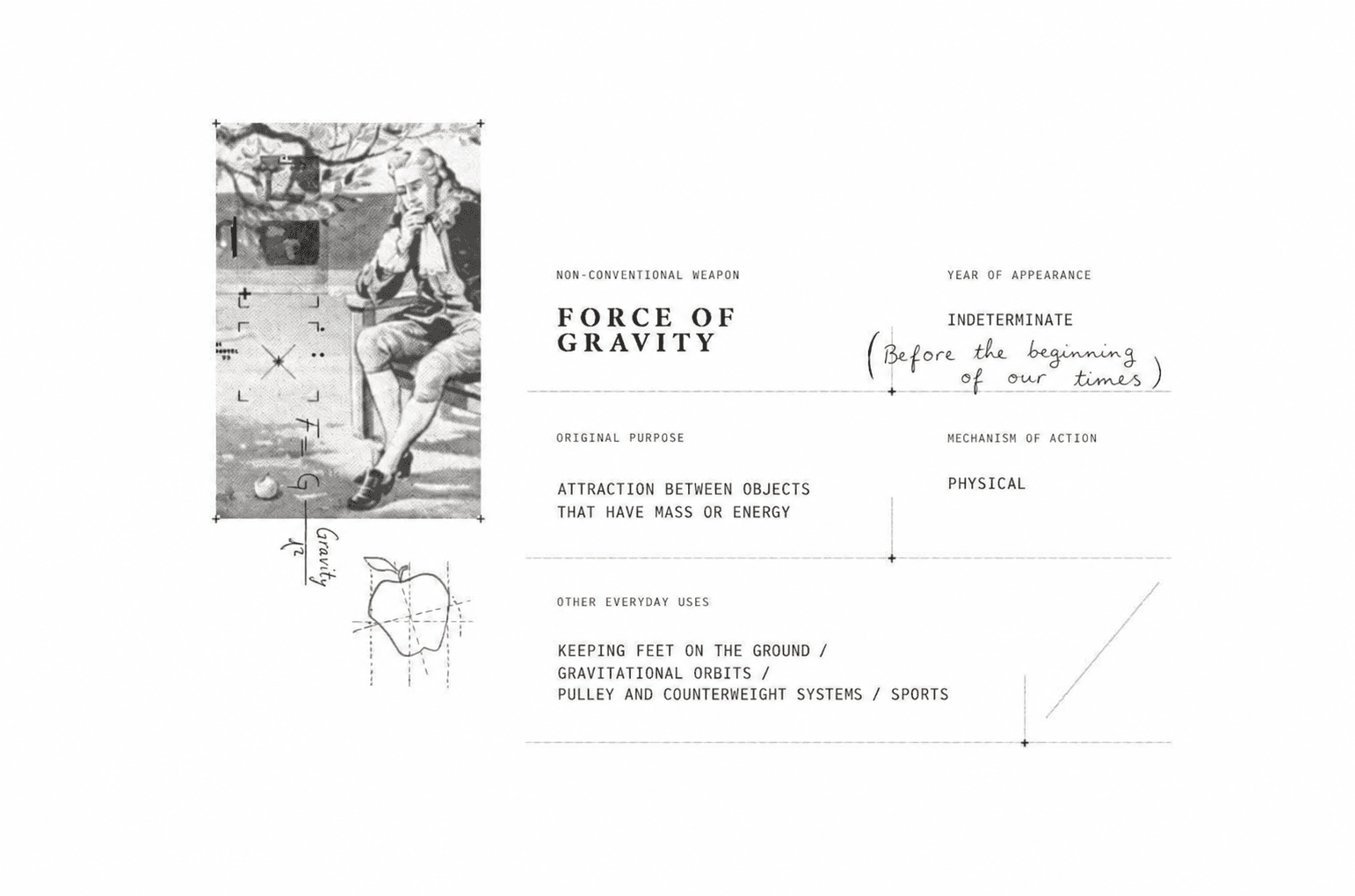
In 1687, Isaac Newton proposed Newton’s laws, although he didn’t call them that because, while he was quite a narcissistic person, he wasn’t that bad. In those laws, he systematized gravity mathematically and explained that the attraction between two bodies is proportional to their mass and inversely proportional to the square of the distance between them. Put simply for people reading this on a bus, the more mass two objects have, the more strongly they attract each other. But move them farther apart and that attraction plummets: double the distance between them, and the force becomes four times weaker. Gravity works in mysterious ways.
On top of that, Newton added the laws of motion, which allowed him to predict the trajectories of bodies like apples or planets with considerable accuracy. What Newton didn’t explain was why these things happen with gravity. How does it work? For that, we had to wait almost two centuries—the same amount of time it took to build the Tower of Pisa—for Albert Einstein to come along and explain gravity as a curvature of spacetime.
I’m not a physicist, and I know this isn’t the best way to explain it, but this is how I understand it: the idea is to think of spacetime as a stretched sheet with a massive object placed in the middle, like a bowling ball. If you toss a little ball nearby, it will tend to move toward the bowling ball, or, depending on the direction and force you give the little ball, it might keep circling the bowling ball without quite falling all the way toward it—in other words, it might enter orbit. This happens not because the smaller mass is attracted by a force, as Newton thought, but because it is moving through spacetime deformed by the presence of the greater mass. This way of looking at it has its limitations, as I said, especially because it doesn’t take the deformation of time into account (only that of space), but it’s a good first way to understand gravity.
From Below
In any case, before we understood what it is, how it behaves, or the secrets of its multidimensional nature, we humans used gravity for something we know how to do all too well: kill. Just look at the Assyrians. The Assyrians were bad. Or, well, I can’t say whether they were bad; in fact, I’m not sure I can define whether an empire is good or bad, but you can say the Assyrians were particularly bloodthirsty.
The Assyrian Empire existed between 1813 and 609 BC and, at its greatest extent, covered almost one and a half million square kilometers along the Tigris River, from what is now Egypt to present-day Iran.
The two main cities were Nineveh, devoted to agriculture and home to major irrigation works, and Assur (from which the empire gets its name), devoted above all to trade. To make the empire easier to study, it is usually divided into three periods: Old, Middle, and Neo-Assyrian. The last, which lasted from 963 to 632 BC, was the period of greatest imperial expansion, thanks to King Tiglath-Pileser III, who ruled from 744 to 727 BC.
Tiglath-Pileser III claimed that in the past, in legendary times, all the conquered land had been Assyrian, and that therefore the current conquests were not acts of aggression or looting, but just projects to reclaim those territories. Until then, conquest meant laying siege to a city, negotiating with the besieged, who became vassals of the new rulers, and not much else: daily life didn’t change much for the people; they just had to pay tribute to someone else. That’s why cities often changed vassal allegiance. But from Tiglath-Pileser III onward, Assyrian conquests went much further. Conquered lands became part of the Assyrian Empire, the gods were replaced, the rulers were executed, and Assyrian rulers were installed in their place.
This approach to conquest was a major innovation for its time. People like new things, but this was not one of those cases. The fierce resistance the Assyrians encountered among the populations they tried to conquer convinced them that they had to impose terror. And they were masters of terror and mass subjugation, so they didn’t hesitate for long. They began to include large-scale impalements, beheadings, and attacks with siege towers in their invasions—structures made of wood and metal that allowed them to protect themselves while attacking.
The strategy of striking hard and brutally worked. During the Neo-Assyrian period, the empire grew enormously. Ashurbanipal, who ruled from 669 to 631 BC, was the last great Assyrian king. The empire became the largest political entity in the Mediterranean, all directed from Nineveh, the capital. At that time they conquered Egypt, and to celebrate the expansion, the king ordered major works in the palaces, which were decorated with incredible reliefs that told stories. Also, to the delight of the nostalgia-minded and explorers, the king ordered the construction of what was probably the first great library in human history. It wasn’t that he was interested in literature; he was extremely superstitious and wanted every magical formula and spell in existence at his disposal. That’s why he instructed soldiers to send any writing that seemed important straight to Nineveh.
But soon everything would change dramatically.
The Egyptians rebelled against the Assyrian rulers, and Ashurbanipal’s brother, who ruled Babylon, quickly joined them. Soon all the conquered peoples united, and just twenty years after its peak, the empire collapsed completely.
Obviously, the capture of the capital was extremely bloody, and the great palaces were set on fire. The good thing is that the fire caused the walls to collapse, and both the library and the spectacular reliefs were fairly well protected for more than 2,000 years, until we discovered this story.
The person who discovered it was Austen Henry Layard, an adventurer who was in that area in the mid-nineteenth century and liked listening to stories. He wasn’t trained as an archaeologist, but he was very interested in the mounds he saw in territories that were then part of the Ottoman Empire. Mounds are small artificial hills formed by successive buildings, each built over the ruins of the previous ones, over several centuries. But besides the mounds, because he liked listening to stories, he heard the legend of great Nineveh, the cursed city that had fallen because of its arrogance, and couldn’t resist the temptation to start digging.
The discovery of Nimrud, another Assyrian city, and then of Nineveh were probably the most important archaeological discoveries of the nineteenth century. But for the purposes of this story, what matters is that the reliefs on the walls of the great palaces made it possible to document Assyrian siege techniques. One in particular was ruthless. And it used gravity.
During sieges, Assyrian soldiers dug beneath the walls, making large tunnels that ran under the fortifications. The tunnels were supported by wooden beams, so once they were finished, the Assyrians set fire to the beams, the tunnels collapsed, the fortifications came down, and the city was left vulnerable to invasion. The technique of undermining fortifications was the great military innovation that allowed the Assyrians to expand so quickly in such a short time.
The Defenestration of Prague
The one that did last a very, very long time was the Holy Roman Empire. Perhaps longer than any other in human history. Almost nine centuries, from 962, when Otto I was crowned emperor. But you know what they say: what goes up must come down.
The Peace of Augsburg, signed on September 25, 1555,My historian friend Martín Di Tomás told me this story and, in exchange, asked to be mentioned in a footnote. Still, when he told it to me, he got the date wrong by several decades. was an agreement to put an end to decades of wars between Catholics and Protestants. Unlike the way Tiglath-Pileser ruled, the peace agreement (arranged by Ferdinand of Austria, brother of Emperor Charles V) said “cuius regio, eius religio,” which means “whose realm, his religion.” In other words, each ruler in each region of the empire was free to choose that region’s religion. And their subjects had to adhere to that religion or migrate to another realm within the empire that suited them better. Something entirely new.
In Bohemia,In fifteenth-century France, Roma people were called “Bohemians” because people believed they came from Bohemia (which wasn’t true). Later, the name began to be used for artists outside the official scene, who moved between different smaller or lesser-known places. That’s where the adjective “bohemian” comes from. a region of the empire located in what is now the Czech Republic, whose capital was Prague, things were a little more complicated because there were large groups of both Protestants and Catholics. If the king was Catholic, it caused problems with the Protestants, and vice versa. And it wasn’t easy to make so many people migrate. So, in 1609, Emperor Rudolf II granted freedom of religion to Bohemia’s main religious groups in an edict known as the “Letter of Majesty.”
Everything was going relatively well until Ferdinand, Archduke of Austria, was elected king of Bohemia in 1617, and then everything started going relatively badly. At first, Ferdinand assured everyone he would respect the charter signed eight years earlier by his predecessor, but later he became convinced that he had to obey the divine call to restore the glory days of the Catholic Empire. And, as we know, that tends to cause problems with urban planning.
The whole kerfuffle started over the construction of churches. The Protestants wanted to build two new churches in the city, which the Letter allowed them to do, even though the king was Catholic. But Ferdinand—drunk on power, I suppose—confiscated the land where they planned to build them and, on top of that, handed it over to the Catholic Church.
There were skirmishes, and some people were arrested. The Protestant leaders joined forces to protestCymbals…! and demand the prisoners’ freedom, but their petition was rejected. The Protestants then organized a large demonstration (that is, a large protest)More cymbals…! for May 23, 1618, at Prague Castle, where Catholic and Protestant deputies would meet to try to find a solution to the conflict.
On the day of the demonstration, a crowd gathered at the castle, and the Protestant deputies managed to get several demonstrators to accompany them to the council chamber, which was in the upper part of the castle and where the meeting was to take place. There were four Catholic deputies and four Protestant ones, plus the demonstrators. Two of the Catholics, seeing they were outnumbered and that tempers were running high, managed to escape, but the other two, Counts Villem Slavata and Jaroslav Martinitz, stayed in the room and joined the small crowd of Protestants. Then the arguments began. The conflict escalated. Then another count, Jindřich Thurn, a war veteran who led the Protestant demonstrators, accused the Catholics of leading the king into waging a religious war against his Protestant subjects. And in the heat of the debate, he exclaimed: “They must not be allowed to leave alive.”
That’s the sort of thing you shouldn’t say to an angry mob, because they tend to take it very much to heart. So, after the count’s words, the two Catholic deputies who had stayed in the room, high up in the tower, were thrown out the window.
The Defenestration of Prague had taken place.Writing this chapter, I learned that “defenestrate” means “to throw someone out of a window,” perhaps the most obvious way to kill someone using gravity. But there have been defenestrations with consequences beyond the fate of the person who fell out the window. Enrique Ruano was a Spanish student and activist who was arrested by Francoist police on January 17, 1969, when the Spanish dictatorship had been in power for nearly thirty years. He was a member of the Spanish Popular Liberation Front (FELIPE, great name), an underground organization opposed to Francisco Franco’s regime. Ruano was tortured in custody and, four days later, the official account claimed he had thrown himself out of a window. However, the circumstances of his death, contradictions in the police account, and subsequent forensic reports led family members, friends, and historians to maintain that he had been thrown from the seventh floor of the building at 60 Calle del Príncipe de Vergara, in Madrid. His death sparked a series of mass protests, among the most important against Francoism. Although the dictatorship did not fall then, the case of Enrique Ruano became one of the clearest symbols of its violence and decline. The dictatorship would end five years later with Franco’s death.
Both fell 21 meters, an enormous distance, but incredibly, they survived. Catholics maintained that it was a miracle. Protestants, by contrast, said they had survived because they had landed on a mountain of fecal matter that had accumulated beside the castle, which, obviously, had no bathrooms.
After the Defenestration of Prague, the rebels deposed the king and organized a large army. In response, the emperor mobilized his own armies to reclaim Bohemia and punish the rebellion. The Protestant states supported Bohemia, and the Catholics supported the emperor. The conflict spread across all of Europe, beginning the Thirty Years’ War, in which an estimated 25 to 40% of Europe’s population died—probably the bloodiest war in the continent’s history.
The conflict ended with the Treaty of Westphalia, where the states’ religious tolerance was agreed upon once again, stripping the empire of its power. The empire finally collapsed 156 years later, as Napoleonic troops advanced.
During that same war, Galileo Galilei was condemned by the Catholic Church for, among other things, maintaining that the Earth revolves around the Sun.
It Isn’t Always Infallible
Using gravity seems like an infallible way to kill someone, but it isn’t. Vesna Vulović was a Serbian flight attendant who, on January 26, 1972, incredibly survived a fall of more than 10,000 meters while flying over Bohemia, which was then Czechoslovakia and is now the Czech Republic. The plane she worked on, a McDonnell Douglas DC-9, was torn in half in an attack. She was in the rear section of the plane, trapped by a food cart, when the explosion occurred. Incredibly, the branches, snow, and food cart cushioned the fall, and Vesna survived, though she was terribly injured. She was also lucky that Bruno Honke, a lumberjack with extensive first-aid experience from learning it during World War II, happened to be passing by. Bruno managed to keep her alive until rescuers arrived. Vesna remained in a coma for several days and suffered several lasting effects, but died 44 years later in her apartment in Belgrade, apparently from heart problems.
Ciencia + Epidemias + Guerras: la trilogía completa de un autor que logra hacer graciosa hasta a la Fiebre Amarilla.
No es un bunker antiaéreo, pero esta sobrecubierta protege tus tres carbalibros y los hace lucir mucho mejor. Cuidá las cosas que te hacen feliz. Impresa en serigrafía con tinta blanca sobre acetato, en Imprenta Cumbre.
Incluye: - Las armas tontas | Breve inventario de astucias y torpezas bélicas - Breve atlas anecdótico de la ciencia - Fiebre: Breve colección de Epidemias - Sobrecubierta de edición limitada. Impresa en serigrafía con tinta blanca sobre acetato.
Trilogía Carba$94.000$104.700
Ciencia + Epidemias + Guerras: la trilogía completa de un autor que logra hacer graciosa hasta a la Fiebre Amarilla.
No es un bunker antiaéreo, pero esta sobrecubierta protege tus tres carbalibros y los hace lucir mucho mejor. Cuidá las cosas que te hacen feliz. Impresa en serigrafía con tinta blanca sobre acetato, en Imprenta Cumbre.
Incluye: - Las armas tontas | Breve inventario de astucias y torpezas bélicas - Breve atlas anecdótico de la ciencia - Fiebre: Breve colección de Epidemias - Sobrecubierta de edición limitada. Impresa en serigrafía con tinta blanca sobre acetato.
Las armas tontas$34.900
Historias reales de seres humanos intentando convertir en armas los objetos más improbables. El punto exacto donde coinciden la guerra, la ciencia y la estupidez.
172 páginas. Encuadernación Binder. Cubierta impresa a dos tintas (negro + Pantone plateado). Ilustrado por el estudio de diseño gráfico The Negra.
Biografía del autor: Juan Manuel Carballeda. Buenos Aires, 1⁰ de marzo de 1984. Doctor en Biología, docente de la Universidad de Buenos Aires y la Universidad Nacional de Hurlingham e investigador del Conicet. Trabaja con virus. Colabora con medios gráficos y audiovisuales. Escribió Breve atlas anecdótico de la ciencia (El Gato y la Caja, 2019) y Fiebre. Breve colección de epidemias (El Gato y La Caja, 2021). Nunca mató a nadie.
Historias reales de seres humanos intentando convertir en armas los objetos más improbables. El punto exacto donde coinciden la guerra, la ciencia y la estupidez. En formato ebook, porque si un pañuelo puede ser un arma homicida, un libro puede ser digital.
Formatos .epub y .mobi.
Biografía del autor: Juan Manuel Carballeda. Buenos Aires, 1⁰ de marzo de 1984. Doctor en Biología, docente de la Universidad de Buenos Aires y la Universidad Nacional de Hurlingham e investigador del Conicet. Trabaja con virus. Colabora con medios gráficos y audiovisuales. Escribió Breve atlas anecdótico de la ciencia (El Gato y La Caja, 2019) y Fiebre: Breve colección de epidemias (El Gato y La Caja, 2021). Nunca mató a nadie.