This content was translated using artificial intelligence and may therefore contain errors.
The Missing Plane
In the early hours of September 1, 1983, the Japanese fishing boat Chidori Maru No. 58 was fishing for squid in the calm Sea of Japan, near Sakhalin Island. Squid fishing takes place in the early hours of the morning, using high-intensity lights that illuminate the water almost as if it were daytime. This attracts plankton, which in turn attracts small fish and squid. The Chidori Maru had some multiple hooks, called “squid jigs,” that bobbed up and down rhythmically, imitating fish and catching the poor squid that fell into the trap. Apart from that, the sea was calm, and Shizuka Hayashi and the boat’s seven crew members let themselves be rocked gently by the waves, daydreaming about who knows what.
But at 3:30, the sound of a particularly low-flying plane brought them back to the dark reality of the open sea. There was a flash, an explosion, and a little while later a very strong smell of fuel that gradually faded away.
Perhaps Shizuka and the crew would have benefited from knowing a thing or two to help them understand what they had just experienced. For example, they could have known that a few hours earlier, on the night of August 31, Soviet radar had detected an RC-135 in the area, an American spy plane used during the Cold War. The RC-135’s presence in that particular area was especially inconvenient: it was Soviet territory, and missile launch tests were often carried out there.
They would also have needed to know that the day before, in the early hours of August 31, Korean Airlines flight KAL007 departed New York’s John F. Kennedy International Airport a little behind schedule, with 269 people on board. The plane was a Boeing 747-200, and its first stop was Anchorage Airport in Alaska, where it was supposed to refuel before setting out on the final leg to Seoul, South Korea. Everything went normally: KAL007 took off from Alaska at 4:00. Since Boeing 747s are very large planes, first-class passengers sat on the upper deck, above the pilots, in a super-luxurious and exclusive area with incredibly large seats and a menu of drinks and meals prepared by chefs. Downstairs, the layout was similar to that of other planes: at the front, the fairly comfortable business seats, and at the back, economy class, where we travel if we’re lucky. KAL007 had about 80 empty economy-class seats; the rest were occupied. The crew numbered 29.
After leaving Alaska, KAL007 was assigned route R-20, or Romeo 20, on its way to Seoul.Aviation uses the phonetic alphabet. Each letter has a word assigned to it. My favorites are “Bravo” for B, “Charlie” for C, “Mike” for M, and “Zulu” for Z. That was, in principle, good news. It was the shortest route to their destination. It was also the one that passed closest to the Soviet exclusion zone.
When planes take off, they use heading mode to orient themselves, a function that keeps them flying straight as they gain altitude. Once they’re stabilized at altitude, the pilots have to switch to inertial navigation mode (INS), which has the entire route to the destination loaded in advance. The plane also has to pass several checkpoints over the ocean to make sure it’s on the right course. For KAL007, the first checkpoint was Bethel, about 50 minutes into the flight.
This isn’t meant to belittle the pilots’ job—in fact, I would have loved to fly commercial planes—but the truth is, once a plane takes off, there isn’t much else to do. If everything goes smoothly, the job consists of waiting comfortably in a cockpit with dim lights and white noise—in those days, probably smoking cigarettes—We’re talking about a structure weighing several hundred tons, flying at 1,000 kilometers per hour, pressurized, at an altitude of more than 10,000 meters. It’s really hard to understand how smoking on planes was ever allowed. The crazy thing is, it wasn’t easy at all to ban it. It wasn’t until 1996 that the International Civil Aviation Organization issued a document recommending a complete ban on smoking on planes, and the ban was implemented gradually. In fact, China didn’t ban smoking in the cockpit until 2019. Even so, many planes are still manufactured with indicators that switch on and off to show when smoking is not allowed and, of course, they’re on for the entire flight. until the autopilot takes the plane to its destination. That was exactly the situation aboard KAL007 when they tried to contact Bethel radar. The captain couldn’t reach it and instead heard static. Since that kind of malfunction was fairly common, the people aboard KAL007 did something that was also fairly common: they asked KAL015—a flight that was following (or so they thought) the same route as them and had taken off a little earlier—to relay to the control tower the message that they had passed the checkpoint.
The problem is that, as the later investigation revealed, KAL007 had never changed its flight mode and was still in heading mode, flying straight north and gradually drifting farther from its planned route. They hadn’t passed Bethel at all, but had flown several kilometers away from it.
And even with all this information, the astonished fishing boat crew would have remained in the dark about what had happened until nearly a decade later. It wasn’t until 1992, after the Soviet Union had ceased to exist, that Russian Federation president Boris Yeltsin visited Seoul, the capital of South Korea, with the main purpose of handing over KAL007’s black boxes, which made it possible to find out what had really happened to the plane lost over the ocean.
Eventually, thanks to the press, the Japanese learned the truth: KAL007 had entered the Soviet exclusion zone, radar had detected it, and a Soviet fighter plane had started pursuing it. The situation might not have escalated if it hadn’t been for the American spy plane that had been in the area a few hours earlier, leaving the Russians a little on edge, I think. In any case, General Anatoly Kornukov, commander of Sokol Air Base on Sakhalin, made a decisive call: he ordered the Soviet SU-15, the fighter pursuing KAL007, to fire. A few seconds later, the Soviet fighter pilot, Gennadi Osipovich, reported, “The target has been destroyed.”
The black-box transcript confirmed that, despite being far off course, the KAL007 crew didn’t know it. At the moment of impact, there’s an explosion, followed by Captain Chun Byung-in’s voice telling passengers to put on their masks and put out their cigarettes. A few seconds later, silence. And a smell of fuel that the black box couldn’t record, but that was clearly noticed by a few Japanese fishermen nearby.
A Battery of Problems
Luigi Galvani was an Italian doctor who made a revolutionary observation in the late eighteenth century: if he touched an electrical source to the muscle of a frog’s leg, with the bone and nerves still attached, the muscle contracted.The electric current was applied using a Leyden jar, a glass bottle that can store static electricity. The charge is generated by friction and transferred, through a wire, to the conductive interior of the bottle. The glass acts as an insulator between the inner and outer surfaces. At the mouth of the bottle there’s a metal rod connected to the interior. When a connection is made between that rod and the outside of the bottle, the circuit is closed and the charge is released quickly, creating a good spark, which in the eighteenth century must have blown the minds of everyone who saw it. This device, independently discovered by Ewald Georg von Kleist in 1745 and Pieter van Musschenbroek in Leiden in 1746, was the first time in history that humans were able to store electric charge for later use.
But that wasn’t the most interesting part. What he discovered shortly afterward was that if two different metals touched the nerve in the frog’s leg, the animal’s muscle contracted too, without any need to apply electricity.
Luigi Galvani thought, as any of us would have in his place, that he had discovered something like a source of animal electricity. The truth is, he was partly wrong: although there are electrical impulses inside cells, discovered years later thanks to squid nerve cells,We’re talking about the squid neuron, whose giant axon can measure up to 1.5 mm in diameter. It was first described in 1909, but apparently we still weren’t quite up to appreciating its sheer awesomeness. In 1939, Alan Hodgkin and Andrew Huxley published “Action Potentials Recorded from Inside a Nerve Fibre,” showing that an electrical impulse was involved in the transmission of information along the squid’s axon, proving poor Galvani right—141 years after his death. The squid uses this structure to respond to danger by shooting out a jet of water that makes it accelerate very quickly and escape predators. Still, poor thing, it can’t resist a set of squid jigs bobbing up and down in the illuminated sea. what Galvani was seeing was a battery. A plain and simple battery—though it wasn’t called that yet—made up of the two metals touching the muscle, with the frog’s bodily fluids doing no more than bringing those metals into contact, allowing electrons to pass between them. Still, not a bad discovery, especially for his nephew Giovanni, who used it to put on shows in which he brought the dead back to life using real corpses, as a fairground attraction, and made a pretty penny. But that’s another story.
Alessandro Volta was a critic of Galvani. Unlike his colleague, Alessandro thought that the electricity didn’t come from the bodies, but from two different metals in contact through a fluid. He called it “metallic electricity.” He decided to test his hypothesis by making a stack of disks of different metals—zinc and copper—alternating and in contact through damp cardboard. And it worked. Why? Basically, what happens is that the zinc oxidizes, loses two electrons, and those electrons travel through the damp cardboard and end up reducing the copper by giving it electrons. That flow of electrons is, precisely, electric current, and since it was a stack of little disks, the device came to be called a “pile.” Everyone sided with Volta rather than Luigi.
Poor Galvani. On top of everything else, in 1796 Napoleon Bonaparte invaded Bologna, where Galvani had been born and taught, and when he refused to swear allegiance to the French Constitution, he was stripped of his professorship. He died sad, two years later, living in his brother’s house, without the consolation of knowing that his surname would go down in history thanks to the spectacular experiments from the Frankenstein era… performed by his nephew.
Batteries began to catch on tentatively during the nineteenth century, especially at exhibitions, where they were used to create sparks and put on a show. But when I learned about their first domestic use, I was pretty surprised. Batteries came into people’s homes through the front door, but at first they stayed right there: they were used to power doorbells.
The first doorbells, which became popular toward the end of the nineteenth century, when most homes still had no electricity, ran on batteries. The doorbell had two parts: one fairly large part inside the house, consisting of the battery and the bell, and another outside, the button you pressed to ring. In fact, the tango “Yira, yira,” by Enrique Santos Discépolo, brilliantly performed by Carlos Gardel, goes, “When the batteries in all the doorbells you press are dead,” and refers exactly to those doorbells with their drained batteries.
The batteries in the doorbells of Gardel’s day were Leclanché cells, named after their inventor, Georges Leclanché, a French engineer who used zinc and manganese dioxide as the metals to oxidize and reduce, respectively. Because the key thing in batteries is which element is oxidized and which is reduced. And since many of these oxidation-reduction reactions are reversible, rechargeable batteries exist too.
At first, batteries were large and ran out quickly. Nobody could yet imagine battery-powered devices that could be carried around. It wasn’t until the beginning of the twentieth century that we got portable batteries, used to power flashlights, and by the middle of the century, thanks to transistors that made radios much smaller, the first portable radio.
Maybe the difference from the printing press is that it took too long to arrive (and when it did, books already existed).I’ll talk about this in the next chapter. Which reminds me… have you still not found the secret message in the prologue? Terrible spies. The battery, on the other hand, was an invention that arrived too early. It was discovered at the beginning of the nineteenth century, but didn’t start being used until almost a hundred years later. The first cell phone in history, the Motorola DynaTAC 8000X, released in September 1983, two weeks after the KAL007 crash, had a nickel-cadmium battery. Although it technically qualified as a portable device with a rechargeable battery, it was a nightmare: it needed 10 hours to charge, and the battery lasted just over half an hour. Then there was the damn memory effect: if you didn’t fully discharge the battery before charging it, it lost performance over the next few cycles. Later, around the mid-1990s, nickel-metal hydride technology arrived. It could store more energy, allowing batteries to start getting smaller. Then, with the new century, batteries made with various lithium-based chemistries began to be used; they lasted longer and were much smaller by comparison. And so, with the new century, humans were able to have electronic devices that stayed unplugged for quite a while and were also getting smaller and more portable.
Of course, this didn’t come for free. Lithium went from being a white salt used to make industrial grease to becoming a fundamental strategic resource: the largest reserves are concentrated in the lithium triangle, which includes parts of Argentina, Bolivia, and Chile. Extracting it isn’t easy because it’s dissolved in underground brines, tens of meters below the salt flats. Those brines also contain many other salts. The traditional way to extract it is to pump the brine from those underground reservoirs into enormous evaporation ponds, where the water is left to evaporate for months. In the process, up to 800,000 liters of water are lost for every ton of lithium produced. But that’s not all: the lithium still has to be purified, separating it from all the other salts in the brine, and guess what that takes. Yes, water. A lot more water. All of this takes place in arid environments where water isn’t exactly abundant. Another problem is that in Argentina, for example, most of the extraction is done by foreign companies that take the lithium away without making the rest of the batteries in the country.
Of course, lithium isn’t the only option. In fact, all elements that can be reversibly oxidized and reduced are potential components of batteries that, with a little luck, could be smaller and more efficient than today’s.
And that’s where the lanthanides enter the story: that group of elements at the very bottom of the periodic table, forgotten. In fact, their name means something like “the ones that remain hidden” in Greek. This group,El Gato y La Caja, the publisher of this book, has an amazing book called 118. El universo en una tabla, which tells the story of every element. which includes europium, promethium, dysprosium—all great names—is known as “rare earths,” another great name. These elements are becoming increasingly important because their unique properties make them excellent magnets and even better batteries, since they’re very good at reversibly oxidizing and reducing. Europium is spectacular too, because it glows a very bright red and is ideal for LED screens. These elements, whose properties we’re only just beginning to understand, could make electronic devices smaller and more efficient—everything the twenty-first century wants.
Of course, having something so valuable can also be a problem. For example, in 2025, Donald Trump, as president of the United States, canceled a press conference with Ukrainian president Volodymyr Zelensky, telling him he hadn’t thanked the United States enough for its support of Ukraine. It was an incredible moment: people were shouting, Trump was pointing his finger at the Ukrainian president, everyone was looking in every direction. The real reason for the scene was that Zelensky had questioned the part of the agreement that gave the United States the right to access Ukraine’s rare earths as economic compensation for its intervention. Another example: in Myanmar, in 2021,A fitness class led by Khing Hnin Wai, a Burmese physical education teacher, went hugely viral. In the background of one of her classes, you could see army tanks passing by on their way to carry out the coup. a coup took place, followed by a civil war and human rights abuses. Although it seems China, its most important neighbor, didn’t promote the coup, the truth is that it didn’t condemn it either, and above all, it maintained trade relations with Myanmar, which, remarkably, quintupled its rare-earth production, almost all of which is exported to China.
In short, in 2026, as I write this, rare earths are the most important strategic resources, and they’re almost always behind every active armed conflict.
Death by GPS
The KAL007 disaster, caused by an error in its navigation systemsActually, it was a missile, but you know what I mean. that put it in the wrong place at the wrong time, was what led to the Global Positioning System (GPS), until then restricted to military use, being made available for civilian use.
The secret behind how GPS works is very simple and wonderful: there are lots of positioning satellites—more than a hundred—orbiting our planet. To figure out where we are, we need three satellites to measure with great precision how far away they are from the device in our hand.
The first of these three satellites gives us the surface of a sphere—that is, all the points in the universe that are exactly that distance away. A second satellite does the same, generating another sphere which, when overlaid on the first, gives us a circular line of possible points exactly that distance from both. Now, if we add the distance information from a third satellite, we add a third circle that intersects the other one at two points: one is usually somewhere else, probably very far from Earth, while the other is the exact point where we are with the device. To be fair, a fourth satellite is needed to correct for the exact time difference between the signal being transmitted and received, but the important information comes from the first three.
Although GPS use wasn’t widespread in the 1990s, once it was incorporated into electronic devices, it became indispensable, especially for those of us with an awful sense of direction. And it’s unquestionably a deathblow for us nostalgics, who are sad to have stopped using pocket guides, essential for finding our way around the city. In Argentina, the Guía Filcar was published every year, with updated map editions for Argentina’s major cities and their surroundings, and there was the Guía-T for the Autonomous City of Buenos Aires.Twitter allowed us to discover that there are people my age who, despite growing up using these products, had never understood the pun hidden in the names “Guía-T” and “Nero Burning Rom.”
Of course, relying exclusively on GPS to find our way can cause problems. The first and most obvious is the possibility of being left without any bearings when our phone battery dies, which happens to me all the time. The second is what happened to Albert and Rita Chretien.
The story of Albert and Rita Chretien is pretty harrowing. On March 19, 2011, they set out in their Chevrolet Astro van from their home in Penticton to Las Vegas to attend a trade fair—not one as spectacular as those of Giovani Galvani (Luiggi’s nephew), with sparks and bodies being reanimated, but a trade fair, common in that city, where they were going to showcase their small drilling business.
They had almost 2,000 kilometers of driving ahead of them. Fortunately, the Chevrolet Astro is pretty comfortable. Instead of taking the most direct route, Albert and Rita decided to take a less-traveled road, with great mountain views, along State Highway 51. They knew there had to be a turnoff somewhere that would take them onto Route 93, which went straight to Las Vegas.
Something started to seem off. The miles ticked by, night fell, and the turnoff never appeared. To make matters worse, they don’t have mate in the United States, which I imagine made the trip even more tedious. But Albert had an ace up his sleeve: a GPS he’d bought a few days earlier and never used. At the time, they thought the nearest city was Mountain City, Nevada, about 700 kilometers from Las Vegas, and they’d already been driving for several hours, so they turned it on and entered that city as their destination, planning to rest there for the night.
The directions took them along a small dirt road near a ghost town and eventually to a confusing three-way intersection, where the real problems began. The name Mountain City is no euphemism, and the GPS kept sending them along a road that only got worse, a mountain road heading toward snow-capped peaks.
Once the fair in Las Vegas got underway, the organizers noticed that Al Chretien Excavations wasn’t there. When their relatives found out several days later, they started looking for them. The problem was that nobody knew about the turnoff they had taken, so they searched 4,500 kilometers of roads without success. On April 8, almost three weeks after they had set out, the authorities scaled back the search.
Almost two months later, taking advantage of the cold letting up, Troy Hill, his daughter Whitney, and her husband went out on an ATV for what seems to have been a customary activity called “shedding”: going into the woods to look for deer antlers, which fall off at that time of year. At one point, they spotted a Chevrolet Astro in the distance, with ribbons tied to its antenna. They went closer and saw a woman inside. It was Rita Chretien, wrapped in a blanket and ready to die.
But she didn’t die. And it was Rita who told the story of the day they got lost:
Since it was getting dark, they decided to keep going because it was impossible to turn around on the mountain road. At some point, the van got stuck. They spent the night inside the Chevrolet, and in the morning they divided up the provisions they had. Albert set out on foot toward Mountain City, taking the chocolate-covered almonds, while Rita, who had injured herself a few days before the trip and couldn’t walk well, stayed in the van with a small bag of nuts that she rationed carefully. For days, she melted snow to drink, went on short walks, and read the Bible. After hearing the story, the shed hunters, decided it would be best to go for help without moving Rita, who looked very weak. When they returned with rescue helicopters, incredibly, she had packed her bags and was ready to leave.
Albert’s body was found a year and a half later, frozen on the mountain.
White Toyota Corolla
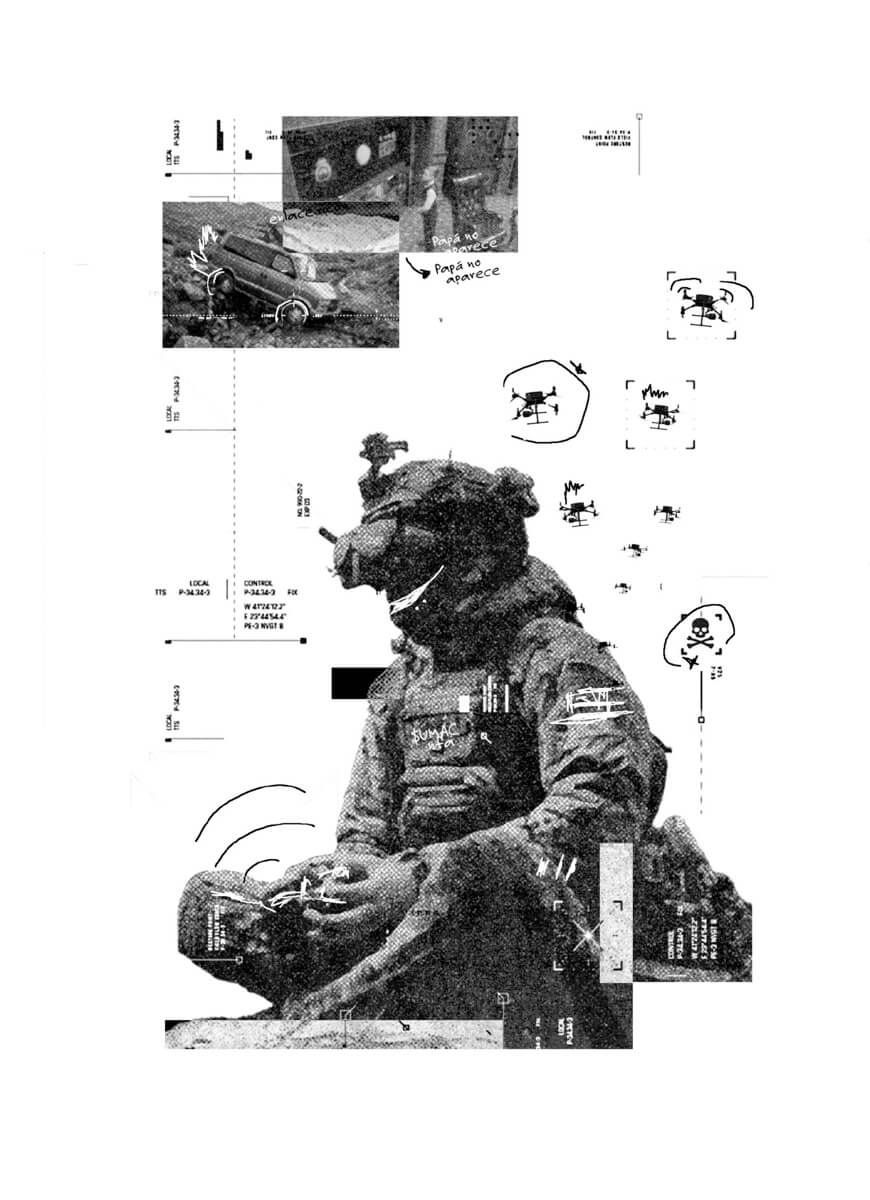
But the invention of GPS, batteries, and human error in aviation all converged to create the dumbest weapon humanity has ever seen: drones.
On August 26, 2021, a horrific attack took place at the airport in Kabul, the capital of Afghanistan, killing 186 people. It was a suicide bombing carried out as thousands of Afghans were trying to flee the country after the fundamentalist Taliban came to power. The United States controlled the airport, from which it operated its military forces throughout the country. Announcing the deaths of 13 U.S. soldiers in the attack, General Kenneth McKenzie, head of the U.S. military command, said the attack had been carried out by ISIS and that they would surely strike again imminently.
Thousands of intelligence reports about ISIS’s methods of operation were reaching the Pentagon, but one detail caught their attention in particular: ISIS always used white Toyota Corollas for its operations. I think that’s pretty smart, because white is the most common car color and the Toyota Corolla is the best-selling car on the planet, so a white Toyota Corolla is the perfect car for going unnoticed.
Three days after the attack, on August 29, Zemari Ahmadi, who worked as a systems technician for the U.S. nonprofit Nutrition and Education International in Kabul, stopped by the office to pick up a laptop he had to give to his boss later. Then he filled several water containers and loaded them into his car, a white Toyota Corolla. He didn’t know that an MQ-9 Reaper drone, which is quite large and can fly for several hours at high altitude without being detected, was following him. The model of his car, combined with seeing him load containers and carry a laptop, aroused the suspicion of U.S. intelligence. Of course, the containers didn’t hold explosives, but drinking water. And his laptop was just that, a laptop.
At 4:30 p.m., Ahmadi arrived at his home in Khwaja Bughra, a residential neighborhood near the airport. To make matters worse, his home had been wrongly flagged as a potential ISIS location. His three children and several nieces and nephews were playing in the yard when a second MQ-9 Reaper appeared on the scene and fired a Hellfire missile. Ahmadi, his 30-year-old cousin, and seven children, including his own children and nieces and nephews—in all, ten civilians—were killed in the attack.
The Pentagon’s subsequent investigation concluded that it was a tragic mistake.
In the war in Ukraine, which is happening as I write this, drones have started being used on a massive scale—lots of drones, swarms of drones—which makes everything much more terrifying. A drone swarm consists of hundreds of little devices, perfectly coordinated and guided toward a target, capable of recognizing it and firing at it or even crashing into it in a kamikaze attack. I’ve been arguing for years that little things are always more terrifying than big things. If we compare the destructive power of a fighter jet costing hundreds of millions of dollars with that of thousands of drones flying in coordination, I think you’ll agree with me.
Dumb weapons
This chapter is over. I’ve explained how different factors came together to create drones, told a harrowing story about drones, and even just left you with a sort of moral. But I can’t resist the temptation to tell one last story.
The first few days of December 2001 weren’t easy for Alan Yoshida. He was part of ODA (Operational Detachment Alpha,also known as the “Green Berets”) 574, a small group of about ten members of the U.S. Air Force operating in Afghanistan at the start of the war that began after the attacks on the Twin Towers. Their detachment was stationed about 65 kilometers north of Kandahar, the country’s second-largest city, at a U.S. military position on a hill. Afghan forces were stationed just a few kilometers away and, at that moment, were under intense machine-gun fire.
But at 9:30 in the morning on December 5, without knowing where it came from or how the cornered Afghans could have done it, a bomb exploded over Alan’s company. Three soldiers died. Alan survived with serious injuries. He later learned that the bomb was a JDAM (Joint Direct Attack Munition), weighing almost a ton and dropped from a B-52 bomber. And the most striking thing of all: it was an American bomb.
From the makeshift base, Alan directed the bombing with a portable GPS device known as the “PLGR.” The PLGR is a kind of green brick, waterproof, with a modest screen where you enter coordinates and other data by pressing a few buttons. Alan’s problem was that, during the bombing, at the crucial moment, the PLGR ran out of battery. It was a lithium battery, much more advanced than the ones in cell phones at the time, but much less advanced than today’s lithium batteries.
Since the U.S. Army isn’t a bunch of amateurs, it had spare batteries charged and Alan quickly replaced the battery. What he didn’t know was that when it restarted, the GPS had a feature, a behavior, one of those things tech people like to debate whether it’s a bug or a feature: instead of transmitting the target’s coordinates, it transmitted the coordinates of the device itself.
Neither the bomber pilot nor Alan realized this until it was too late.
Although the United States was able to quickly oust the Taliban regime from power after the invasion, it never managed to bring stability to the region and eventually withdrew twenty years later. Something similar happened to the Soviet Union, which invaded Afghanistan between 1979 and 1989 to prop up the country’s pro-Soviet government, and also failed.
Alan died of cancer in 2023 at the age of 51. For his service in Afghanistan, he received the Silver Star, the third most important decoration in the U.S. Army.
Ciencia + Epidemias + Guerras: la trilogía completa de un autor que logra hacer graciosa hasta a la Fiebre Amarilla.
No es un bunker antiaéreo, pero esta sobrecubierta protege tus tres carbalibros y los hace lucir mucho mejor. Cuidá las cosas que te hacen feliz. Impresa en serigrafía con tinta blanca sobre acetato, en Imprenta Cumbre.
Incluye: - Las armas tontas | Breve inventario de astucias y torpezas bélicas - Breve atlas anecdótico de la ciencia - Fiebre: Breve colección de Epidemias - Sobrecubierta de edición limitada. Impresa en serigrafía con tinta blanca sobre acetato.
Trilogía Carba$94.000$104.700
Ciencia + Epidemias + Guerras: la trilogía completa de un autor que logra hacer graciosa hasta a la Fiebre Amarilla.
No es un bunker antiaéreo, pero esta sobrecubierta protege tus tres carbalibros y los hace lucir mucho mejor. Cuidá las cosas que te hacen feliz. Impresa en serigrafía con tinta blanca sobre acetato, en Imprenta Cumbre.
Incluye: - Las armas tontas | Breve inventario de astucias y torpezas bélicas - Breve atlas anecdótico de la ciencia - Fiebre: Breve colección de Epidemias - Sobrecubierta de edición limitada. Impresa en serigrafía con tinta blanca sobre acetato.
Las armas tontas$34.900
Historias reales de seres humanos intentando convertir en armas los objetos más improbables. El punto exacto donde coinciden la guerra, la ciencia y la estupidez.
172 páginas. Encuadernación Binder. Cubierta impresa a dos tintas (negro + Pantone plateado). Ilustrado por el estudio de diseño gráfico The Negra.
Biografía del autor: Juan Manuel Carballeda. Buenos Aires, 1⁰ de marzo de 1984. Doctor en Biología, docente de la Universidad de Buenos Aires y la Universidad Nacional de Hurlingham e investigador del Conicet. Trabaja con virus. Colabora con medios gráficos y audiovisuales. Escribió Breve atlas anecdótico de la ciencia (El Gato y la Caja, 2019) y Fiebre. Breve colección de epidemias (El Gato y La Caja, 2021). Nunca mató a nadie.
Historias reales de seres humanos intentando convertir en armas los objetos más improbables. El punto exacto donde coinciden la guerra, la ciencia y la estupidez. En formato ebook, porque si un pañuelo puede ser un arma homicida, un libro puede ser digital.
Formatos .epub y .mobi.
Biografía del autor: Juan Manuel Carballeda. Buenos Aires, 1⁰ de marzo de 1984. Doctor en Biología, docente de la Universidad de Buenos Aires y la Universidad Nacional de Hurlingham e investigador del Conicet. Trabaja con virus. Colabora con medios gráficos y audiovisuales. Escribió Breve atlas anecdótico de la ciencia (El Gato y La Caja, 2019) y Fiebre: Breve colección de epidemias (El Gato y La Caja, 2021). Nunca mató a nadie.