This content was translated using artificial intelligence and may therefore contain errors.
The decision was obvious to Martín when he accepted the offer: a startup in San Francisco wanted him to work as a remote freelance contractor from his apartment. He would earn seven times what he made in his salaried government job, in clean dollars, cash in hand. He’d also be leaving behind the piercing roar of the D line at rush hour, the awkward queues at the office cafeteria microwave, and the ritual of having to say hello to people he didn’t care about. It was 2022, when the pandemic was just beginning to ease and remote work, with its promise of absolute autonomy, let him hold on to the flexibility and comfort he’d grown used to during lockdown. “Keep living in Phase 1,” he said enthusiastically. Because being cooped up had done him good. It had let him be more himself.
Martín got a little guilty pleasure from seeing the thousands of dollars on his invoices every month. It gave him an adrenaline rush, too. Even more when he multiplied the amount by the peso exchange rate—so many zeros, unbelievable. Now all the effort he’d put in at UTN was worth it: the long nights studying, the long shifts at the university bar, the number of times he’d sat the Physics II exam, all the parties he’d missed, all the girls he might have dated if he hadn’t always been shut away studying. He ran the same calculation again and again, and the result never changed: in less than a year, he’d be able to buy a plot of land and build a house in Córdoba, furnish it nicely, get a car, find a better nursing home for his grandmother. Designer clothes.
Things started to fall out of sync within a few weeks. First, there was the time. Much of his workday passed while San Francisco was still asleep. When he woke up, still slow and groggy, and logged on, the people in Europe were in full swing, asking him for things at the peak of their day. And when he needed something, they were already asleep.
Time passed without leaving a trace. The clock marked hours that failed to register in the body. Mornings had no recognizable beginning, and nights no proper end. Nothing started work, nothing brought it to a halt. Without the shared rhythms that, as the French philosopher Henri Lefebvre noted, structure social time and give everyday life its contours, his day became homogeneous, with no landmarks. His time stopped being shared time and became pure passage, without contours or pauses.
Soon the disorder stopped being just a matter of schedules. It started getting into his head. His thoughts and moods seemed out of sync. He was uncomfortable when people scheduled meetings during his lunch hour. It made him angry that they didn’t know not to schedule meetings when Independiente was playing. It bothered him that people didn’t talk about politics in meetings, even for a little while, or that an announcement about candidates running in an election didn’t change his coworkers’ moods at all. The others appeared on screens from different hemispheres, different seasons, different languages, under different lighting, sometimes in low definition. His time, his space, his history, his events no longer seemed to belong to any shared geography.
Six months later, they were still calling him “Marteen.” Then they started sidestepping the problem of having to wonder every time they referred to him: saying “hi guys” and “what about you” at every meeting was enough.
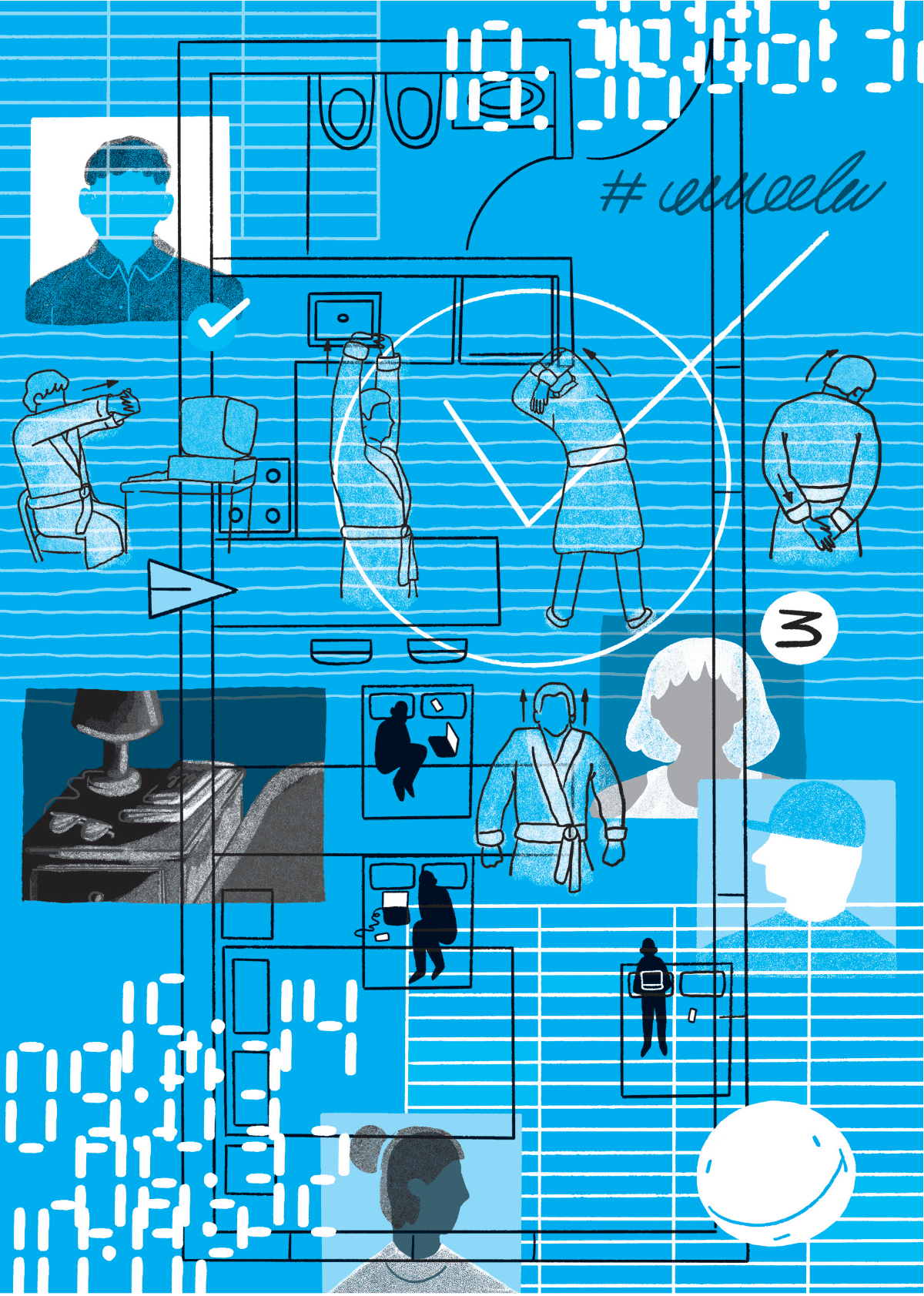
The lack of shared rhythms also blurs the boundaries of space. Without breaks or shifts, without other people marking moments of beginning or end, the inside becomes continuous, expansive, omnipresent. Martín learned this quickly: the bed became his chair; the kitchen, his hallway; the door, his only boundary. An ironclad boundary. The whole apartment grew denser, as if gravity were increasing in that studio. What had once been a refuge was now his surroundings and his periphery. The outside became optional and, therefore, avoidable. Too noisy, too uncertain, too crowded.
As he withdrew, almost imperceptibly, more and more things stopped mattering. He no longer checked the forecast or kept an eye on the time. After all, whether it rained or not, at one time or another, was completely irrelevant. His body felt heavy; getting dressed was hard. Just the bare minimum: changing his T-shirt every so often for work, if that was all the webcam showed. The mirror bothered him; he felt bloated and soft, and preferred not to know. The immediate became the only thing he could tolerate. The delivery apps responded without delay, without questions, without eye contact. He started piling up boxes with the Rappi logo. He swore that when he had enough, he’d fold them up properly and take them out.
Hartmut Rosa, the German sociologist, philosopher, and political scientist, defines this experience as a loss of resonance: the deeper feeling that the world no longer responds. For Rosa, resonance isn’t an intense emotion or necessarily an affectionate bond. It’s the possibility of being touched by something and responding to it from a place that isn’t utilitarian. An urban rhythm, a banal conversation, even the urgency of running so as not to be late can all be forms of resonance. And Martín had lost that echo. His surroundings had become completely available—everything within reach thanks to his salary, technology, the city—and yet everything was utterly silent. Like being in the world without anything passing through you. Like living without an echo.
At some point, he started drinking beer, though he’d never liked it much as a teenager. His favorite was Blue Moon, the one people recommended on Reddit. At first, he’d have one at the end of the workday. Then one to start and one to finish. Then, on weekends, whatever was left over. He wasn’t trying to get drunk, just to bring on a familiar feeling. Give a ritual some shape. Draw boundaries around things and, while he was at it, calm his mind.
At the same time, he got better at making the memes he posted on Reddit. He didn’t show them to his high school friends or his family because they surely wouldn’t get them. They were jokes about how a company can have spectacular lunches but still botch its new features. The best moment of the day was when the users he felt closest to said he was getting sharper all the time. Or when someone new messaged him to ask how they hadn’t come across him before. Getting more and more upvotes was his greatest achievement.
When the house felt too stifling, he picked fights online. He went on social media to fight what seemed wrong and false to him, and because he was bored and fed up—“if people were better informed,” “if they didn’t fall for the sales pitch,” “everyone ends up repeating the same thing,” “what an idiot this woman is.” He went online to fight. He preferred to fight. A fight is still a form of interaction.
Being quieter seemed like an expected effect of remote work, weeks without in-person meetings, and a professional life that ran without commuting or interruptions. At first, speaking less had seemed like a good thing. Like a monk, not having to talk taught him to know himself better. And anyway, he’d never been good at elevator talk. Work conversations were mostly chats on Slack or Discord. And in meetings, people talked about the week’s work, metrics, performance, growth. Short sentences. Monotone voices. All in all, plenty of opportunities to keep quiet.
Over time, he began to notice certain oddities spilling over into the rest of his life. He spoke less, yes. He also wrote more slowly. He hesitated before sending a voice message. Sometimes he was surprised by the sound of his own voice. And when he tried to speak after going many days without doing so, something cavernous came up from inside him. He coughed to clear his throat, but the growl only went away after several sentences.
In The Corrosion of Character, the American sociologist Richard Sennett examines how new forms of work, based on constant mobility, individual adaptability, and the absence of stable structures, make it difficult to build meaningful careers and lasting relationships. Far from widening the scope for action, flexibility often dissolves the frameworks that make connection with another person possible. But sometimes it reflects badly on you to acknowledge this emptiness. In the logic of individual success, admitting that you need relationships seems superfluous, ungrateful,weak. As if success should be self-sufficient and sealed off; as if the only legitimate measures were salary and promotion. For example, Martín’s position was well regarded. In those days, being a programmer carried prestige. Then there was the autonomy, the good income, the professional recognition. Saying he felt disconnected could sound improper, as though he didn’t value what he had. White people problems. In a country so accustomed to misery, complaining about that job would have been disrespectful. But what was starting to weigh on him had nothing to do with the tasks or the work itself, much less the salary. It was the absence, a certain kind of silence that hadn’t been there before.
Perhaps it’s a double silence: an objective silence and another around the image of oneself. In Precarious Life, the American philosopher Judith Butler argues that the subject is constituted through exposure to others. This exposure isn’t limited to the dramatic or the intimate; it also plays out in everyday life, in being part of a scene, in having some possibility of a response. When that web is interrupted, suffering doesn’t necessarily follow, but the experience does become blurred.
When everything can be taken care of inside the home—work, food, leisure, even social contact mediated by screens—we also lose access to a specific category of spaces: third places, those that the American sociologist Ray Oldenburg defined as “social settings that are neither home nor work, but that serve a structural function in community life.” They are places for casual encounters, open and accessible, where you can be without any explicit reason. Bars, gyms, squares, libraries, neighborhood clubs, cafés where you don’t need a reservation: places that don’t demand planning or performance, where you can cross paths with others without having to seek them out or justify your presence. Unlike home, which demands intimacy, and work, which imposes productivity, third places make a lighter, unscheduled kind of togetherness possible, sustained by simply being in the same place. Their contribution is relational and civic: they allow movement between public and private life, offer scenes of low-key exposure, and create a social texture that gives shape to everyday life.
What tends to happen in these spaces—running into someone, exchanging a trivial remark, recognizing a face without remembering their name—doesn’t seem significant at the time. But taken together, that repetition without obligation creates something crucial: weak ties. The sociologist Mark Granovetter defined them as weak social ties characterized by low emotional intensity, infrequent contact, and little depth. They aren’t close friends or family: they’re people you recognize by sight, casual acquaintances, people on the periphery of our networks.
The counterintuitive but crucial thing is that it’s precisely because of their distance that these weak ties most often open the way to new worlds. Granovetter demonstrated it with data and statistics: new information, job opportunities, unexpected connections tend to come through these peripheral connections, not through the inner circle. Strong ties tend to be redundant: everyone knows the same things. Weak ties, on the other hand, connect you to different networks. They’re the ones who recommend you for a job, introduce you to someone, or let you know about something that wasn’t on your radar.
Martín didn’t realize it right away, but he did gradually, as no one told him anything new, he met no one new, he became no one’s go-between and witnessed no scene that wasn’t his own. Everything that happened in his life was predictable, self-referential, programmable.
What happened to Martín is echoed in hundreds of online accounts from forums, communities, and social networks. Variations on the ways in which different spheres of life start to come undone.
The shower: some people say it’s the texture of the curtain they can’t stand; others say it makes them feel more revulsion than relief. “I went weeks without showering. The smell didn’t bother me, but the water on my skin felt strange.” Hygiene doesn’t disappear entirely, but it loses its immediate purpose. Sometimes it only comes back when someone gives you a push.
The bed: it isn’t just for sleeping. It becomes the only place, continuous and without a schedule. One person says the pillow has taken their shape. They don’t say it as a complaint, just as a fact. The bed stops marking a time for rest and becomes the center of operations.
Food: a silent act. No table, no plate, no pause. Lots of delivery, lots of supermarket packages. Standing in the kitchen, straight from the pan. More practical; they’ve gone days without washing anything.
There are less visible changes. “When I spend a long time without moving, my skin goes dull. Almost as if it were absorbing the air,” says a Quora user. Another talks about inflammation, stiffness. They don’t associate it with illness, but they mention it. They mention it because they feel it; something in the body has changed.
A woman on a forum says that at night she curls up in bed with a heavy pillow on her chest. She needs to feel something on top of her. A slight pressure to replace, if only for a while, the absence of another person’s presence.
Most of these show up as offhand comments, but read together, they form a recognizable pattern. Wrist injuries from the mouse, cervical hernias from poor posture, pimples on the back from not getting out of bed. A physical language of disconnection.
At eleven on a Sunday, the doorbell rang. His mother and grandmother had shown up unannounced with a container of milanesas and mashed potatoes, and a Welsh cake they’d made together. Martín came downstairs in slippers, and as soon as he opened the door, the still air in the studio filled with the smell of home cooking and floral perfume, like roses. His grandmother slowly lowered herself into the only armchair and said in a dry, deep voice, “You look like you haven’t slept at all, Martín.” “Could be. I’ve got a lot of work, and I still have to get used to the company’s rhythms. It’s really demanding,” he replied, leaving out the part about how many nights he barely slept because he stayed online until the early hours, debating on X and trying to learn more and more about every subject. His mother asked him, “Wouldn’t it do you good to see a psychologist, Martín? So they can help if work is stressing you out so much.” “Relax, Ma, I’m fine. Grandma, pretty soon I’ll be able to pay for your nursing home, so you can take whatever classes you like and maybe catch yourself a millionaire there, huh?” His grandmother waved the comment away. His mother laughed.
Did he look that tired? That same night, Martín typed “online psychiatrist insomnia Capital Federal” into the search bar. His mother had suggested a psychologist, but he went straight for a psychiatrist. If he needed to take something, he might as well save time. The psychiatrist, a woman whose name he never remembered and whom he saw online for 15 minutes once a month, prescribed him 10 milligrams of Zolpidem.
What a relief to sleep. What a relief to take the Zolpidem at 10 p.m. and come back to consciousness the next day feeling fresh, with no hangover. His mother and grandmother had been right after all: being able to sleep would help calm his mind.
He’d read on forums that Zolpidem—they call it “Ambien,” because that’s what it’s called in the United States—had some pretty serious side effects. Once, he googled the medication to understand why he couldn’t remember parts of the previous night, when he hadn’t fallen asleep right away, and found hundreds of stories. “Ambien horror stories,” they were called. Under that heading were accounts of people who climbed into a closet and woke up there, who peed on their brother and didn’t remember, who drove to an ice cream shop in another town and only knew because of the wrapper they found in the morning. The psychiatrist may have warned him, but he’d forgotten.
What happened to him was that he made purchases on Mercado Libre. Packages arrived at the security booth in his building, and Martín didn’t know what they were until he opened them. A soda maker. A PlayStation 5. An electric guitar that came with sheet music for learning how to play. Camping gear for four. A Blade racket, used a lot on the professional tennis circuit. He watched a lot of tennis on TV while he programmed; it helped to have voices in the background.
But why had he bought a racket? He didn’t remember, but it made sense. He’d read a lot about the Bryan Johnson method, one of his tech idols. Johnson was a pioneer in extending life, and that was the future: avoiding death or, at the very least, living much longer. Physical activity and socializing were very important for longevity, Johnson said. So yes, later he remembered that he’d made all kinds of plans to address this part of the protocol, which, he admitted, he’d been neglecting a little. The racket was for playing at a club with people he’d meet there. The best racket to make up for the fact that he’d only played as a kid, that he couldn’t get by with a bad one. A Blade, then, to socialize and start exercising again. Because he had the money, and like Johnson, he never wanted to die.
Encouraged by those same forums, he established a strict routine: breakfast with water and salt, a cold shower, kettlebell workouts, eating gluten-free and without processed sugar, a flexible paleo diet, monitoring his smartwatch metrics to find ways to improve.
Seven months later, he put the racket up for sale. He offered it to his high school classmates—almost all of them men—and included a list of the players who used it in the message (Tsitsipas!). He’d only used it five times because in the end the club thing hadn’t worked out. It was too much hassle; there was traffic, and he was more comfortable inside. If he kept up with the weights, his exercise was already taken care of.
Researchers, consultants, artists, designers, remote psychologists… lots of jobs follow a logic like Martín’s, not just programming. The American economist Juliet Schor points out that the gig economy —a labor market based on temporary, flexible, project-based jobs—fragments traditional employment relationships, breaking apart the idea of a work community sustained over time. Sold as a privilege, flexibility conceals emotional precarity. According to Schor, loneliness in these settings isn’t a side effect: it’s the structural cost of a production model based on the dismantling of relationships. Organizing work around tasks replaces any shared narrative. Work stops being a web in which to anchor experience. The autonomy celebrated in corporate rhetoric conceals a functional loneliness, with no reason to meet and no friction that forces you to be in the presence of another person. Even in jobs that involve being physically present—like delivery or customer service—the algorithmic logic erases opportunities for interaction: the app tells you what to do, the person does it. There’s no pause, no camaraderie. There are tasks and production. Deliveries, sessions, designs, reports, trips. Anything that isn’t part of that circuit is seen as a leftover. And relationships with others are out of place. Futile and idle.
But even in that context, there was one thing Martín never put off: visiting his grandmother at the nursing home. He’d been able to pay for a better one, a more expensive one. After all, she’d helped him through his university years. She deserved it. And he knew it was important to her that he visit.
Every time he had to go, he looked for every possible excuse not to, but that was unacceptable. So he showered, got dressed, and took a Cabify, hoping the driver wouldn’t speak to him. “To the nursing home, right?” he’d ask the driver, checking that he’d gotten into the right car. And also making it clear that this was a serious trip, that he wasn’t in the mood to talk about politics or current affairs, things he surely hadn’t heard about anyway.
Horacio works at the nursing home Martín pays for his grandmother. He’s a geriatrician and has worked in nursing homes for more than 38 years. He once had a nursing home of his own, but it came with too many problems, so he decided to stay on as medical director at this one, which works with PAMI but also has private patients.
For Horacio, loneliness builds over time. It has to do with what you lose and how those losses accumulate. “The problem with living a long time,” he says, “is that more and more losses keep piling up.” The phrase comes back in different versions, as though he needs to say it again for it to sink in. You lose your partner, your friends, your job, your body. Each loss on its own seems manageable. Together they leave a void that nothing in particular can fill. When he talks about old age, he puts it simply: “You can live a long time, but you’ll almost certainly need a few years of care.” It’s a predictable stage of life. And he adds something that matters to him more than the number: that stage tends to come when your support network has already weakened. Your partner may be gone. Your friends, even more so. If there’s no family nearby, or if your family can no longer hold everything together, your life rests on institutions.
That’s why he insists so much on how to touch, speak, and approach someone. When a nurse moves a patient without warning, he stops them. Says the patient’s name. Explains. Waits. “Even if they don’t answer, they register it,” he repeats. “The body registers it.” He says it because he’s seen it too many times. An arm that stops resisting. A breath that settles. A tiny gesture that appears too late, when no one is looking anymore.
The day at the residence is mapped out before it begins. Breakfast, medication, lunch, a nap. That order holds things together. It also flattens them. Between one thing and the next, there are long hours with no requests or tasks. On that flat stretch of time, patients sit around, looking down the hallway, watching others pass by who seem to have something to do.
The food cart is an event. Then time goes back to having no markers.
That’s where what Horacio calls boredom comes in. Understimulation. Few things coming in from outside. Few things demanding a response. No one asks because almost nothing depends on them anymore. The day passes without friction. The body is left with nothing to do.
The pandemic took that to an extreme. Horacio tells the story of a man who always argued about the TV, the chair, anything at all. During lockdown, he stopped. “That’s when I got worried,” Horacio says. And here, too: a fight, at least, is a form of interaction. As long as someone is fighting, they’re in the scene. When nothing bothers them anymore and nothing calls for a response, another kind of loneliness sets in.
As soon as COVID let up and visits resumed—even if they were brief and subject to protocols—the effect was noticeable. People sitting up straighter in their chairs. Others moving closer to a room that wasn’t theirs. Conversations overheard in passing.
“A lot of the time, visits are shared. Someone comes to visit their grandfather and ends up talking with several people who come over, so everyone gets to feel visited,” he says. The presence circulates. Then it leaves. The place closes in again. That’s when Horacio brings up an idea that helps him make sense of all this. He learned it from reading Pichon-Rivière and confirmed it by observing groups for years. Pichon believed that a person is sustained within a group when they occupy a place connected to a task. Something that organizes the scene. Something that’s needed. Not as productivity or some lofty sense of purpose, but as a position. Horacio puts it his own way: “If you don’t have a role, you go downhill faster.” That’s why he insists on assigning small tasks to the residents. Opening the door when someone arrives. Letting people know there’s a visitor. Walking someone to the dining room. Handing something out. They aren’t big responsibilities. They’re positions. Someone is expecting you to do something. The day takes on a different shape when you have a role, even if it only lasts ten minutes. And he tells the story of a woman who, for a while, was the one who announced when family members arrived. She would stand near the entrance and call out. “Marta’s daughter is here,” she’d say. She didn’t do much more than that. But people waited for her. When she stopped, no one took her place. The hallway fell silent.
The visit went as usual. Martín chatted with his grandmother, repeated the same jokes about the country with the other residents, and caught up with Horacio. He said goodbye with a wave and left, still enveloped in the smell of cologne.
On the way back in the Uber, he wondered if he could develop something to keep the old folks at the residence company, to ease their boredom.
Maybe design a virtual companion, perhaps with robotics, perhaps just conversational. He’d need a cloud server, an API to connect it to an interface, maybe an Arduino. And for those with hearing problems, a large tablet that could turn in response to sensors. He could buy it all on Mercado Libre and it wouldn’t cost him that much. He could build them something that would stimulate them. Something that would make their lives in the nursing home a better place. Something that might spare him having to go every week, perhaps, especially on the weeks when he has to work late or there’s an Independiente match.
Crónicas, ensayos, perfiles y análisis para explorar la epidemia de soledad del siglo XXI. Más que un libro, la radiografía de una sociedad que ha logrado optimizarlo todo, excepto los vínculos.
152 páginas. Papel bookcel 80 gramos. Impreso a dos tintas. 14,5 x 20 cm. Ilustraciones de Paula Maneyro.
Biografía de la autora:
Victoria O’Donnell es socióloga (UBA) y magíster en Métodos Cuantitativos en Ciencias Sociales (QMSS) por Columbia University (Nueva York, Estados Unidos), con financiamiento Bec.ar–Fulbright. Consultora, docente e investigadora especializada en tecnología y salud mental. Dictó clases en la UBA, la UNSAM, FLACSO y CEPAL. Se desempeñó en análisis y estrategia en la función pública, en el sector privado local, organismos internacionales, empresas globales de tecnología y clínicas de salud, con foco en enfermedades crónicas no transmisibles, salud mental y consumos problemáticos.
Crónicas, ensayos, perfiles y análisis para explorar la epidemia de soledad del siglo XXI. Más que un libro, la radiografía de una sociedad que ha logrado optimizarlo todo, excepto los vínculos.
Formatos .epub y .mobi.
Biografía de la autora:
Victoria O’Donnell es socióloga (UBA) y magíster en Métodos Cuantitativos en Ciencias Sociales (QMSS) por Columbia University (Nueva York, Estados Unidos), con financiamiento Bec.ar–Fulbright. Consultora, docente e investigadora especializada en tecnología y salud mental. Dictó clases en la UBA, la UNSAM, FLACSO y CEPAL. Se desempeñó en análisis y estrategia en la función pública, en el sector privado local, organismos internacionales, empresas globales de tecnología y clínicas de salud, con foco en enfermedades crónicas no transmisibles, salud mental y consumos problemáticos.