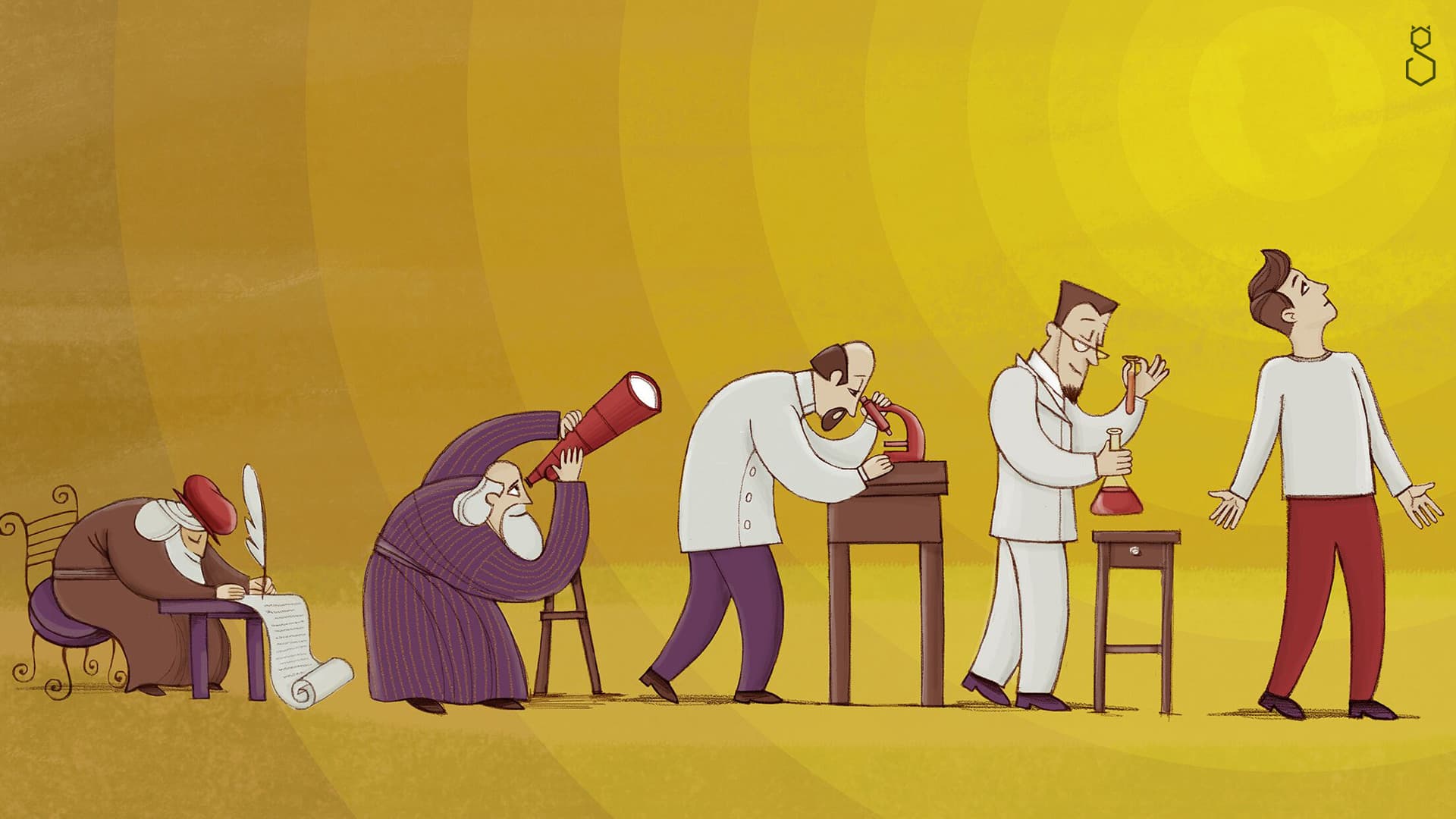
Scientists are famous for asking cool questions and tackling the search for answers using the most powerful and objective method we know. Great. Congratulations, guys. Now, I also have a question:
Who named you Emperor of Truth, dude? Or, in more formal terms: Why should we believe scientists?
The question is much more relevant than it seems, mainly because of the problem it represents for someone for whom a lab coat used to give them authority and now has to go out and explain that, actually, their credibility comes absolutely from somewhere else.
For you, who don’t dive deep into the hidden seas of scientific knowledge, science is also a matter of belief. When Dr. Genius from UBA (Buenos Aires University) or MIT talks to you, you can decide whether to believe them or not. But, why believe a scientist? Or worse, why would one scientist believe another scientist? Being a physicist, how do I know whether to believe a biologist, a chemist, a homeopath or an astrologer? And that’s not even mentioning lawyers, bricklayers, and fridge repairers, who, by being outside this circuit, have it way tougher.
We all remember those stimulating and fun high school classes where teachers interrupted your nap to tell you that “Science is always right because it follows the scientific method.” But for that tiny, ultra-minority of approximately 97% who weren’t paying attention in high school, we can tackle it in a way that’s a bit less sleep-inducing.
This whole scientific method thing is, first of all, about using clues to infer something you think is true about whatever you’re studying, which on the street is known as formulating a hypothesis (and by “street” I mean “a hypothetical place we assume exists but for which we still don’t have a single piece of evidence”). With your hypothesis in hand, you figure out what consequences it would have if it were true; that is, part of a scientist’s job is to predict the future (like astrology, but that works). The last step is to compare the consequences of that theoretical model with reality, that is, with observations or experiments. If the consequences don’t match the observations, then the hypothesis falls. As Dick Feynman (a.k.a., the third Feynman) said: “In this simple statement is the key to science. It does not make any difference how beautiful your guess is, it does not make any difference how smart you are, who made the guess, or what his name is. If it disagrees with experiment, it is wrong.” In other words, science is about testing and testing until one of our hypotheses to explain a little piece of the Universe works. That, or you open a corner shop.
This is called the deductive method, because starting from something general (the hypothesis), I have to be able to deduce many small consequences and natural phenomena, that is, it goes from the general to the particular.
However, the deductive scientific method has some little issues. Namely:
- To compare the consequences with experiments, scientists often assume auxiliary hypotheses that add ambiguities (what we internally refer to as “an endless series of ad hoc patches: the duct tape of the scientific method.”). For example, quantum mechanics is a series of principles used to explain how the super-microscopic world works (that is, everything very, very small, at the level of atoms, molecules, and whatever joke you want to add about some ex). But, very often, when comparing its consequences with nature, experiments mix microscopic things with macroscopic ones (for instance, measuring devices), and it’s precisely in that relationship between the atomic and the macroscopic that theories start to leak and show a bit of spinach in their teeth.
- A lot of the science that gets published or accepted doesn’t follow exactly the same shade of scientific method. As an example, there’s the inductive method, which is what Darwin used to create his Theory of Evolution. Charlie, by looking at a ton of animal species, drew a general conclusion for all of them. So the inductive method is like the deductive one, but backwards: it starts from the particular and goes to the general. It’s another example of doing science, even if it’s not strictly framed within the deductive scientific method.
- We already understand how to decide if a hypothesis is wrong, but how do we know if it’s true? Here’s where science gets pretty: we can’t. That’s where the phrase attributed to Einstein comes in (though who knows if he actually said it, but that doesn’t make it any less true): “No amount of experimentation can ever prove me right; a single experiment can prove me wrong.” This is known as falsificationism and boils down to “It’s easier to prove there’s a unicorn in your kitchen than to prove there’s no magical bearded man controlling the Universe, because for the first one, I just need a unicorn and a kitchen, while for the second one, you’d have to lift every rock on every planet in every galaxy of every system, and so on, until you don’t find anything. What a drag.”
Only as a hypothesis explains more and more experiments can we start gaining confidence in it, but never fully guarantee it, because we don’t know if at some point or in some other neighborhood of the Universe this model will fail.
Saying that a hypothesis is true because its consequences match experiments is called the fallacy of affirming the consequent. And, as we know, a fallacy is an argument that looks totally valid but is actually smoke and mirrors.
The crazy part is that in general the opposite happens. We believe science when it says something is true (like the Big Bang or quantum mechanics), but not when it says something is not (like astrology, homeopathy, or those platform sneakers that for some undocumented reason are TOTALLY GOING TO MAKE YOU LOSE WEIGHT). The thing is, this is exactly the point where science really shines: it can assert that a theory is false, but it can never assert that another is true.
This shows us that, in reality, the beautiful thing about science is not its ability to give answers, but to ask questions. The question is what matters and is what takes us to the lab every day. Many people think that discovering things nobody knows is ruining the magic, and spend their lives asking themselves the same questions (with or without being amazed by them). The point is that each answer found opens up many, many new questions to be answered. And that’s what’s cool about science: it shows us more and more questions. Without it, we’d always be asking ourselves the same things and we’d miss out on the incredible pleasure of doubting, saying “I don’t know,” and having to think about how to answer that new question.
Curiosity may have killed the cat, but it surely had a blast while it lasted.
Now, hold on. Didn’t all this rambling start with the promise of explaining why we should believe scientists? The answer is yes. Yes, we should believe scientists when they claim something, but not only because they follow the scientific method, but because of the way science has been and continues to be built and knowledge constructed over the years, through questions, doubts and curiosities that are addressed with more and more rigor every time. Science is the consensus of a bunch of uncompromising, pain-in-the-neck skeptics, all organized. A group of quite a few people who spent and spend their lives studying very specific things in a very meticulous way, building on what other scientists already studied and sometimes even trying to disprove them, in a bloody evidence-off where some lose and others win but where, ultimately, we all win. May Thor will it that someday someone makes the Theory of Evolution tremble and offers us an alternative so huge that even Darwin himself falls madly in love with it.
Science shows every day that it’s at least somewhat right. It advances at incredible speeds, making increasingly complex predictions and at the same time making possible the development of new technologies (meaning it not only talks a better and better game, it also does better and better). Thanks to it, today we have things that 400 years ago we couldn’t even dream of, and not just material toys. We have the possibility of living longer and better (offer not valid for most inhabitants of big cities), but mainly of going through our finitude in increasingly freer ways, using a way of going through reality that comes with more and better questions.
But there’s no need to “believe or bust.” There are options, and the nicest one is to doubt and ask for more information. The best part of stepping out of the believe-or-bust dichotomy is that it lets us accept ideas based on the best available evidence, as opposed to the previous habit: making up whatever we feel like according to whichever Mysticism class we took, unleashing the eternal and unsolvable discussion that ends in whether your ghost is better than mine.
The scientific method makes us freer and less stubborn. It lets us go from the hyper-overrated “These are my principles and I’ll stand by them to the death” to “These are my principles, but if you have evidence to the contrary, awesome, let’s totally go with that.”