“The problem with humanity is that we have Paleolithic emotions, medieval institutions, and godlike technologies.”
Every day we see a new example of how artificial intelligence increases labor productivity in an ever more diverse range of sectors. As the diffusion of AI grows and its benefits become more evident, our dependence on it will also increase: people who learn best how to incorporate the tool will have competitive advantages over those who don’t. Mastery of it will be a non‑negotiable requirement to apply for certain positions. Within a certain timeframe, this dynamic will turn it into a mandatory tool, regardless of its implications. This is not new, and the spread of the plow in agriculture taught us this thousands of years ago: technology that is highly advantageous becomes mandatory, whether we like it or not.
Long ago and far away
Before the spread of the plow, animism was fairly universal among human societies. That is, humans recognized an intrinsic sacred character in every living being, which shaped our bond with them. Being animist didn’t stop us from hunting an animal to eat it, but it did stop us from whipping it all day long and pretending its function on the planet was to serve us. When members of animist societies killed a buffalo, there was no shortage of rituals and ceremonies of gratitude. The process was part of a cycle of life, in which they were predators.
Over time, some societies developed technologies that made it possible to till the land with greater intensity and power. The plow evolved and began to be pulled by cattle. Productivity in food production skyrocketed, as did the distance in the bond between humans and their whipped animals.
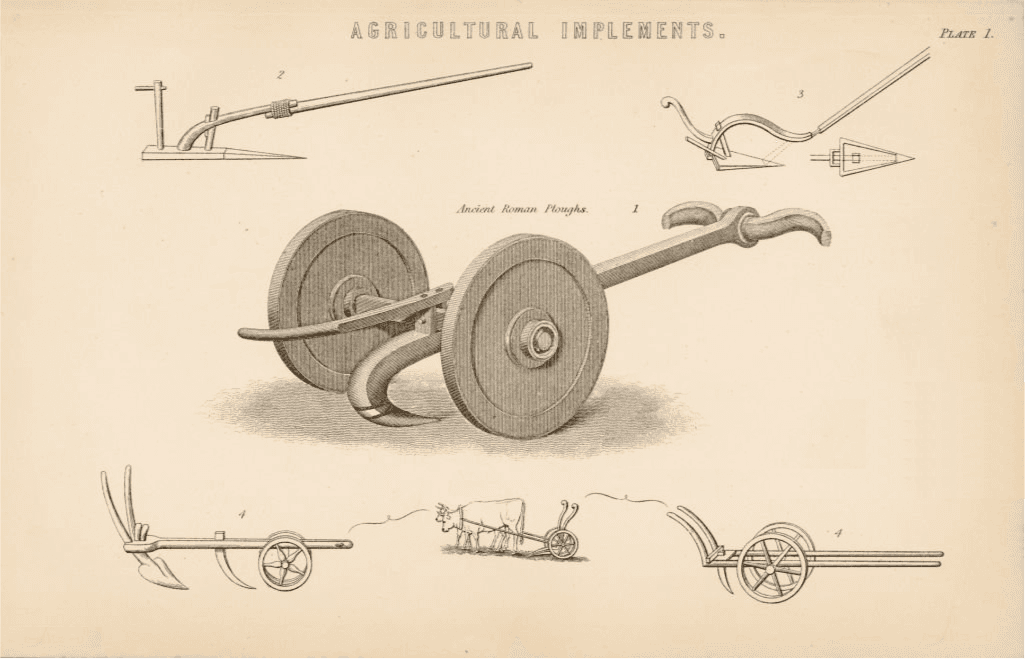
We can play at imagining the debates within a neighboring animist society. Many people would have been horrified at how this technology degraded the bond with what they considered sacred, going against deeply rooted ethical values. On the other hand, there surely were those who warned about the risk of being invaded in the future by neighboring bands that were growing their population size at the expense of animal abuse. It’s likely that several people argued that the best thing to do was to use the plow for a while —despite their beliefs— in order to grow enough not only to prevent the neighbor’s immorality from spreading, but eventually also to be able to invade those impious folks next door and restore the ethical values of animism. We can know little about whether these conversations actually took place, because the truth is that only those societies that used the tool survived. When the competitive advantage of a technology is that great, its use is not optional. If my social group doesn’t use it, the one next door will, before invading me. That’s how we ended up in a paradoxical situation in which we have the power to kill the buffalo, but no longer to save it.
Animism disappeared almost completely, but its example serves to illustrate three basic principles of the relationship between technology and human behavior, according to anthropologist Daniel Schmachtenberger:
1. Technology that is highly advantageous becomes mandatory. As said: those who use it transcend in history and those who don’t are left behind. You cannot transcend in history without using it. Someone else is going to use it, going to take advantage of the technological edge. Even if I don’t want to, I have to, because everyone else will.
2. Technology is not value‑neutral and encodes behavioral patterns (sociotechnical paradigms). Instead of being a hunter‑gatherer, now I’m hitting a buffalo all day long. The effects can be both positive and negative and generally tend to go beyond what was originally intended. In other words, the risk of indirect effects that change behavior in an unintended way is high.
3. By encoding behavioral patterns, it also encodes value systems and, by doing so at scale, it encodes culture. From a materialist perspective, infrastructure conditions and impacts the social structure and superstructure. The introduction of the plow affected the value system, which changed from “we are part of a web of life and every form of life is sacred” to “nature exists to serve us.” That was the result of a complex interaction, with a value system integrated into a technological infrastructure that conditioned it. One additional point is that, before the plow, a good portion of food was provided by women, whereas later that percentage became a minority, since this new technology required male strength.
Godlike technologies
These principles are highly relevant for thinking about the spread of artificial intelligence and the risks it poses for humanity. Not long ago, Elon Musk and hundreds of prominent figures warned about AI’s potential to “destroy humanity,” signing a letter calling for a temporary halt to development until we have a better understanding of the risks. Weeks later, Musk himself announced the launch of his own project in this field. While this may seem like contradictory behavior, it is completely rational: it stems from knowing that neither he nor anyone else has the power to stop the advance of this technology, so he will try to gain enough control over it to influence its development. It’s like the animist tribes that took up the plow so that their ethics would become dominant, given the risk that “someone else with worse ethics” might win out.
But in the AI race there is no time to evaluate second‑ or third‑order effects, and whoever tries to do so will simply lose ground to those who don’t. Incentives in this type of development are geared toward early capture of the benefits. No one has an incentive to carry out comprehensive risk analyses that slow down the chances of capturing markets. The only way is forward and fast, otherwise it doesn’t happen.
This dynamic in which the adoption of certain technologies becomes mandatory might not have been so serious when we were just a few million people on the planet and the impacts of our technological developments were local. But today we are a planetary species —a geological forcing— and that same dynamic can be catastrophic for both the planet and people. That is why it is one of the great “multipolar traps” our globalized society faces. These kinds of traps arise in situations where powerful actors, such as states or corporations, relate to one another through competition or conflict, which leads to a state of affairs of perpetual instability or even existential risk for humanity. A clear example is the development of nuclear weapons: in an ideal world we would want them not to exist, but no power is going to be the one to disarm while the risk persists that its adversary is doing the opposite. In the end, we end up in a world where several countries have the real capacity to wipe each other out. As early as 1953, Robert Oppenheimer, the director of the laboratory that designed the nuclear bombs as part of the Manhattan Project, said in a speech to the U.S. Council on Foreign Relations that “we may be likened to two scorpions in a bottle, each capable of killing the other, but only at the risk of his own life.”
Godlike resources
Something very similar happens with the development of hydrocarbon projects. We know that, if we want a habitable planet for our civilization, we must phase out hydrocarbons over the coming decades. Faced with this imminent global need, our reaction as humanity was to begin a kind of desperate race to see who will manage to extract the last drop that can be sold on the market and capture as much of the remaining “rents” as possible.
In this context, controversies arise around various hydrocarbon projects in different countries. Let’s take the example of Vaca Muerta in Argentina, a true “carbon bomb”: today, more than half of the country’s gas and oil comes from this basin. Its potential could transform Argentina’s macroeconomy, contributing to the trade balance in just a few years more than double what agricultural exports currently provide. Investments for the energy transition in infrastructure, efficiency, and diversification of the energy supply —estimated by the National Secretariat of Energy at around 66 billion dollars by 2030— could be leveraged on this reality. Without a doubt, Argentina has an incentive to make the most of its available resources while it still can.
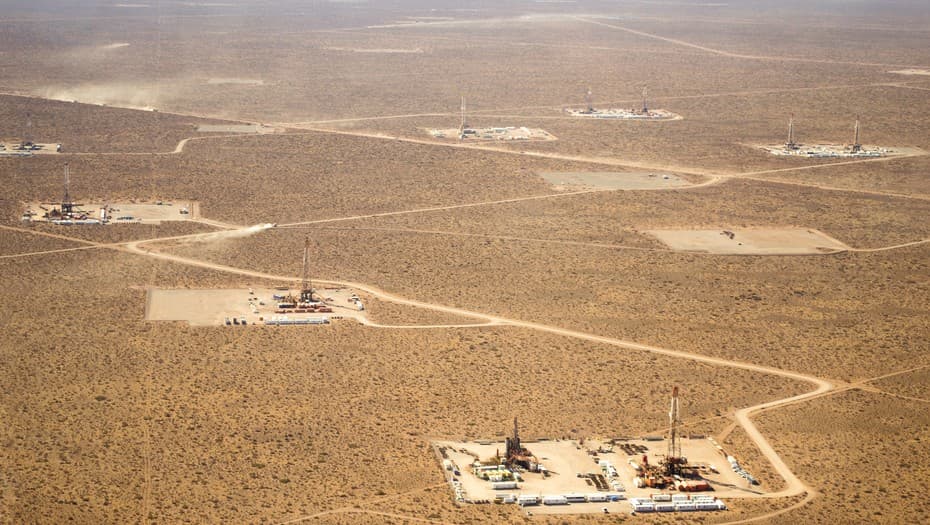
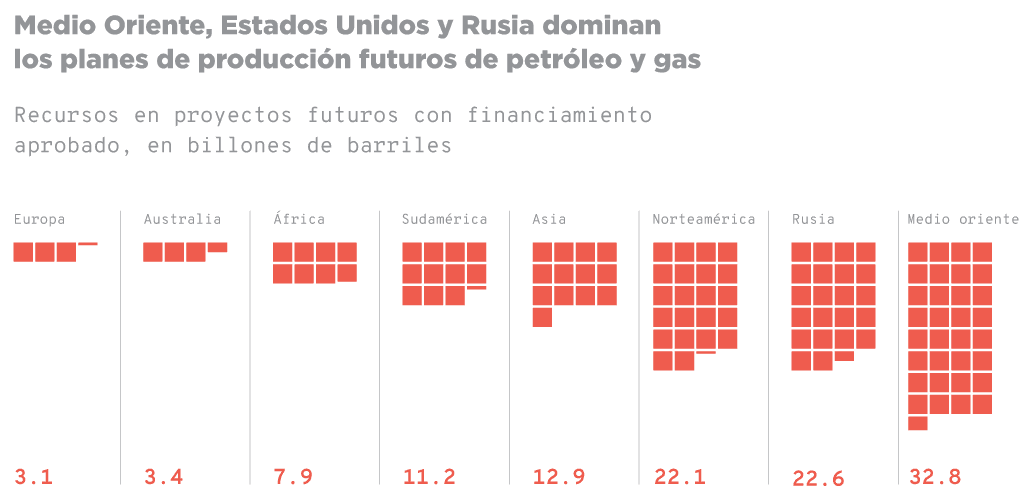
However, there are those who believe it is necessary to stop these kinds of developments, since they are incompatible with global warming targets. The problem is that hydrocarbons are a buffalo we are going to have to beat, whether we like it or not: if the gas and oil don’t come out of Vaca Muerta, they’ll come out of the Middle East, Russia, or the United States. In fact, this report from ‘The Guardian’ shows that two‑thirds of the 116 billion barrels of gas and oil committed in investments by energy corporations come from these three rich regions. Not long ago, at the beginning of 2023, Biden gave the green light to one of the planet’s most risky oil projects, located in Alaska. For its part, Norway has one of the most aggressive policies on hydrocarbon exploration, even as it paints exports derived from that resource green by investing in electric cars.
This creates a situation in which the countries that contributed the most to the historical concentration of greenhouse gases are also those best positioned to continue benefiting from the global hydrocarbon market in two ways: on the one hand, they are projected to capture a significant share of the remaining hydrocarbon rents, and on the other, they are the ones leading the development of technologies that they then sell as solutions to climate change, consolidating their geopolitical role. Is it fair that, in the context of a climate crisis, countries like Norway, the United States, or Australia continue to finance their economies by exporting hydrocarbons?
Beyond these ethical debates about global responsibility for climate change and the fair appropriation of the remaining hydrocarbon rents, the truth is that in practice what will happen is that each country will seek to impose its own interests for its own benefit. Even if it doesn’t want to, it will become mandatory for each of them to take advantage of their competitive advantages if they want to strengthen their dominance over competitors. It is the logical behavior of any society organized around surpluses generated first by agriculture, then boosted by hydrocarbons and finally deepened by digitalization. The plow, hydrocarbons, and Artificial Intelligence are just the tips of the iceberg.
So… what do they have in common?
What connects these developments —and any other emerging technology with the potential either to transform humanity for the better or to endanger its existence— is that they don’t appear out of nowhere and are not the product of evil —or at least not only—, but rather the result of human behaviors driven by incentive systems.
Those well‑intentioned people who seek to save our beloved humanity from the harmful impacts of these ventures must understand that their struggle is not so much against other people’s bad intentions, but rather against the systemic incentives under which decisions are made. In many cases, on the other side of the ring there are not bad people, but normal people doing the right things within a system that is wrong. Systemic incentives are what lie between what is desirable and what is possible. Also, sometimes there are bad people, but I tend to think that systems shape us more than intentions do.
Recognizing that we live in a world full of multipolar traps means recognizing that the room for maneuver to stop the harmful impacts of technological developments is in many cases limited, if not nonexistent. This gets worse in situations where the technology is capable of slipping away from any coordinating instance: what happens, for example, when an artificial intelligence model is open source? Whom are we going to hold accountable for its misuse or its unintended impacts? When code is released, accessible for anyone to use, we don’t have a tax address to file a complaint against or a corporate headquarters to shame.
Today we find ourselves in a race against the clock to tame the gods we have created. If we don’t do it in time, our civilization will be the great buffalo of our times. The range of possible futures has become as vast as it is uncertain. Today, it is just as plausible to imagine a scenario in which human creativity shines thanks to the liberation of machines as it is to imagine one in which machines learn that the planet would be healthier without human civilization and act accordingly. We are at that moment in history when there is still time for possible futures to coincide with desirable ones. We have a window of opportunity to have these conversations. We must not take it for granted.