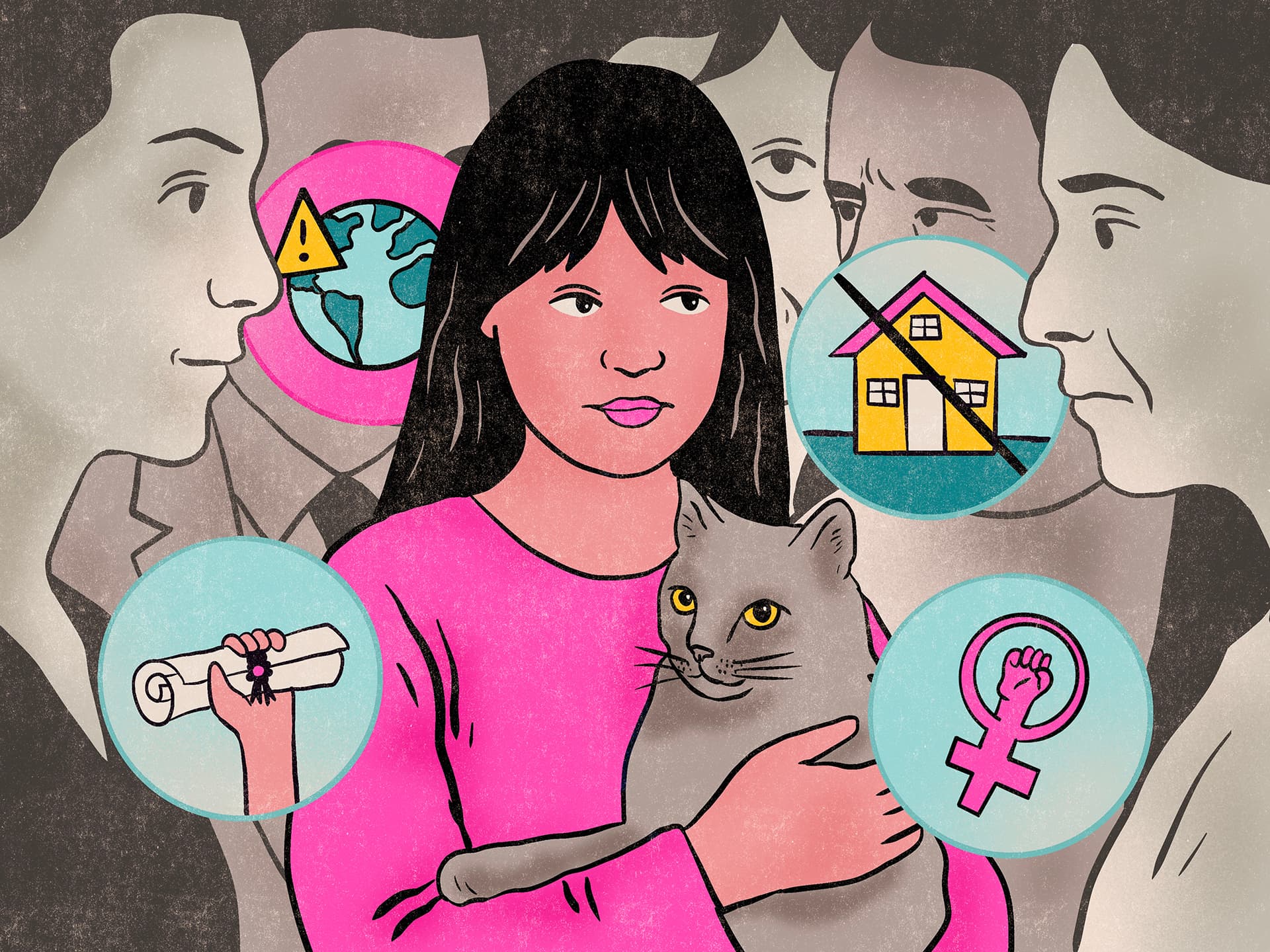
1/ Managing the pain
I got the call at four in the morning and they told us we could go right away: despite the resuscitation maneuvers, they couldn’t bring her out of yet another cardiac arrest. I walked into the operating room trembling and then I saw it. An aluminum gurney with a sheet covering a tiny lump, but it didn’t quite cover everything: her brindled tail hung down, motionless, my cat’s tail. I had never been so close to a dead body and so forced to do something with that dead body.
I pulled back the sheet, picked up my cat’s body, opened her eyes, looked at her fixed yet still bright pupils, and I did it because I wanted to see them one more time. I noticed her gums, already purple, the shaved little paw where the IV line had been placed, and I put her around my neck as if she were a fur stole. I cried at the vet’s while I walked around the gurney with my corpse-stole. With my cat around my neck I cried for the last bastion of our family of three that we still had that year, the children we had lost and couldn’t have.
My cat died six months after she started coughing and ten days after stumbling as she got off the bed. We spent a ton of money on ultrasounds, blood donors, lab tests, medication and a hospital stay at the best veterinary clinic in Buenos Aires. We met people — mostly older adults — with no hope, who were organizing collections and selling things because they could no longer afford the clinic to prolong their pets’ lives, pets that were sometimes 14, 18 years old Throughout this piece, I will speak of “pets” and of “companion animals” interchangeably and according to various emphases or expressive needs of the text, fully aware that they do not connote the same thing. We consider “pets” to be companion animals, and animals as non‑human persons.. We also met young couples, families with children who came with cans of tuna or little packets of soft food to visit Amarelho, Dana, Chicho, our companions in the hospitalization ward. I discovered that the “humanization of pets” wasn’t the complaint my mother used to repeat so often in the eighties (“these days it seems like a dog is worth more than a kid,” she loved to say), nor those news articles that, for the umpteenth time, think it’s clever to announce the existence of “Couples who prefer pets instead of children, a growing trend.” The “humanization of pets” was, instead, an experience very similar to mine, and we had been in that place for a long time. Mochi wasn’t our cat‑child (in fact we didn’t know the term), but she was the third pillar of my family. Of course, we accepted the cremation service the clinic offered us, and it seemed fair and appropriate.
Condolences followed, mostly through messages on the photos we posted on social media as a memorial. My brother and my mother have a tacit policy of managing pain down to what is strictly necessary, so the next day my brother writes to me:
“On the rescuers’ Facebook there’s a little ginger one up for adoption…”
I thought he was being disrespectful, totally out of line, shitting on my grief. But I answered:
I’m writing this several years later while Mirindo, the little ginger cat, the most spectacular and sweetest cat that exists and has ever existed in the city of Buenos Aires, the one where there are more pets than children, licks his tail and gives me goo‑goo eyes.
Back then, I remember, it became fashionable to make visible the B‑side of motherhood and all of that sounded boring and trivial to me. I spent my entire thirties avoiding having children, finding no meaning or transcendence in the idea of putting up with a whiny little brat dependent on my time and attention. Having a child seemed to me like an overrated, imposed experience, a drag compared to travelling, working peacefully with a cat on my lap, buying clothes, sleeping through the night and relaxing in childfree boutique hotels, now that we were starting to save money to enjoy ourselves.
But then, a tiny doubt and it happened: nothing made me want to have a child more than finding out that I couldn’t.
2/ The drop
The birth rate in Argentina has been in free fall since 2014. The decline is abrupt: in 2023, the number of live births was 48% lower than in the year 2000. The drop in the birth rate in the city of Buenos Aires — a more up‑to‑date figure — shows the same thing: by 2025 births were 48% lower than in 2016.
Even though this fact has been well‑known for some time, it’s now at the center of the agenda. We could say it was put in the spotlight as something urgent when the most conservative sectors of politics labeled it a tragedy caused by abortion and so on. But that wouldn’t be entirely fair, because the drop in birth rates is also on the global agenda and is the focus of anxiety, concern and joy for many governments of different political stripes, public policy makers, academics and activists. Perhaps the most interesting thing to think about is to what extent it represents a problem, for whom it doesn’t, and, in any case, what it’s telling us about ourselves.
It’s very common to present fertility as something to do with wanting (saying “people want/don’t want to have children”), to explain it as the sum of individual desires and wills. To understand why some desires prevail over others, people hazard cultural or economic causes and nothing is more tempting than wrapping up the analysis with one’s own experience of how beautiful it was to have one or several children, or how horrific it was or — also with great passion — how wonderful it is not to have them and all that is gained.
But in reality… what does the drop in birth and fertility rates depend on? On abortion, as the president says? On Buenos Aires residents who hate kids and prefer to have dogs instead of children, as the deputy mayor claims? On the fall in teenage fertility that those of us who care about the human and reproductive rights of girls and adolescents celebrate? On the women who decided to slam the door on patriarchy and its mandates and stop providing cheap labor and soldiers for capitalism? On couples who declare themselves childfree? On couples who would actually like to have children but give up because they have no way to access housing suitable for raising them? Does it depend on the increase in people who can’t find anyone with whom to form a couple? On people who want children but don’t have the money to raise them? Or does it have more to do with infertility problems? Is it the — justified — fear many young women have of being left alone to face all the domestic work and caregiving? Of women who are afraid of losing their jobs? Or of young people who see that project as a burden? Is it fear of climate change?
Of all the things I mentioned, some are true and do help explain the drop in births. Others are not at all, they’re pure ideology that has nothing to do with truth, rationality or data. Sometimes they’re even bits of data manipulated to produce semi‑trash ideology whose sole aim is to shock. If we dive a bit deeper, we’ll find a genuine multi‑causality, but I’ll say this up front: nothing is going to end irreversibly and even less so in a “natural” way.
3/ Firstborn (and siblings)
Demography is a black box in which a single round figure, a percentage, a rate that goes down, up or stagnates literally contains millions of lives and their circumstances: desires, rational choices, spiritual choices, natural disasters, expansion of rights, violation of rights, brutal socioeconomic realities, biological determinants, desired and undesired effects of public policies, effects of the market and the culture industry, affective and emotional configurations. Opening the black box of demography is complex: it implies figuring out what the creature is made of, removing the noise, measuring it, weighing it, asking it questions, trying to see where causality lies, avoiding spurious correlation. Because, needless to say, when it comes to babies, nothing fits better than what old methodology professors used to say: “If we observe an increase in the number of storks… is that the cause of the increase in the number of babies?”
To begin with, there aren’t fewer storks: the drop in total fertility is largely explained by the abrupt and surprising fall in teenage fertility, which was 11.5% in 2023, 64% lower than in 2005. This trend is shared by almost all countries in the region.
This excellent news is mainly due to successful access to reproductive health rights, such as effective contraceptive methods appropriate for these age groups, and comprehensive sex education. Fertility has also dropped among the younger age groups and among women with lower educational levels. This directly means that more girls (and also boys) continue their studies and define projects and career paths with greater autonomy, and it opens the possibility of realizing motherhood when they truly want it.
Some popular science pieces that try — probably rightly — to tone down the alarm over the drop in births stop the analysis here. But the reality is that the decline in teenage fertility doesn’t explain everything. If we removed that universe, we would still see fertility going down. Much less, but it goes down. In that extra set of reasons and causes there may be more than just a strictly demographic “crisis” or “danger.”
The second factor contributing to the decline in births is the drop in the total number of children due to fewer second and third births. In other words, there are fewer siblings. The fall in second and third (or later) births among women aged 25 to 49 accounts for 42% of the drop in total births in Argentina, according to a very recent study by researchers from the Universidad de la República (Uruguay), CONICET and the Autonomous University of Barcelona. This trend is also global, and it makes sense given the tendency to postpone first births to older ages.
I think these data can also be read alongside the following: not only has fertility (which measures births, i.e., biology) fallen, but in Argentina the number of people who apply to form or expand families through adoption has also gone down.
Why? Why do we have fewer children and later in life?
4/ Without children
According to a survey by the United Nations Population Fund (UNFPA), carried out with 14,000 people around the world and representative of 37 countries, half of all pregnancies worldwide are unintentional. This is due to reasons of access to health care, to information or because, for example, 25% of women cannot refuse to have sexual relations (they are raped).
The “final” number of children for the total population is not the desired one either: “31% of participants said they had fewer children than they would have liked, while 12% said the opposite.” The reasons why most people surveyed do not have the number of children they would have liked are diverse: medical, economic (access to housing, unemployment, low wages, precarious work), or simply not having had a partner. In another item, 23% of all respondents mentioned that there was at least one period in their life when they wanted to have children and could not. And of that 23%, almost half were unable to have any. Again, the reasons why they couldn’t are health, economic insecurity, gender discrimination and pessimism about the future.
But the fertility rate can’t measure those who don’t have children because they didn’t want to or because they couldn’t (whether first or second children), and this is a very important part of the “childless.” As we’ve just quoted, part of what shows up as a drop in birth rates may be due to fertility problems, and these are on the rise: with higher maternal age, problems with natural fertility increase and, furthermore — although it’s rarely mentioned — there is a decrease in male fertility worldwide, which has been falling over recent decades.
So let’s see what really happens with the category whose explanatory weight is most invoked and imagined as responsible for the drop in births: those who don’t want to have children. I prefer to put it this way instead of saying “those who never want to have children” because it’s very hard to know whether it’s a definitive never (especially when respondents are younger), whether it’s a more or less activist conviction (as in childfree activism) or whether it’s a “softer” non‑desire shaped by economic circumstances or lack of family support.
According to the UNFPA global survey, among the population that has not yet had children, the proportion that says they do not want them is under 10% in most countries, although it reaches 18% in developed countries such as Germany.
In Argentina, a study by the consultancy Voices/UADE showed, in a survey, that 10% of respondents of all ages said they did not want to have children. This figure rose to 41% among young people aged 16 to 29. These figures are similar to those recorded for the same age group in countries such as the United States, for example, although they gradually decrease as respondents’ age increases. Again, there is a core group who do not want children in their lives and another group who feel they do not have the conditions to have them. Among those who have children and say they do not want any more, the third most frequently cited reason — the other two being advanced biological age or having fulfilled their reproductive goals — is the economic inability to support them.
To add more “multi” to the causality around “desire,” we should add other data: fertility treatments grow year after year, as does oocyte vitrification, that is, technology that offers possibilities for deferring the age of motherhood. Also, between 2019 and 2022 vasectomies increased, but in the last year requests for reversals have also doubled (that is, men who regret it because they want to have children at some point), according to data from the Hospital de Clínicas (UBA).
5/ Buenos Aires dogs
A study by the consultancy Voices shows that 79% of Argentines have pets in their homes and that 80% consider their dog or cat to be “their children.” The consultancy Sentimientos Públicos conducted a survey in the city of Buenos Aires and showed that 15% of “centennials” (young people aged 18 to 29) said they prefer to have companion animals rather than children. When the data from the latest city government survey on responsible pet ownership came out, showing an increase in the number of pets and of households with pets (attributed to the pandemic effect), it was immediately linked to the drop in births. This turned into a new and persistent news item when it was discovered that the birth rate in the city had fallen by 48% in 2025. The media, and even the experts consulted, accepted as valid the idea that “people in Buenos Aires prefer to have dogs rather than children.”
First, let’s clarify some concepts: the “humanization” or “anthropomorphization” of pets is one possible way of relating between humans and animals, which involves attributing human traits to their behavior, interpreting instincts or responses as specific feelings or rationalities that have nothing to do with the species. “Humanizing pets” can also refer to following practices such as dressing them up, pushing them in strollers, celebrating their birthdays with parties or taking them to social events as guests, among others. There is a huge market that increasingly encourages a humanizing attitude (groomers, party venues, boutiques and clothing designers, pet friendly restaurants and hotels), as well as a preference for acquiring small, “lapdog” breeds. Ethologists and veterinarians point out that these behaviors can be harmful for animals because they do not respect the needs for movement, contact with other animals and the territoriality of their species. While some of this is clearer, other issues, such as prolonging pets’ lives in ways that sometimes border on therapeutic obstinacy, are still under debate. That said, although it’s a growing trend, along with a market that amplifies it, not everyone “humanizes” their pets: the reality is that there are many shades and an interesting heterogeneity in how different people relate to and love their animals.
Having said that, the trend for more and more people to adopt companion animals and consider them their children or part of the family is a global phenomenon. And although there was a ten‑point increase, 58% of households in the city still do not have pets.
To claim that people in Buenos Aires prefer dogs to children, we would need to construct and measure specific data and see whether there is a strong correlation. So far, no such data have been produced. But if we play a bit with the numbers we do have, we’ll see that districts 4, 8 and 9 are those with the most households with pets and the highest number of dogs. At the same time, districts 4 and 8 are the ones with the highest number of children. This is no coincidence; these are precisely the districts in the southern part of the city, which tend to have more births and high fertility rates. Meanwhile, the districts with the lowest fertility (5 and 6) have fewer pets than the citywide average. If we could draw any conclusion from these data, it would be that there are more pets where there are children. The fact that dog ownership goes hand in hand with raising children — for multiple reasons — and that the drop in fertility is not explained by dog ownership has also been studied by those who do research in depth on the link between “raising humans” and “raising dogs” from the perspective of ethology, the scientific discipline that studies animal behavior.
The idea that the birth rate is falling because people prefer to raise dogs instead of having children is, so far, just an ideological statement aimed at blaming and belittling a population that, in part, is not having children because it is not finding the conditions to do so, and it flattens the real diversity that exists in the relationships between families and companion animals. Many people and couples of childbearing age do choose to have pets instead of children; others choose to have pets and children, or to have pets and would have a child if they could. Companion animals are also adopted by families with children, older couples whose children are grown, or people who live alone and are past reproductive age. In short: everything indicates that people in Buenos Aires are having more pets whether or not they have children, and that Argentines in general consider them children, while many others humanize them regardless of whether they have had human children.
6/ Neither heroes nor villains
Now, even if we should take away the weight of statistical causality and blame from pet people, it is true that there is an important segment of (very) young urbanites who prefer to have pets rather than children, or girls who say they will not be mothers and even actively campaign on it, as well as childfree couples. Accounting for these groups and trends is relevant not in order to measure them and consider them a problem or, on the contrary, heroes of resistance against the mandate, nor to get stuck in the taxonomic study of a cultural novelty. Understanding these groups allows us to better grasp how rationalities, feelings and subjectivities are operating which, together with a host of objective conditions, can affect various socio‑economic and demographic dynamics.
Anti‑speciesism, feminism, the centrality of the self and its emotions, technologies and changes in how we communicate — and reproduce — have generated new ways of experiencing feelings. As shown, for example, in the work of Florencia Angiletta and Joaquín Linne, the couple is no longer necessarily the center of emotional life, friends are family and companion animals are considered part of it. Pet families and eco families are ways of making interspecies families and include a variety of possible configurations: couples without children (by choice or not) and their animals, friends who live together and share companion animals, families with human and non‑human children, among others.
These changes in sensibilities and preferences also occur within a context. Young people are the group hit hardest by unemployment, informal work and low wages. The passion for travel and the “nomad spirit,” the preference for home office work and entrepreneurship instead of formal employment, self‑education instead of long university degrees, do not speak only of cultural trends but of how certain forms of youth employment, functional to the profits of contemporary capitalism, have taken root. In any case, low wages and unstable contracts — even among highly qualified young people — seem to fit perfectly with the emotional configuration, desires and cultural aspirations of a couple of generations. This also offers clues as to how the youngest are making families.
7/ The best policy
The persistent concern about the crisis in birth rates and its catastrophe feeds a fear that is often used in ethno‑nationalist discourse, according to which some people should increase their birth rate while others (for example, immigrants) should curb their “compulsion” to overpopulate the world. The reality is that a large part of the world’s population does not enjoy the full exercise of their sexual and reproductive rights, which includes choosing how many children they want to have or not have: that is the real fertility crisis according to UNFPA, and I agree.
The best population policy is not to try to promote birth processes, much less to denigrate or blame groups of people, but to create conditions so that people can have the family they truly want and not the one they can manage. Inequalities and the lack of care networks have more to do with low birth rates than feminism, pets, contraception or abortion. On the contrary, the best “pro‑natalist policy” is to foster conditions for young lives to generate personal and family wealth along with quality care systems for babies and children, in addition to full access to sexual and reproductive health rights. There is no need for a special policy; we need to exploit people less and invest more.
If alarm still persists, there is still the demographic bonus: until 2040, Argentina will have a higher proportion of people in intermediate ages — the population of working age who can generate wealth — in relation to the dependent population (the old and the young). This is the ideal historic moment to create the economic conditions, infrastructure and design of care and social security systems for these populations. The solution is more sophisticated than scolding people so they’ll reproduce.
Up to this point there is a viable answer, one I agree with. But I would add something more.
8/ Silence that child
A few days ago, at the Cincinnati Masters, 22‑year‑old tennis player Emma Raducanu was involved in a scene the media called an “incident.” While she was trying to serve, a baby in the open‑air stands was crying. Clearly upset because she couldn’t concentrate due to the crying, Raducanu complained to the chair umpire. The umpire answered:
“It’s a child, do you want me to take a child out of the stadium?”
Raducanu laughed, shrugged and, backed by the crowd who applauded and shouted “Yes!”, replied:
You could say those are the tacit rules of tennis, which sacralize silence above everything. That Raducanu — and part of her crowd — is 22, that she was 17 during the pandemic lockdowns, that she is a contemporary of the fourth wave of feminism and, at the same time, of the rise of the new far‑right movements across the globe. We could ask ourselves what her life was like as a little girl not that long ago, how adults treated her, what thoughts and meanings were able to trigger that so self‑assured “yes,” why other ways of reacting to a baby’s crying — instead of asking that it be thrown out as something completely natural — failed to kick in. The same questions apply to the crowd.
If the twentieth century was the century of human rights and ended with the Universal Declaration of the Rights of the Child, if we built the figure of the child as a subject deserving special protection, then among everything that has cracked and broken in these first decades of the twenty‑first century it turns out another idea has also appeared, more and more often: that boys and girls do not deserve any special consideration, not even if they are particularly vulnerable: “she’s an activist, let her handle it.” “He’s at a tennis match, he should be quiet, he shouldn’t be there.” Adult‑centrism — far from meaning authority and protection — is a form of power by which we exercise total control over children, who are only accepted when they are silent, still and regulated — that is, when they have nothing childlike about them — and for whom we feel entitled to decide, at our own convenience, where they do and do not deserve to be or live.
In the world we share today, the commodified boom of Montessori philosophy coexists with live footage of babies being kidnapped along with their defenseless mothers, of children under siege and condemned to starve, reels of neonatal wards being bombed and babies wearing garbage bags as diapers. Those of us raising human children, at least in the poorer countries, know how scarce the care and support network is, and we see how more and more the message we get is that children should not be there. The scope of that there is growing, along with its justifications. The adults and young adults of this era, very central characters, mostly watch and comment. The world is ours.
Perhaps another way to think about the “birth‑rate crisis” and to trigger a more productive kind of panic should begin not with how many children must be born to be useful, but with what we are doing with the children who exist today. With the kind of adults we are, not only with our conditions and problems, but also with our responsibility and will.
It’s true, bringing a child into the world is a lot of work. And once they’re here, it’s very hard to get them to be quiet. But if you stop to think about it, you’ll realize that, sometimes, what’s truly impossible is getting yourself to be quiet.
I am grateful to Drs. Octavio Bramajo, Georgina Binstock and Carla Zibecchi for the discussions and data they shared with me to write this article. Also to Lic. Magdalena Jousset and veterinarian Laura Rial, from the Canine Behavior Research Group (ICOC)‑UBA/CONICET.