
Maybe some of you saw a piece that came out in January, saying that Argentina has (according to statistics from the International Astronomical Union) the highest percentage of women working in astronomy: 42%.
GOAL. High five. Confetti. Hip to hip.
Or not. This is actually a beautiful fun fact that, together with the big news that for the first time in history a class of graduating NASA astronauts is made up of 50% women, puts us at risk of celebrating the tree that hides the forest.
If we analyze the information available on official websites of Argentina’s science and technology agencies, as well as some recent research papers on the subject, we see that, although inequalities persist, in recent years the integration of women into the scientific‑technological field has evolved favorably.
Now yes. Confetti and LET’S F*CKING GO
No, hold up. Again, don’t let the confetti hide the forest. Because there IS a forest. First, because inequalities are still there, which means there is still work to do; and second, because that persistence is the visible face of something deeper.
The first thing to say is that there are practically no official statistics from the last 10 years for the national scientific system (the latest report on ‘The gender situation in science and technology agencies in Argentina’ from the Ministry of Science and Technology is from 2007), and even less so regarding science from a gender perspective, which seriously hinders the possibility of working on an analysis that leads to public policies aimed at reversing the diagnoses (mainly because there are no diagnoses).
Looking at some available data and studies on the subject, I came across some interesting numbers. In the particular case of CONICET, although there has been a clear increase in the number of women who entered the research career in recent years, the percentages of men and women, in relative terms, have remained stable. Meaning that, in reality, there are more women because there are more people overall, because in general several branches of science and technology in the country have grown in these years.
But here the most important thing is not simply the number of men and women, but how they are distributed across the categories (that is, how things are spread out as we go up the hierarchy). Let’s analyze the whole pyramid from the base. Before entering the research career, when we look at the distribution of fellows (doctoral, master’s, etc.), we see that the initial percentage of women is over 50%. Awesome. BUT it turns out that the proportion does not hold when entering the career, and much less between ‘high’ and ‘low’ positions. In the first categories there is even a slight increase in favor of women, who approach 60%. However, in the higher ranks there is a much higher percentage of men than women. A TON more. DOUBLE in the most power category, where women barely reach 28%.
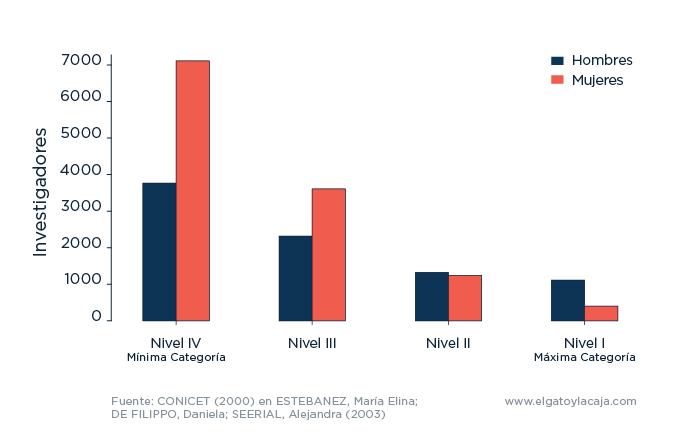
Number of men and women in each research category
At this point, some people say ‘Weeell, but that’s on its way to being reversed, because if there are more women working in science today, when those newbies start climbing, there’ll be more women researchers in badass positions’. But CONICET is not Super Mario Bros, and ‘leveling up’ doesn’t seem to depend only on each researcher’s individual effort.
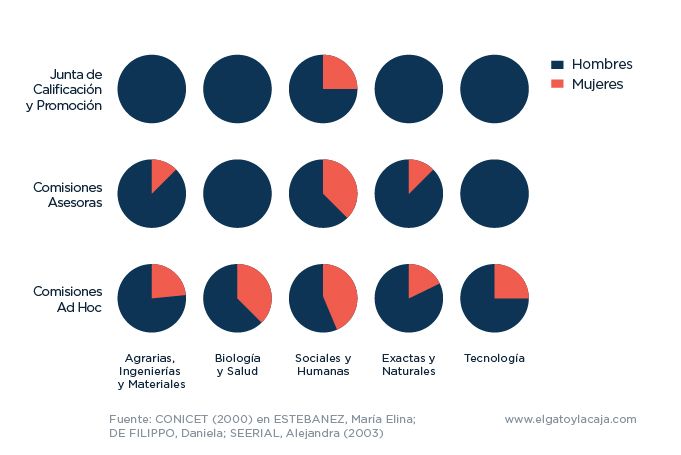
Thinking that women will steadily increase in number category by category, year by year, in a straight line is going to be somewhere between difficult and ‘fighting the Balrog’ as long as we don’t balance the gender share in the different evaluation bodies: Qualification and Promotion Board, Advisory Committees and ad hoc Committees. That’s where they REALLY decide who is in a position to make the little jump.
And, you’re not going to believe it, but it turns out that these groups are always composed mostly of men, with a smaller asymmetry in the Social Sciences and Humanities commissions.
We’re not saying that evil men who are enemies of women deny them the chance to move up in order to favor their teammates from Thursday’s pickup soccer. We’re saying that in science, as in other work environments, business, politics, etc., women face ‘barriers’ to their professional development, which have to do with the so often mentioned ‘gender roles’.
It’s impossible to understand this last point without thinking about the place of women in society, far beyond the scientific system. From advertising, television, film, the news, grandma’s comments, a ‘model of woman’ is built: in this discourse, women are ‘more sensitive’ than men, ‘hormonal’, ‘naturally maternal’, devoted to raising children, taking care of the house and fantasizing about Mr. Muscle, so we are ‘more suited’ to humanities and social careers or to health and education, and not to other disciplines that require traits associated with the ‘masculine’, such as rigor, judgment and rationality, traits of the exact and natural sciences and engineering. In this way, men’s abilities are also devalued, forcing them into ‘dehumanized’ models of masculinity, less sensitive and empathetic.
On the other hand, this assignment of roles determines not only the supposed abilities of each gender, but also the ‘natural’ places they should occupy in spaces of power. To give some examples: according to UN statistics, only 22% of parliamentarians worldwide are women, and among Fortune 500 companies, only 5% of CEOs are women. This means that women are not (we are not) participating in the spaces where the big decisions are made, which puts a bias on the decisions taken (it’s a metaphor, I couldn’t find reliable statistics on the role of women in fishing companies).
Another interesting aspect is that, if we look even more closely at the distribution of men and women within CONICET and set up a mixed ‘married vs. single’ game, the proportion of women on each team would not be even, not by a long shot, and even less so if we look by category. And this is no coincidence, but has to do with this little issue of role assignment: in the highest levels of the national scientific system, the number of married women is much lower than the number of married men. Because if women are at home taking care of their children, it’s unlikely they can devote themselves to their professional career in the same way as men, making it harder to meet the requirements needed to advance, which generally have to do with activities that take a ton of time (writing papers, reports and grant applications, training human resources, leading projects, etc.).
Diana Maffia (the Galadriel of gender research in this country) says in one of her papers that there is a certain preference for choosing male advisors among CONICET fellows, which, according to the author ‘reinforces male symbolic power while (…) suggesting that the rules are indifferent to sex (among other biases), and with which pre‑existing ideological preferences are covered over with neutral rhetoric’. Translation: the system itself reinforces the idea of men as natural leaders, trainers, role models or references, reproducing socio‑cultural patterns that feed back inequalities.
So, how do we explain this? What are the barriers that make climbing the little ladder of the scientific system harder for women than for men?
Mabel Burin (the Professor McGonagall of gender‑perspective studies at the national level) refers to two metaphors: the glass ceiling and the sticky floor, which speak to us of the implicit and informal limitations that women suffer when trying to advance in their careers. Maffia describes them like this: ‘The glass ceiling represents an invisible upper surface in women’s career paths. Imperceptible but impossible to cross, it lets us see the upper steps of a career but prevents us from moving on. It is invisible because there are no laws or established social devices, no explicit codes that impose such a limitation on women, but it is built out of implicit, informal and hard‑to‑detect barriers. The sticky floor is the inertia that keeps so many women immobilized in their positions, trapped at the base of the economic pyramid, without the strength to face the conflict that confronting something new and challenging the system would mean’.
These are not the only barriers women face in the scientific sphere; on top of that we have:
- Internal barriers, which are fundamentally based on the lack of identification role models, something that reinforces the stereotype regarding gender roles. Most women scientists attribute their inspiration for choosing their career and their vocational decision to male teachers, since they rarely had the chance to form research teams with women. Luckily this is on borrowed time, but only if we make a point of noticing that we’ve been producing stars like Gloria Dubner, Belén Elgoyhen, Andrea Gamarnik, or Cecilia Bouzat, and that the only Argentine scientist in last year’s ranking of the 100 most influential people was the ecologist from Córdoba Sandra Díaz.
- External barriers, which mean that women scientists take on masculine values in the work world and merely describe the unequal distribution of domestic work as a fact.
- Vertical segregation, which reflects the barriers that the way the scientific community is organized presents to women’s access to positions of greater responsibility. Women hold fewer project leads and have less money to carry them out (grants).
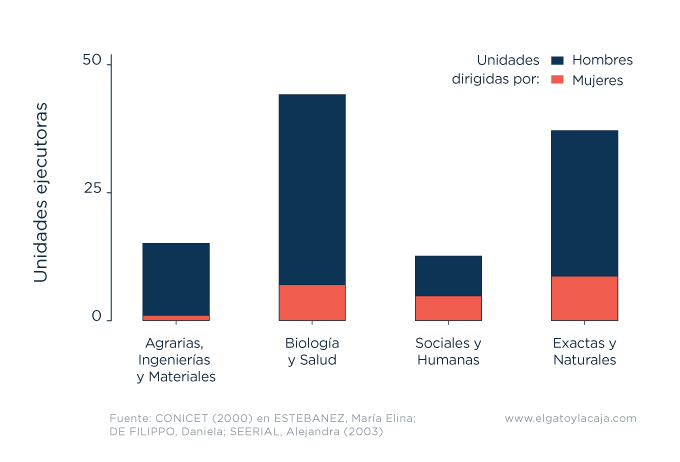
Although women take part in evaluation committees, they are not present in those that allocate grants, rarely in institutional decision‑making levels and almost never in scientific policy decision‑making bodies. This systematic absence is sometimes justified by saying that they have little time to participate in these committees. The lack of time, of course, is related to domestic responsibilities. But segregation is seen as a personal decision, as a personal preference for being available for the family, and not as a sexist barrier.
- Horizontal segregation, which refers to maintaining a division in the labor market by virtue of which women are concentrated mostly in certain sectors of activity that have lower social standing and, in general, worse working conditions.
- Wage inequality: although it is an internationally proven fact that women with the same training and doing the same tasks earn approximately 30% less than men, in science this is usually hidden by research categories. The same difficulty in moving up is seen by women as a ‘personal’ hurdle that has nothing to do with gender differences (‘there are few fellowships’, ‘there’s little funding’, ‘there must have been better candidates in this call’). This wage gap also makes it harder to pay for domestic help for care work, so the likelihood of abandoning a scientific career is greater.
Advancing in the research career is harder than winning the Mortal Kombat final, and it’s like women don’t have the cheat codes for the fatalities.
If we add to this the fact that there really are very few properly disaggregated statistics that would allow us to analyze the issue in depth, detecting and verifying these barriers and their consequences becomes an almost impossible task.
But this is a problem that is not solved by statistics alone and is not limited to the world of science. It has to do with the way our society is built, with the values that are conveyed and those that are not, and with how this affects both men and women in different areas of life. The scientific system is just a reflection of a general problem.
Maffia sums it up like this: ‘We can see that although women are accepted into academic and scientific institutions, there remains the challenge of not cross‑dressing intellectually as the price of inclusion, the challenge of asserting our way of seeing and interpreting the world in order to make valuable contributions to science, and the challenge of breaking the stereotypes that say that the qualities we women bear are systematically inferior. Strengthening women’s epistemic authority, not allowing our demands for equality to be interpreted as a weakening of science’s standards, as a loss of knowledge quality, because that would mean leaving undiscussed the system’s hardest ideological core: the identification of difference with hierarchy’.
We have to fight to really balance women’s participation in the scientific field, especially outside purely academic institutions. The more girls have access to the educational system and to scientific and technological knowledge; the more women are respected in their decision to be or not to be mothers; the more little girls stop being singled out for choosing blue and a toy car or ball; the more equal the distribution of domestic work and child care; the more we are told in class that there were loads of women who revolutionized science with their discoveries and theories (Marie Curie, Henrietta Swan, Rosalind Franklin, Jocelyn Bell, Lynn Margulis, and like that, a TON); the more chances we will have to grow and develop within (and outside) the scientific field.
A beautiful woman is one who fights. And if she does science, she’s twice as beautiful.