This content was translated using artificial intelligence and may therefore contain errors.
At 8 years old, Milo thinks about the question and tells his mom that feeling lonely means having nobody. “Like, feeling like there’s nobody.” He’s only felt that way once, at his dad’s house, when everyone was asleep and he was awake.
He thinks his friend Julio really is lonely. He says Julio doesn’t even have a dog or a brother, doesn’t have anyone to play with, and his parents work. They work a lot, and Julio always plays alone. Even though Julio is one of the most popular kids at school and is great at sports, Milo thinks screens actually make him feel lonelier. He, on the other hand, doesn’t feel lonely because he has more things to do. His parents work a lot too, but it’s different. He has dogs, does taekwondo, draws. He loves his dogs, and when he’s with them, he feels safe.
Milo remembers when his dad used to leave him alone in the room at their country house and the monsters would appear (“because, yeah, there are monsters out in the country, Mom”), and he would feel really, really scared. Then he’d hug one of the dogs that lived there and instantly feel better: the fear would go away “super fast.”
He talks about another classmate, Juan, who is “schizophrenic.” He explains that it’s because he plays alone and imagines things on his own. He doesn’t mind being by himself. With his real friends, like Iván or Lolo, it’s different. Milo talks about feelings with them. He’s told them about Juanrón and Flaco, his pets who aren’t around anymore. Once, when he told a friend something sad, the friend got sad too. Julio’s dad said that if you feel lonely, you can talk to ChatGPT, but Milo doesn’t agree. It’s a robot; it doesn’t even have feelings. It’s fun, but it’s got nothing to do with it. Milo has strong opinions about screens. He confesses to his mom: “Honestly, I have to say I kind of like them, but sometimes they’re shit.” The screen? “The screen, yeah, honestly, honestly. I mean, it’s ruining the planet.” His mom asks him if he really thinks that or if he’s just repeating what he’s heard, and he says both: he heard it on the news, and honestly, he thinks it’s true.
He also sees a big contradiction. His mom and dad tell him to get off his screen, but they’re on their phones all day. He tells them: “You and Dad tell me to get off my screen because I’ve been on it all day, but you and Dad are on screens all day.” It doesn’t matter if it’s for work; it’s still screen time, and he doesn’t like that. He extends his observation to his dad’s group chats, where it’s always the same three people online making the same jokes. “The conversations, the jokes, it all gets so old. You can’t live on one joke.”
His grandfather Pedro, on the other hand, is 90 years old and barely uses his phone, “only for stuff out at the country house,” and when he’s with him, he pays him more attention and talks to him more.
When his mom asks him why he thinks they’ll only give him a phone when he turns 15, he replies: “Yeah, because honestly, so I don’t get on social media so young, you know? Because it’s not that great,” but then adds, “I’m sure they’ll give it to me when I’m 13.”
Milo loved running an errand in the morning. He went by himself for the first time, and it made him feel grown-up. It was a good kind of being alone, and he felt safe the whole way. He walked to the corner store thinking about the future. Milo thinks a lot about the future. He thinks that from 2090 onward, robots will be “like the president of this world.” He says: “I wouldn’t like that either, but Mom, I don’t want to scare you, it’s the truth.” And he thinks that in the year 3000 there will only be robots, but that being surrounded by robots will be a bummer because they don’t have feelings.
He’d like to have a little brother. He tells his mom that if he does get a brother, it would be nice to move closer to his dad’s house. He imagines he’d be important to his brother. He even says, half-joking: “I’m going to be the first person to hit him.” But then he clarifies: “No, not when he’s a baby, but when he’s…” And he says he’d teach him to play soccer and, when he’s older, PlayStation too.
He knows about rumors, follows the news closely, and reads forums. He heard that they’re going to erase all the progress in Roblox in 2027, so he stopped playing. “All my progress is going to get erased, so, bye. All my progress, so I said, no, I’m not playing anymore. That sucks.”
His mom asks if he knows what to do if he feels lonely. Yes, if he feels lonely, he calls her or his dad. If they’re not around, sometimes he logs on to Fortnite to see if any friends are online. Once, his dad’s friend logged on and gave him his first dance. That made him feel like he had company, but he knows it’s not the same. Because then he turned off the PlayStation and was still alone.
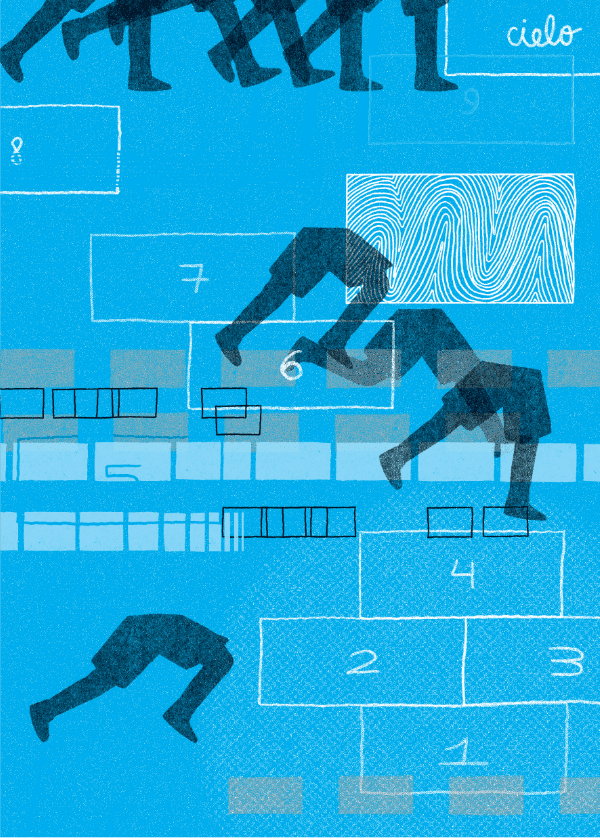
“I know Nico’s been playing PlayStation because he can’t stop moving,” says Adela, an education specialist. She says that when her 7-year-old son turns off the console, he’s still all wound up. “Until he runs, jumps, does something with his body, he can’t concentrate on anything else.” The screen leaves his mind racing and his body parked. She sees that disconnect between the speed of mental stimulation and the development of motor skills and movement in the schools where she works, too. “It’s absurd, they bump into everything. I’m not talking about fights. They crash into tables and chairs, trip over backpacks that are always in the same place. They grab each other hard, but because they’re clumsy, not because they’re mean.”
It’s like this every day. Two kids want to hug and end up pushing each other. A girl runs, can’t stop in time, and takes out half a desk. Recess without a ball lasts only a few minutes; someone cries because a hand meant to be gentle misjudges its strength. The specialists she works with put it in less dramatic, but equally precise, terms: overstimulated minds, undertrained bodies. Kids who recognize an app icon in a second but don’t know how to join a circle without pushing anyone. Fingers that move deftly across a touchscreen but hesitate in front of a pair of scissors, a ball of yarn, a jump rope.
Digital parenting specialist Lucía Fainboim sums it up this way: an anxious generation. Overwatched in the physical world and left unprotected in the digital one. Children are shouted at to be careful from every direction at the playground, but they spend hours navigating the internet alone, exposed to content they’re not ready for. Kids who can’t tie their shoes have unlimited access to a universe that overwhelms them. The result, she says, is cognitive debt. We are giving up abilities. The mind atrophies from a lack of creative use, and the body from too much stillness. This debt becomes tangible in physical clumsiness. And in the vacant stare that has a name: the Gen Z stare.
The root of the problem is a migration. The work of childhood, which for centuries was physical play, has moved to the screen. As Lucía Fainboim reminds us in her book Caring for Childhoods in the Digital Age, for Piaget, play was how a child assimilated the world; for Freud, how a child processed trauma, making what was distressing repeatable. It was a way of training the body alongside other bodies. Running, waiting, negotiating, giving way. A space where a shove was just a collision, not an incident. Where clumsiness was part of learning and not necessarily a warning sign.
Today, much of that work takes place in digital environments. There are rules, tactics, and community there, too. But when screen-based play takes up almost all the space, we lose the territory where the body can make mistakes without every error becoming a data point to analyze. The New Zealand psychologist Brian Sutton-Smith spoke of several rhetorics of play. Our era has prioritized the rhetoric of progress: play as a tool for stimulating something in the future. Play that serves no purpose, that exists only for the pleasure of being together without a clear goal, has been pushed aside. We’ve lost lightness. We’ve lost the community built through sweat and shared laughter.
In giving up that space, we also give up the chance to build healthy autonomy. Fainboim insists: autonomy isn’t gained through solitude, but through support at just the right distance. What the Argentine author Samantha Schweblin calls rescue distance. An adult close enough to step in if things get serious, but far enough away for the child to try, fail, and learn to trust their own judgment. A distance that today is being replaced by anxious supervision or, paradoxically, distracted absence.
This mismatch creates two worlds with opposing rhythms. On screen, everything flows. The next video plays automatically, the chat updates nonstop, but outside, time has a different beat. Conversations get stuck. There are long, awkward silences. A joke can fall flat. The lack of concentration stems from the fact that many children spend their waking hours in the first rhythm, and when they’re asked to function in the second, they try to adjust two systems that are no longer compatible. There’s a physical cost, too. Neck and back pain in 9-year-olds are signs of bodies bearing an unnatural burden: hours of tense stillness followed by chaotic bursts of energy. This situation creates a paradox. On the one hand, a childhood sealed inside physical bubbles (home-car-school) and overexposed online. On the other, a desperate search for community that, when it can’t be found in the physical world, moves to the internet. The American researcher danah boyd called them networked publics. Spaces where young people socialize according to their own rules, away from adult scrutiny. What a parent sees as wasting time on a phone may be an adolescent’s first experience of genuine belonging.
This is where the story of Mats Steen, better known as Ibelin Redmoore, becomes essential. Mats was a young Norwegian with a degenerative disease that confined him to a wheelchair at 11 and later to his bed. His physical world was a bedroom. His digital world was World of Warcraft. The name of his avatar: Ibelin Redmoore. When he finally died, at 25, his father felt it as a double tragedy: the tragedy of losing his son, plus the certainty that Mats was leaving without ever having known love, the most beautiful experience in life. And yet that certainty was shattered. After the funeral, his father decided to log into the game to tell his son’s virtual friends that he had died, and found a community in mourning. Dozens of characters came over to offer their condolences. They shared stories with him. And a young woman introduced herself as Ibelin’s girlfriend. She explained that they had found each other in the game, written love letters to each other through their avatars, and supported each other for years. His father understood then that his son had had a deep, intense, and real relationship after all. Only in a place that he, looking in from the outside, didn’t know how to recognize as valid.
Ibelin’s story breaks down the simplistic dichotomy between the real and the virtual. For many young people, digital worlds aren’t an escape. They’re workshops where a we is made. Where versions of identity are tried out. Where a sense of continuity is woven, something that life, fragmented by schedules and tasks, doesn’t provide them. There, against all adult predictions, they find a powerful antidote to loneliness.
But this antidote has an inherent limitation. What is gained in community is lost in physicality. In networked publics everything can be archived: messages, achievements, photos. What can’t be captured is physical contact. The weight of shared silence. The instant sense of safety that comes from hugging a dog when you think there are monsters in the room. Digital connection, however deep, operates in one register, while physical presence operates in another. And when a human being grows up trained almost exclusively in the first, the second becomes a foreign and terrifying language.
The consequences of this imbalance are tangible and self-reinforcing. Fainboim sees them in certain phenomena, such as adolescents who prefer talking to artificial intelligence. AI is predictable; it doesn’t judge or reject. It offers company without risk. The real risk appears elsewhere: in sexuality.
Pornography, sometimes consumed as early as age 8 or 9, provides the first and crudest instruction manual. A distorted curriculum that dictates what bodies, performance, and pleasure itself should be like. It creates an impossible expectation and, at the same time, a quiet shame. The natural awkwardness of desire, the negotiation of consent, the simple stillness of one body against another have no place in that script. The result is an emptying out. On the one hand, the other person becomes a character to be satisfied according to an impossible script. On the other, your own body feels monstrously inadequate. It doesn’t measure up that way. It doesn’t work that way. It doesn’t look that way.
This doesn’t kill desire, but it poisons the path to another person. It fills it with performative anxiety. Many young people admit to postponing or avoiding real-life encounters not because they don’t want them, but because they’re afraid they won’t live up to the role they’ve seen on screen, that they won’t know how to move in a scene with no instructions. The so-called sexual recession —a sociocultural phenomenon documented over the past decade, describing the sustained and significant decline in the frequency of sexual relations, especially among young adults and adolescents, and linked to factors ranging from digital hyperconnectivity to economic insecurity—has one of its roots here: it is self-esteem collapsing under the weight of fiction, and the inability to imagine an encounter outside it.
When we look at ourselves in the mirror of our screens, we see ourselves as monsters. The edited lives on social media, filtered bodies, epic and optimized existences turn our ordinary reality—with its grays, its silences, its imperfect forms—into something defective and grotesque. We feel that our conversations aren’t clever enough, our bodies aren’t valid enough, our lives aren’t worthy enough to be shown.
And so the circle closes. In schoolyards, the scenes speak for themselves: groups sharing silence as they look at their phones, others watching from the sidelines, not daring to join in. Conversation flows when it can anchor itself to something external: a video, a meme, a streamer’s joke. When that’s missing, an awkward void remains, one for which there’s no script. Many connections are cultivated, but few places of refuge are built.
This is no longer the loneliness of an empty room in a faraway place. It’s the loneliness of someone surrounded by others who doesn’t know how to inhabit their presence or tolerate their own. It’s the paralysis of having been trained for a kind of sociability with an exit button, only to find yourself trapped in a loop: the other person’s unpredictable gaze and the constant judgment of your own image.
For Milo, at 8 years old, the monsters were shapes in the darkness out in the country, and his dog’s warm body could scare them away.
Now the monsters are the very fabric of social life. Terror no longer lives in absence. Perverse as it may seem, it lives in presence. The other person in front of us. And us in front of the other.
Crónicas, ensayos, perfiles y análisis para explorar la epidemia de soledad del siglo XXI. Más que un libro, la radiografía de una sociedad que ha logrado optimizarlo todo, excepto los vínculos.
152 páginas. Papel bookcel 80 gramos. Impreso a dos tintas. 14,5 x 20 cm. Ilustraciones de Paula Maneyro.
Biografía de la autora:
Victoria O’Donnell es socióloga (UBA) y magíster en Métodos Cuantitativos en Ciencias Sociales (QMSS) por Columbia University (Nueva York, Estados Unidos), con financiamiento Bec.ar–Fulbright. Consultora, docente e investigadora especializada en tecnología y salud mental. Dictó clases en la UBA, la UNSAM, FLACSO y CEPAL. Se desempeñó en análisis y estrategia en la función pública, en el sector privado local, organismos internacionales, empresas globales de tecnología y clínicas de salud, con foco en enfermedades crónicas no transmisibles, salud mental y consumos problemáticos.
Crónicas, ensayos, perfiles y análisis para explorar la epidemia de soledad del siglo XXI. Más que un libro, la radiografía de una sociedad que ha logrado optimizarlo todo, excepto los vínculos.
Formatos .epub y .mobi.
Biografía de la autora:
Victoria O’Donnell es socióloga (UBA) y magíster en Métodos Cuantitativos en Ciencias Sociales (QMSS) por Columbia University (Nueva York, Estados Unidos), con financiamiento Bec.ar–Fulbright. Consultora, docente e investigadora especializada en tecnología y salud mental. Dictó clases en la UBA, la UNSAM, FLACSO y CEPAL. Se desempeñó en análisis y estrategia en la función pública, en el sector privado local, organismos internacionales, empresas globales de tecnología y clínicas de salud, con foco en enfermedades crónicas no transmisibles, salud mental y consumos problemáticos.